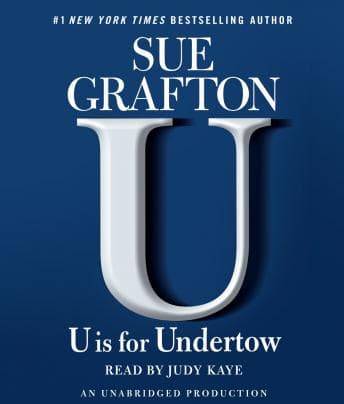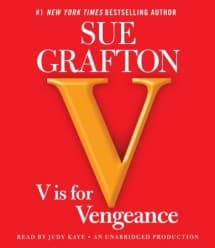

"A punch in the face that leaves her with two black eyes and a busted nose." That's Kinsey Millhone's thirty-eighth birthday gift, and honestly, it's a decent metaphor for what this audiobook does to your expectations — sets you up for one thing, delivers something else entirely.
I was up late last night, couldn't sleep, Ranger sprawled across the foot of the bed while Linda was dead to the world. Figured I'd knock out the last three hours of this one. Bad idea. Not because the book kept me wired — because the narration kept pulling me out of it at exactly the wrong moments.
The Plot Runs Like a Multi-Domain Operation
Let me cut to the chase on the story itself: Grafton constructed something ambitious here. This isn't your standard PI-follows-the-clues structure. She's running parallel tracks — a professional shoplifting ring connected to mob money, a gambling-addicted rich kid, a dirty cop, a widower hunting for answers about his dead lover. I ran into a similar kind of converging-threat structure in Bad Place, where what looks like a simple missing persons case keeps pulling the floor out from under you. Kinsey stumbles into the whole mess after witnessing a shoplifter at Nordstrom's (of all places), and what starts as a minor retail theft observation spirals into something with real teeth.
The author clearly did their homework on organized retail crime. The mechanics of how the shoplifting ring operates — the fencing, the layered protection, the way it connects upward to legitimate-looking businessmen — that stuff felt credible. Grafton spends real time building out the villain side of the equation, giving you chapters from the perspectives of the criminals themselves. It's a bold structural choice for a series that's historically lived inside Kinsey's first-person POV. Sometimes it works beautifully. Sometimes it dilutes the thing you came for.
At 15 hours, there's a lot of real estate to cover. The pacing through the middle act — roughly hours six through ten — gets sluggish. Grafton's always been a slow-burn writer, and I respect that, but there are stretches where you're watching characters make financial arrangements or have domestic arguments that don't push the story forward. I bumped up to 1.5x during a couple of those passages, which tells you something.
Where Judy Kaye Lost the Mission
Here's where it gets complicated. Judy Kaye has a genuinely good voice. Pleasant, clear, professional. She reads well in the technical sense — clean phrasing, no stumbles, solid rhythm. If this were a standalone novel with a female protagonist and minimal male characters, she'd probably be fine.
But this is Kinsey Millhone. And Kinsey is feisty, sharp, a little bit of a smartass. She's got an edge that's been central to this series for twenty-plus books. Kaye's delivery smooths all of that out. Her Kinsey sounds — and I don't mean this as cruelly as it's going to land — a little bored. World-weary in a way that doesn't match the character's fundamental energy.
The male characters are where things really fall apart. There are a lot of men in this book — the widower, the dirty cop, the mob guys, the gambling kid. They all end up sounding disturbingly similar. When you've got a scene between two male characters having a tense conversation, you shouldn't have to rewind to figure out who's talking. I had to do that at least three times. It's not that Kaye can't differentiate at all — it's that the differentiation is so subtle it gets lost, especially if you're listening at anything above 1x speed or in a car with road noise.
I've heard longtime fans of the series swear by Mary Peiffer's narration of the earlier entries, and I get it. There's a specificity to how a character should sound when you've spent twenty-something books with them. Kaye's version is competent but feels like a stranger doing an impression of someone you know well.
Who Should Saddle Up — And Who Should Walk Away
If you're a Grafton completist working through the alphabet, you're going to listen to this regardless of what I say. Fair enough. The story itself is solid — maybe a B-plus Grafton entry. The multi-perspective structure is interesting even when it meanders, and the last few hours deliver a payoff that justifies the slow middle. State of Terror pulls off the same kind of multi-POV juggling act — and I had the same reaction there: the structural ambition earns some patience during the slower stretches.
If you've never read Grafton before, do not start here. You're at letter V in a twenty-two book series. Start at A, obviously.
If you're coming to this purely as an audiobook experience and you're picky about narration — and if you're reading Audiobooks4soul, you probably are — this one's going to frustrate you. The narrator isn't bad, she's just miscast. There's a difference, and it matters.
Worth your time? Here's the debrief: the book earns its keep. The audio production is where the operation loses effectiveness. Ranger fell asleep during hour seven, and I can't say I blame him.
Mission Debrief: Decent Intel, Wrong Messenger
Grafton wrote a book that pushes her formula in interesting directions — the mob connections, the structural ambition, the darker tone. It deserved a narrator who could match that energy. What you get instead is a technically proficient performance that never quite finds the soul of the material. Read it if you're a fan. Listen to it if you've got long drives and patience. But manage your expectations on the audio side.