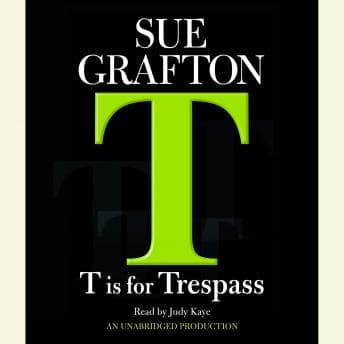

I was halfway through my morning jog along the Charles River when Solana Rojas first spoke, and I literally stopped running. Just stood there on the path like an idiot, earbuds in, heart rate spiking for reasons that had nothing to do with cardio. The protagonist exhibits classic antisocial personality disorder markers - the superficial charm, the calculating manipulation, the complete absence of empathy - and Grafton nails it with clinical precision. As someone who's spent years studying how narratives construct identity, watching this character steal someone else's was genuinely unsettling.
This is book twenty in the Kinsey Millhone series, and honestly? I came for the cozy detective vibes. What I got was a case study in predatory behavior that had me texting my parents to check on my grandmother.
When Grafton Hands You the Scalpel
Here's the thing about T Is for Trespass that makes it different from your standard mystery fare - Grafton does something structurally fascinating. She alternates between Kinsey's perspective and Solana's, which means you're watching the horror unfold from inside the predator's mind. The research actually shows that this kind of dramatic irony - where the audience knows more than the protagonist - creates a specific type of anxiety. And boy, does it work.
The slow build is intentional. Some listeners apparently found the pacing frustrating, but I'd argue that's the point. Elder abuse doesn't announce itself with dramatic music. It creeps in through small violations of trust, tiny trespasses that accumulate until you're looking at something monstrous. Grafton understands human nature here - she's showing us how these situations develop in real time, and it's way more effective than any thriller-paced plot twist would be.
What makes this character compelling is that Solana isn't written as a cartoon villain. She's pragmatic. She's patient. She genuinely believes she's entitled to what she takes. My therapist would have thoughts about this character - specifically about how her lack of insight into her own pathology makes her more dangerous, not less.
The Voice in My Head (Literally)
Judy Kaye. Okay, so - she's got three AudioFile Earphones Awards and two Tonys, which tracks. Her Kinsey is tough, a little weathered, with this dry humor that works beautifully for the character. But here's where it gets interesting: her Solana is genuinely chilling. There's this cold, flat affect she brings to the sociopath's internal monologue that made me uncomfortable in a way I can only describe as "professionally impressed."
That said, I have to be honest about something. The secondary characters - particularly the women - tend to blur together vocally. I found myself occasionally confused about who was speaking during group scenes. It's not a dealbreaker, but if you're the type who needs crystal-clear character distinction (and I am, because I'm analyzing everyone like they're research subjects), you might notice it too.
Some listeners have mentioned that Kaye sounds too mature for Kinsey, who's supposed to be in her late thirties at this point in the series. I didn't find this distracting - if anything, it gave Kinsey a lived-in quality that felt appropriate for a PI who's seen some things. But your mileage may vary.
The pacing of her narration is solid, though she does get a bit breathless during the tense scenes. Honestly? I kind of liked it. It felt reactive rather than performed.
Psychologically, This Tracks
Look, I read a lot of crime fiction, and most of it gets the psychology wrong. Murders in the Rue Morgue is a fascinating contrast—Poe's villain is almost clinical in his detachment, which actually holds up psychologically. Writers either make their villains too obviously evil or too sympathetically redeemable. Grafton does neither. Solana is a person who has learned to mimic normal human connection without actually experiencing it. She's not broken in a way that invites pity. She's just... missing something fundamental. That same unsettling absence of empathy shows up in Undone, though the thriller pacing there is completely different from Grafton's slow burn.
The identity theft angle is particularly well-handled. Solana didn't just steal a name - she stole an entire constructed self, complete with credentials and history. This is a fascinating case study in how identity is performed rather than inherent, which is basically my entire research area. (Don't tell my students I said that, but I might assign this book.)
The elder abuse content is hard to listen to. Fair warning. But it's handled with the gravity it deserves rather than being exploited for shock value.
Would I Listen Again?
At 12 and a half hours, this is a commitment. But it's the kind of slow burn that rewards patience. I finished it during a week of solo cooking projects - lots of elaborate dishes, lots of time to let the tension build.
If you're new to the Kinsey Millhone series, this isn't a bad entry point, though you'll miss some of the relationship context. If you're a longtime fan, this is apparently considered one of Grafton's darkest entries, and I understand why.
For anyone who studies how stories shape our understanding of good and evil, or who just wants a mystery that respects your intelligence enough to make you uncomfortable - this one delivers. Just maybe don't listen while jogging. You'll stop in weird places.