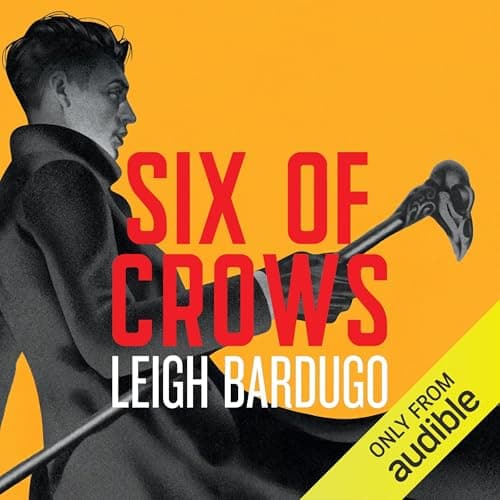

"No mourners. No funerals." That line—the Barrel's version of 'good luck'—hit different when Jay Snyder delivered it with Kaz Brekker's cold calculation somewhere around the two-hour mark. It's the kind of moment that tells you exactly what kind of world Leigh Bardugo has built: one where tenderness hides behind brutality, and a crew of teenage criminals might be the most compelling found family you'll encounter in fantasy.
Let me get the big question out of the way first, because it's the one every potential listener asks: does the seven-narrator setup work? Mostly, yes. Emphatically yes, even. Each of the six crew members gets their own narrator, and the result is an audiobook that feels closer to a radio drama than a standard narration. When Inej's chapters arrive voiced by Lauren Fortgang, there's a specific emotional weight—a quiet ferocity—that distinguishes her sections from, say, Roger Clark's take on Matthias or Elizabeth Evans giving Nina Zenik all that warmth and sharp wit. The character differentiation is immediate. You never wonder whose head you're in.
But here's the honest trade-off: because different narrators voice the same side characters in their respective chapters, you'll occasionally hear Kaz sound slightly different when he appears in Inej's chapter versus his own. It's not a dealbreaker, but during my first few hours of listening—I was on a long drive through a particularly boring stretch of highway—it pulled me out of the story once or twice before my brain adjusted. By the midpoint, I barely noticed. Your mileage may vary, and some listeners genuinely hate this kind of inconsistency. Fair enough.
Now, the story itself. Bardugo structures Six of Crows as a heist novel dressed in fantasy clothing, and it's a smart move. The setup is classic: criminal mastermind Kaz Brekker assembles a crew of specialists to break into an impenetrable fortress. Each member brings a specific skill. Each carries enough personal baggage to sink a ship. What elevates this beyond a standard Ocean's Eleven template is how deeply Bardugo commits to her characters' backstories. That same commitment to excavating trauma without exploiting it is something I kept thinking about in A Thousand Splendid Suns—a completely different genre, yes, but Hosseini does something structurally similar where the backstory IS the emotional architecture, not just decoration. The flashback chapters—where we learn how Inej was trafficked, why Jesper can't stop gambling, what broke Kaz into the person he became—are where the audiobook truly shines. Fortgang and Evans deliver these emotional beats with a specificity that print alone can't replicate. There's a rawness in Fortgang's voice during Inej's memories that genuinely caught me off guard.
The worldbuilding draws from the broader Grishaverse, but you absolutely don't need to have read the Shadow and Bone trilogy first. Ketterdam functions as a fantasy Amsterdam—canals, merchants, vice, and commerce all tangled together—and Bardugo gives you enough context to follow the magic system without drowning you in exposition. The narrators handle the terminology naturally, which helps enormously when you're trying to absorb words like "Heartrender" and "jurda parem" through audio alone.
Pacing-wise, I'll be transparent: the first few hours are slow. Bardugo takes her time assembling the crew and laying groundwork, and if you're expecting immediate action, you might find yourself checking the progress bar. Some listeners have called it not entirely attention-grabbing early on, and I understand that criticism. But the payoff is substantial. Once the heist kicks into gear, the plot twists stack on top of each other with the precision of a well-dealt hand of cards. Kaz always has a plan within a plan, and Bardugo plays fair with her reveals—you can look back and see the seeds she planted.
At fifteen hours, this is a substantial listen that rewards your attention. It's not a background audiobook. The shifting POVs demand that you track multiple storylines and emotional arcs simultaneously. But that's also what makes it so satisfying when threads converge.
Who Should Listen (And Who Should Skip)
The full cast approach, even with its minor inconsistencies, makes this the definitive way to experience Six of Crows for the first time. Seven narrators bringing distinct energy to six broken, brilliant characters—it's the kind of production that justifies choosing audio over print. When Fortgang whispers Inej's prayers or Evans lets Nina's bravado crack just slightly, you're getting performances that add genuine dimension to Bardugo's already strong character work.
Is it perfect? No. The early pacing drags, the narrator switching takes adjustment, and if you're not wired for YA fantasy, the teenage protagonists pulling off impossible feats might strain your suspension of disbelief. Skip this one if slow-burn setups test your patience or if multi-narrator inconsistency is a hard no for you. But for everyone else—especially if you love a good heist, complex characters who earn their redemption arcs the hard way, and fantasy worlds that feel lived-in rather than decorative—this audiobook delivers.