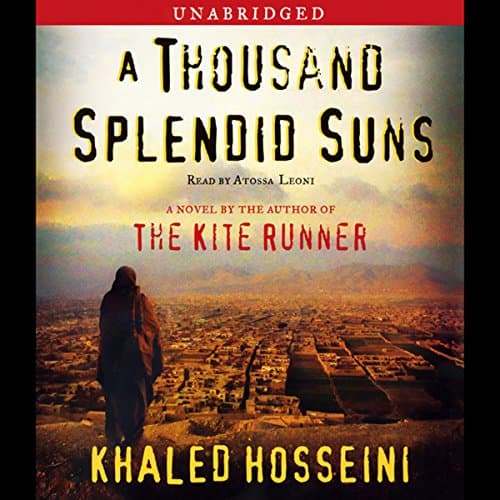

A Thousand Splendid Suns is one of those rare novels where the audiobook version both helps and slightly hinders the experience — and knowing which side you'll land on depends entirely on what you want from a narrator.
SITREP: if you can handle a slow first-half setup and emotionally brutal subject matter, buy this audiobook. It earns every tear. If you need a polished, performed narration with distinct character voices, or if an accent that doesn't match the setting will pull you out of the story, look for the print edition instead.
Now let me explain why.
I started this on a Saturday morning drive to the hardware store. By the time I got home, I hadn't gone inside. I was sitting in the driveway with the engine off, listening to Mariam — an illegitimate child raised in isolation outside Herat — navigate the early humiliations of her life. That's the kind of book this is. Hosseini traces three decades of Afghan history through two women: Mariam, and later Laila, a girl from a comparatively progressive Kabul household whose world collapses around her. Their paths converge under the roof of a brutal husband named Rasheed, and what unfolds between them — suspicion hardening into tolerance, tolerance softening into something that can only be called love — is the emotional engine of the entire novel.
Where The Kite Runner centered male friendship and guilt, A Thousand Splendid Suns turns its gaze toward the women who bore the heaviest weight of Afghanistan's collapse. My review of The Kite Runner covers that earlier novel in full — and reading the two back to back makes Hosseini's evolution as a writer impossible to miss. The result feels both more intimate and more politically urgent. Hosseini doesn't flinch from depicting domestic violence, Taliban oppression, or the grinding erosion of women's autonomy, but he never reduces Mariam or Laila to symbols of suffering. They're stubborn, flawed, sometimes funny, and fiercely alive.
That same refusal to let women become passive symbols of suffering is something I found in Rose Madder too — a very different kind of novel, but one that earns its brutality the same way Hosseini does.
The first half demands patience. If you're coming off something propulsive like The Nightingale or All the Light We Cannot See, you may find yourself restless during the extended setup of Mariam's childhood and early marriage. Some listeners have called this section slow, even boring, and I get the complaint — the pacing is deliberately measured as Hosseini lays groundwork. But without that slow burn, the emotional devastation of the second half wouldn't land. When the story finally brings both women together and accelerates toward its conclusion, every quiet moment pays off with compound interest.
Now, the narration — and this is where things get complicated in a way I didn't expect.
Atossa Leoni is not a professional narrator in the traditional sense, and you can hear it. Her delivery is deliberate, sometimes halting, with a mild English accent that occasionally sits oddly against the Afghan setting. She doesn't do distinct character voices; instead, she relies on subtle tonal shifts to differentiate speakers. If you're accustomed to polished performances — the kind where you forget someone's reading to you — Leoni's approach may initially feel flat or uninflected.
But here's what surprised me as the hours went on: there's an emotional authenticity to her reading that a more technically skilled narrator might not have achieved. Her voice carries real weight during the novel's most harrowing passages — the scenes of violence, the moments of unexpected tenderness, the quiet acts of resistance that define both women's lives. Her pacing, while slow, forces you to sit with the material rather than rush through it. One listener called it "a masterclass in storytelling and oral narration." Another dismissed it as "uninflected reading." Both are describing the same performance. The difference is whether you hear restraint or flatness, and that's going to come down to personal preference.
The production is clean — no background noise, no music, no sound effects. Just one voice and Hosseini's prose. For a story this emotionally intense, that stripped-down approach works.
Compared to The Kite Runner's audiobook, narrated by the author himself, Leoni's performance is less polished but arguably more emotionally present. Against The Nightingale, which covers thematically similar ground — women surviving under occupation, impossible choices, bonds forged in extremity — Hosseini's novel feels rawer and less engineered for dramatic payoff. That's both its strength and, depending on your taste, its limitation.
A content warning: this book contains graphic depictions of domestic violence, sexual assault, and war. These aren't gratuitous — they're essential to the story — but they're unflinching enough that you should be prepared, especially in audio form where you can't skim past a difficult passage.
What stayed with me wasn't any single scene but the relationship between Mariam and Laila itself — how it evolves under conditions designed to make connection impossible. Hosseini earns every ounce of emotion in this story, and Leoni, for all her technical limitations, delivers it with a sincerity that feels earned too.
Who Should Listen (And Who Should Skip)
If you want literary fiction that doesn't pull punches and you're willing to invest in a slow build, this is your mission. Listeners who connected with The Kite Runner or The Nightingale will find familiar emotional territory here. Skip it if you need high-energy pacing from the jump, or if an imperfect narration will gnaw at you — grab the print copy instead. And this is absolutely not background audio. But it's the kind of listen that can turn a long drive or a quiet evening into something you won't shake for weeks.









