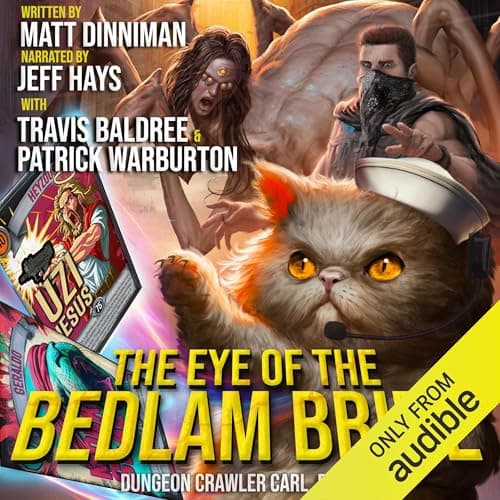
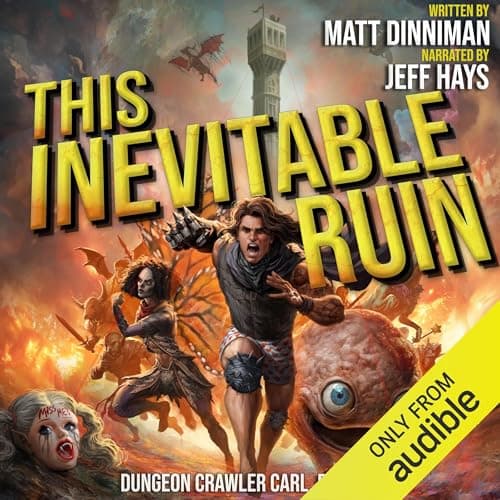
This book is completely ridiculous. And I mean that as high praise.
I started it while pretending to pay attention during a faculty committee meeting about assessment alignment - a phrase so bleak it could qualify as post-apocalyptic fiction on its own - and within minutes I was listening to the end of the world get turned into a galactic reality show. Every human-made structure on Earth collapsing into the ground, from Buckingham Palace to somebody's sad little backyard shed, is such a specific kind of lunacy that you either buy in immediately or you run for the exit. I bought in. Happily.
What Matt Dinniman understands, and understands in a way a lot of "funny" fantasy doesn't, is that absurdity needs rules. This world has them. Carl isn't just surviving monsters and traps inside an 18-level dungeon wrapped around the entire globe; he's surviving a system that rewards spectacle. Views matter. Followers matter. Loot boxes drop from alien benefactors if you kill creatively enough to entertain them. That's not just a joke premise. It's satire with teeth. The book keeps asking what happens when suffering becomes content and survival becomes branding. Pretty bleak, actually. Also very, very funny.
Bread and circuses with goblins
Carl himself is the key. If he were winking at the audience all the time, this thing would collapse under its own smart-aleck energy. But he plays it straight enough that the madness around him lands harder. He's angry, bewildered, stubborn, and just decent enough that you want him to keep going even when the dungeon is asking him to become a performer in his own trauma. This reminds me of what Hemingway said about courage being grace under pressure. Carl's version is more like profanity under pressure, but still.
And then there's Princess Donut, the ex-girlfriend's cat, who should be a one-note gag and absolutely is not. Making her a genuine presence instead of a tossed-off punchline is one of the book's smartest choices. She brings vanity, entitlement, and this bizarre aristocratic dignity to a setting full of blood, traps, and game mechanics. A cat in a death maze shouldn't work. A cat whose social instincts are somehow perfect for a clout-driven interstellar audience? That works because this world rewards performance, and Princess Donut is already performing before anyone hands her a microphone.
There's also a nice tonal trick here. The book can pivot from a stupidly funny exchange to something genuinely nasty without feeling like it changed channels. That's hard to do. My students would hate this. I love it.
Jeff Hays knows exactly how far to push it
Some narrators read a book. Jeff Hays stages one.
His performance as Carl keeps the whole thing grounded - frustrated, exhausted, game enough to keep moving, but never so broad that he turns into a cartoon action hero. Then he flips into Princess Donut's smug, British voice and suddenly the audiobook becomes something else entirely. Not gimmicky. Not cute. A full comic weapon. You hear the hierarchy in it, the self-importance, the offended grandeur. The joke isn't just that a cat sounds posh; it's that she sounds posh while the world has become a slaughterhouse with sponsorship opportunities.
Hays understands that pause is punctuation. He lets jokes breathe just long enough to land, then drives straight into panic, violence, or sheer confusion without losing momentum. That's the trick here. A lesser performance would've made this feel like a novelty item - funny for an hour, exhausting by hour four. Hays avoids that by treating every emotional shift as real, even when the premise is a man and a cat fighting for loot and ratings in a televised apocalypse.
There are also those little added audio bits people mention, and they matter more than I expected. Not enough to swamp the narration, not some overproduced audio drama trying too hard, just enough seasoning to make certain moments pop. The result feels unusually cinematic for a single-narrator production. Worth pausing the faculty meeting for.
And credit where it's due: with a book this dependent on tone, the vocal switching has to be clean. Carl and Donut don't blur together. Side characters don't flatten into one generic "monster/NPC voice." For 13 and a half hours, that's no small thing.
What the book is really poking at
Let's talk about what the author is really saying. Beneath all the gore, language, and wonderfully stupid spectacle, Dungeon Crawler Carl is taking a pretty savage shot at entertainment culture. Not in a sermon-y way. More in a "what if Twitch, Roman gladiators, influencer branding, and the end of civilization got locked in a room together" way.
The dungeon has a time limit on each level, which gives the book urgency. But the real pressure isn't only physical danger. It's visibility. Carl can't just survive; he has to survive in a way that keeps an audience watching. That's dark. That's contemporary. That's why the premise sticks with you after the jokes. If you loved Ready Player One but wished it had more bite, more blood, and way less nostalgia worship, this may be its feral cousin.
I also appreciated that the book doesn't pretend game mechanics are automatically interesting. LitRPG can lose me when it starts reading like someone narrating a spreadsheet. Here, the stats and loot feel tied to personality and survival theater. The prose isn't trying to be elegant in some high-literary sense - this isn't Middlemarch with goblins - but it knows exactly what it's doing. Fast, sharp, and tuned to audio.
If I have any caution, it's this: this is not a casual background listen unless you have a brain better organized than mine. I tried folding laundry with it on and had to keep stopping because the jokes, threats, and dungeon logic come fast. Focus helps. So does a decent stretch of uninterrupted time. Lakefront walk audiobook? Yes. Half-listening while answering emails? Absolutely not.
Who should enter the dungeon (and who should run)
Pick this up if you like your fantasy profane, inventive, and a little mean. Pick it up if you enjoy books that can make you laugh and then make you slightly uncomfortable for laughing. Pick it up if strong narration matters to you, because this performance is doing real interpretive work, not just clean reading.
Skip it if you hate game mechanics on principle, or if violence, language, and sexual content are immediate dealbreakers. And if talking animals annoy you as a rule - well, Princess Donut may not convert you, but she'd definitely judge you.
This is why audiobooks can be their own art form. On the page, I suspect Dungeon Crawler Carl would still be clever and chaotic. In audio, it becomes a performance with teeth. I make a similar argument in my Little Women review - how a narrator can transform material you thought you already knew into something that hits completely differently through headphones.
I'd go back into the dungeon. Not willingly, exactly. But with headphones on? Absolutely.