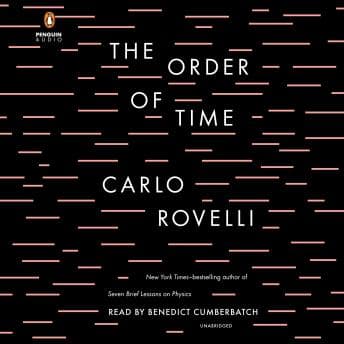

Does time actually flow, or is our brain just hallucinating order to keep us from going insane?
That's the question I was grappling with at 6:15 AM on the Caltrain while staring at a fogged-up window. Look, I'm a simple woman. I see a book about theoretical physics narrated by Benedict Cumberbatch, I click buy. I don't even check the price. (Kevin, if you're reading this, yes, I know I have a backlog. Let it go.)
I usually devour audiobooks to optimize my commute—learning new tech stacks, leadership strategies, whatever. But this? This wasn't optimization. This was therapy.
When Physics Feels Like Poetry
Here's the thing about Carlo Rovelli. He doesn't write like a scientist. He writes like a poet who just happens to know quantum loop gravity.
Most pop-science books try to dumb things down until they lose meaning. Blue Cross had a similar balance problem, though in a completely different genre. Or they go the other way—hit you with so much math you zone out and start thinking about what to order for lunch. Rovelli finds this weird, beautiful middle ground. He explains that time isn't a universal constant. It's a perspective. A blur.
I'll be honest—I had to rewind Chapter 3 twice. Not because the narration was bad (we'll get to that), but because the concepts are heavy. We're talking about entropy and the arrow of time and how the "present" is basically a local illusion. At one point, I literally put my phone down and just stared at the seat in front of me for five minutes. My brain needed to buffer.
It's short, though. Only 4 hours and change. You can finish this in two days of commuting if you don't get interrupted by PagerDuty.
Sherlock Explains the Universe
Okay, let's talk about the elephant in the room. Or rather, the Doctor Strange in the recording booth.
Benedict Cumberbatch narrating this is almost unfair to other audiobooks. His voice is rich, deep, and impossibly calm. It feels like he's sitting in an armchair next to a fireplace, explaining the heat death of the universe while pouring you a whiskey.
But here's a warning: It's too soothing.
I usually listen at 1.5x or 1.75x speed. It's the only way to get through the 50+ books I do a year. But for this? I had to drop to 1.0x. Partially because the physics demands it, but mostly because speeding up Cumberbatch feels like a crime. If you listen to this while tired, you will fall asleep. It's not boring—it's just hypnotic.
He handles the Italian names and the complex terminology without stumbling. You can tell he actually understands (or acts like he understands) what he's reading. It makes a difference.
The Commute Test
So, is it commute-worthy?
Yes, but with a caveat. This isn't background noise. You can't listen to this while checking emails or scrolling Twitter. If you multitask, you'll miss the thread and suddenly wonder why he's talking about smudged memories.
It's perfect for the train when you can just close your eyes and ignore the world. Or a long walk. Skip it for the gym—nobody needs an existential crisis while trying to hit a PR on the squat rack.
Who's this for? Anyone who wants their brain gently broken by physics without needing a PhD. Skip it if you need something you can half-listen to, or if you're already running on four hours of sleep.
The ROI here isn't "I learned a new skill." It's "I feel slightly smaller, but in a good way." Sometimes, after a week of debugging distributed systems where everything is urgent and broken, it's nice to be reminded that time is an illusion anyway.
Grab this one. But maybe drink some coffee first.