
Can you write a convincing Sherlock Holmes story if you're not Arthur Conan Doyle? I mean, really write one - not just dress up a generic mystery in a deerstalker and hope nobody notices?
I finished this one on a Saturday morning, Denise still asleep, coffee going cold on the counter while I stood in the kitchen like an idiot with my earbuds in, genuinely curious whether John Taylor could pull off the voice. Not Cumberbatch's voice - Watson's. Because that's the trick with Holmes pastiche. Everyone obsesses over getting Holmes right, the deductions, the arrogance, the violin. But the stories live or die on Watson. He's the narrator. He's the lens. And Doyle's Watson has a very specific rhythm - that Victorian medical man's precision mixed with genuine wonder at his friend's abilities.
Watson's Cedarwood Box and the Problem of Pastiche
Taylor's framing device is clever enough: Watson has a locked cedarwood chest in his bureau, full of cases too sensitive to publish. It's a neat bit of canon-adjacent world-building that gives these four short stories permission to exist. And to Taylor's credit, he mostly nails the Watsonian voice - the slightly stiff formality, the way Watson editorializes just enough to remind you he's impressed but not stupid. The ballistics experiment in one story and the missing gold bullion in another feel like they could've been pulled from The Strand Magazine circa 1893. The mystery structures are solid. Setup, complication, Holmes being three steps ahead, Watson catching up, resolution.
But here's where my twenty years of teaching literature kicks in. Let's talk about what the author is really saying - or rather, what he's carefully not saying. Taylor writes competent Holmes. He does not write surprising Holmes. The four stories - "An Inscrutable Masquerade," "The Conundrum of Coach 13," "The Trinity Vicarage Larceny," "The 10.59 Assassin" - follow the formula so faithfully that you can pretty much predict the shape of each resolution by the midpoint. Doyle's originals had that too, sometimes, but they also had moments of genuine strangeness. "The Speckled Band." "The Red-Headed League." Stories where the solution was so bizarre you couldn't have guessed it. Taylor plays it safe. The mysteries are satisfying the way a crossword puzzle is satisfying - you feel good completing them, but you don't think about them at dinner.
At two hours total for four stories, this is a quick listen. Each story runs about thirty minutes, which is actually perfect short-story length for audio. No padding. No unnecessary subplots. I respect that economy.
Cumberbatch, the BBC, and the Elephant in the Drawing Room
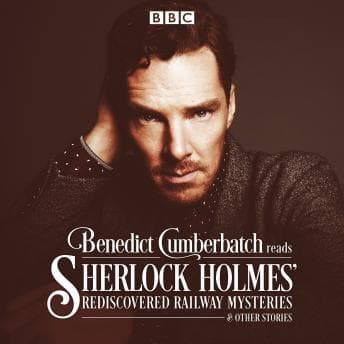
Let's address the obvious: Benedict Cumberbatch reading Sherlock Holmes stories is a marketing decision as much as a creative one. The man played the character on television. You're buying this partly because of that association. And the BBC production leans into it - there are train sound effects, atmospheric music, the whole radio-drama treatment. It's polished. It's professional.
But here's the thing that kept nagging me. Cumberbatch's Holmes voice - his BBC Sherlock Holmes voice - is modern, clipped, rapid-fire. These stories are Victorian. And Cumberbatch does adjust, slowing down, adopting something closer to period-appropriate diction. His Watson is warmer, more deliberate, and he creates enough separation between the two that you always know who's speaking. That distinction matters in audio. Where it gets tricky is the secondary characters - a few of the suspects and witnesses blur together vocally, and in mystery fiction, that's not just an aesthetic issue. If I can't immediately distinguish Inspector Lestrade from the vicar from the railway porter, I'm losing deductive clues.
The production has some volume balance issues too. The sound effects and background music occasionally compete with the narration, which - look, the narrator understands that pause is punctuation. Let the man's silences breathe without filling them with train whistles.
Still. Cumberbatch reading Holmes is like watching a pianist play a piece they know cold. Even when the sheet music is a little pedestrian, the performance has authority. If you loved the Stephen Fry recordings of the original canon, this is lighter, shorter, more of a snack than a meal - but a well-prepared one.
Who Gets a Ticket on Coach 13
This is for Holmes completists who want more and don't mind that "more" means "familiar." If you've read every Doyle original and you're craving that specific Victorian mystery feeling, Taylor delivers it reliably. If you're a Cumberbatch fan from the BBC series, you'll enjoy hearing him in a more traditional register. My students would hate this. I love it.
But if you're new to Holmes? Start with Doyle. Start with "A Scandal in Bohemia" or "The Hound of the Baskervilles." This is why we still read the classics - because the originals earned their place, and the imitations, even good ones, remind you why. I had a similar reckoning reading Tarzan the Untamed - another franchise entry where the formula holds together just well enough that you finish it, but the original's wild invention keeps casting a shadow.
At two hours, this is a perfect faculty-meeting listen. (Principal Martinez, I was absolutely engaged with your parking lot proposal. Absolutely.) The prose deserves to be savored, and at 1.0x speed these stories go down like a good cup of tea - pleasant, warming, and over before you want them to be. Just don't expect the tea to be spiked with anything stronger than milk and sugar.
The Annotation in the Margin
Worth your time on a short walk or a lazy afternoon. Not worth reshuffling your queue for. The stories are competent pastiche elevated by a strong narrator and BBC production values, but they lack the spark that makes you hit "rewind" and listen to a passage twice. I enjoyed it the way I enjoy a well-taught lesson that follows the textbook exactly - nothing wrong with it, but nothing that makes you sit up straighter in your chair either.