
I was halfway through a ten-hour drive from Portland to Boise when Patrick Warburton's voice came through my car speakers, and I laughed so hard I had to pull over at a rest stop outside of La Grande. That moment — and honestly about a dozen others scattered across this nearly twenty-seven-hour listen — is why I keep coming back to Dungeon Crawler Carl.
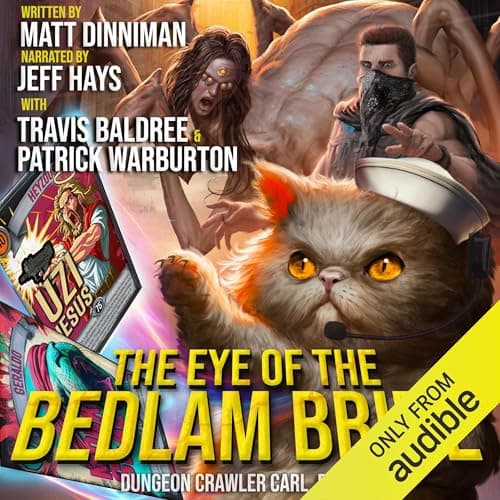
The Eye of the Bedlam Bride is the sixth installment in Matt Dinniman's series, and it might be the most ambitious one yet. The eighth floor of the dungeon drops Carl, Donut, and the surviving crawlers into a map modeled on Earth's final days before collapse. Ghostly, intangible humans wander around living their last moments while legendary monsters rooted in real-world folklore inhabit the landscape. The twist this time? It's a card-capture mechanic. Each team has to hunt down six creatures, trap them into cards, and build a deck strong enough to survive the boss fights waiting at the floor's end. If that sounds like Pokémon crossed with a post-apocalyptic nightmare, you're not far off, and it works better than it has any right to.
At the center of the floor's mythology sits Shi Maria, the Bedlam Bride herself — a formerly god-married entity whose signature attack drives people insane. She's intelligent, she's terrifying, and she's exactly the kind of challenge that forces Carl into impossible choices. Some listeners have noted that the Bedlam Bride doesn't dominate the story as much as the title implies, and that's a fair observation. She's more of a gravitational force than a constant presence, pulling the plot's tension tighter even when she's offscreen. Dinniman uses her the way a good horror director uses the monster — sparingly, which makes every encounter count.
What really elevates this entry is how Dinniman juggles about five different narrative threads without dropping any of them. There's the ongoing corporate drama between a talk show host, an heiress, and their shared history of destruction. There's the deteriorating AI system that raises genuine questions about the dungeon's stability. There's the tiara situation with a friend that I won't spoil but that hits harder than expected. And threading through all of it is the series' signature blend of absurdist comedy and genuine emotional gut-punches. One chapter you're laughing at the chaos, the next you're sitting in silence processing something Dinniman just did to a character you care about.
Now, about that narration. Jeff Hays has been the backbone of this series from the start, and calling this his best work isn't hyperbole — it might genuinely be the peak of audiobook narration in the LitRPG space. His vocal range across dozens of characters remains staggering. Every personality is distinct, every emotional beat lands. The man can shift from comedy to tragedy in the same sentence and make both feel earned.
The guest narrators are the wildcard. Patrick Warburton voicing a character that Jeff Hays had originally modeled Carl's voice after creates this bizarre, satisfying meta-loop that shouldn't work but absolutely does. Warburton brings that unmistakable baritone charisma, and his scenes carry a weight that's different from anything else in the series. Travis Baldree and Annie Ellicott round out the cast and deliver strong performances. One small gripe that other listeners have raised: Jeff Hays's introduction to the audiobook basically reveals which character Warburton plays, which deflates a reveal that would have been genuinely surprising. It's a minor thing, but if you're going in fresh, maybe skip ahead past the intro.
The line "Raul, what the fuck?!" — delivered by Hays — has already become legendary in the fandom, and rightfully so. It's the kind of moment where narration, writing, and comedic timing collide into something that goes beyond the medium. I've relistened to it four times.
At nearly twenty-seven hours, this is a substantial listen, and it demands your attention. The plot twists are genuinely unpredictable, the character development has real stakes, and the card-capture mechanic adds a strategic layer that keeps the dungeon crawling fresh six books in. This isn't background audio. This is the kind of audiobook where you sit in your parked car for twenty extra minutes because you can't pause in the middle of a scene.
Who should listen? Anyone already invested in the Dungeon Crawler Carl series — this is the payoff you've been building toward. Newcomers to LitRPG who want proof the genre can punch way above its weight will find it here too, though you really need to start at book one. Who should skip? If you bounced off earlier entries or can't commit to a twenty-seven-hour listen that requires your full attention, this one won't change your mind.
Dinniman continues to prove that LitRPG can be real literature when the writing is this sharp and the emotional investment runs this deep. I stumbled into that same argument from a completely different corner of speculative fiction when I picked up A Conjuring of Light — genre fiction that earns the word literature through sheer emotional weight. The series keeps escalating without losing what made it special in the first place — the relationship between a man and his cat, trying to survive something that was never designed to be survived.