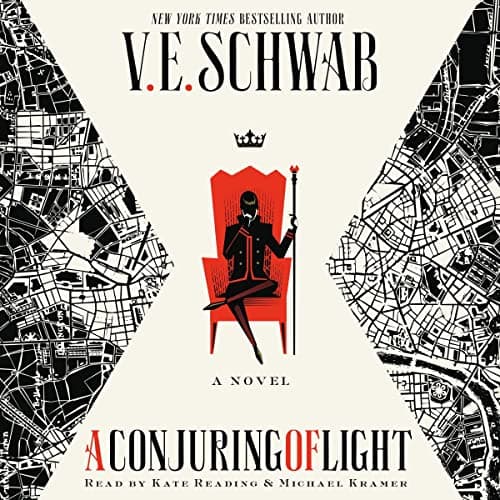

"I'm not going to die," Kell says at one point, though by that stage of A Conjuring of Light, you're not entirely sure you believe him. And that's the engine that drives this 19-hour finale—V. E. Schwab has spent two books making you care about these people, and now she's put a ticking clock on all of them.
I burned through most of this during a weekend road trip, and the pacing worked perfectly for long stretches of highway. The Osaron threat—a sentient darkness consuming Red London—gives the book a propulsive urgency the second book sometimes lacked. Where A Gathering of Shadows could meander through tournament arcs, this one keeps the screws tightening. Characters are cornered, alliances fracture, and the magic system Schwab built across the trilogy gets pushed to its breaking point.
Let's talk about what's working. Schwab's greatest strength has always been her characters, and the payoffs here land. Kell and Lila's dynamic finally evolves past the push-pull tension into something that feels earned. Holland's arc might be the most surprising of the series—he goes from straightforward antagonist to something far more complicated and human. Rhy, the prince who can't die but still has everything to lose, carries some of the book's heaviest emotional weight. Schwab knows how to write people you'd follow into bad decisions.
The dual narration by Kate Reading and Michael Kramer is a known quantity for fantasy listeners—these two have been the voices of the Wheel of Time and Stormlight Archive for years. I spent a good stretch of last winter with Kramer in my ears on Rhythm of War, and that experience reminded me how much range he has with sprawling ensemble casts. Kramer handles Kell and the broader male cast with the steady authority he's known for, and he really shines here given the sheer number of characters he juggles. Reading improved noticeably from her work in earlier Shades of Magic books. Her Lila has more edge, more personality. The emotional beats—particularly in the final act—benefit from her delivery.
But the dual narration isn't without friction. When Reading voices Kell in conversation scenes, or when Kramer handles Lila, there's a brief mental adjustment that can pull you out of the moment. It's not a dealbreaker, but it happens enough that you notice. A few listeners have also flagged that some secondary characters blend together vocally—particularly the Arnesian court characters, who can sound similar enough that you need context clues to tell them apart. If you're listening while distracted, that's going to be a problem.
My bigger issue is with the book itself rather than the audio production. The middle third sags. Schwab is juggling multiple POVs across multiple Londons, and there are stretches where the narrative spins plates rather than advancing them. Some scenes feel like they exist to remind you a character is still in the story rather than pushing their arc forward. The pacing tightens significantly in the final third, but that middle section tested my patience more than once.
There's also a pattern Schwab falls into with near-death fakeouts. Characters get pushed to the edge, you feel the gut-punch, and then the rescue comes. Once is effective. Twice is tense. By the third or fourth time, the stakes start feeling less real. The ending itself is satisfying—it wraps the major arcs without being too tidy—but I wanted to feel more danger getting there.
Where this audiobook genuinely excels is atmosphere. The descriptions of a corrupted Red London, the eerie stillness of White London, the way magic feels almost alive—Reading and Kramer both lean into this. The production is clean, no sound effects or music, just two skilled narrators carrying the story. At 19 hours, it's a commitment, but the audiobook earns most of that runtime.
Schwab's writing has a lyrical quality that translates well to audio. Lines about magic, about power, about what people become when they're desperate—they hit differently when spoken aloud. This is a series that was arguably built for the audiobook format, and even with the minor narration hiccups, the experience is strong.
Who Should Listen (And Who Should Skip)
If you've followed Kell and Lila through all three books, this delivers the conclusion you've been waiting for. Also a strong pick if you're already a Kramer/Reading fan and want to hear them work outside their usual Sanderson wheelhouse. Skip it if you haven't read the first two—this is no place to start—and maybe set it aside if saggy middle sections and repeated fakeout deaths are things that kill your patience. It's not flawless—the pacing stumbles and the tension occasionally deflates—but the character work, the world-building payoff, and the emotional finale make it worth the hours. Schwab sticks the landing where it counts.