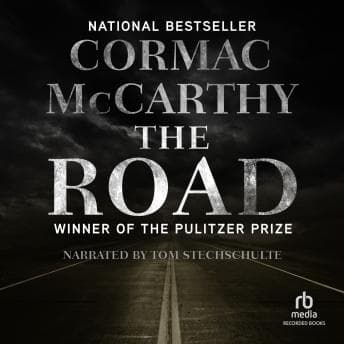

I made a terrible mistake.
I decided to listen to The Road while walking along Lake Shore Drive in mid-February. The wind off Lake Michigan was doing that thing where it feels less like air and more like a physical assault, the sky was the color of a bruised plum, and I had Tom Stechschulte in my ears describing a world covered in ash.
It was perfect. And I was miserable.
(Don't tell my wife Denise, but I sat on a freezing concrete bench near Foster Avenue for twenty minutes just staring at the gray water, letting the cold seep in because it felt like the only respectful way to consume this book.)
The Voice of the End of the World
Here's the thing about Cormac McCarthy—and I tell my AP English students this every year until they roll their eyes right out of their heads—he treats punctuation like it's a suggestion, not a rule. No quotation marks. Minimal commas. On the page, it looks like a block of gray text.
So, how do you translate that to audio?
You get Tom Stechschulte.
I couldn't find much on Stechschulte's background, but he sounds like a man who has seen some things. His voice is gravel, old wood, and exhaustion. It's gruff. Unpolished. And it is absolutely the only voice that could read this book. If you had some chipper narrator with perfect diction reading McCarthy's biblical, spare sentences, it would be a disaster.
Stechschulte understands that the silence between the sentences is just as important as the words. He reads slowly. Deliberately. Some people on the forums call it "monotone" or "sleep-inducing." I get that. Seriously, I do. If you're looking for a performance with fireworks and distinct voices for every bandit and cannibal, you're going to hate this.
But for me? The monotony is the point. The characters are starving. They are walking a dead road to nowhere. The narration should feel like a trudge.
Carrying the Fire
The story is simple. A father and son walking south. That's it. That's the plot.
But the way Stechschulte handles the dialogue between the man and the boy broke me. Because McCarthy doesn't use attribution tags (he rarely says "he said" or "she said"), the narrator has to do the heavy lifting to distinguish the speakers.
Stechschulte gives the father this weary, terrified tenderness. And the boy... the boy sounds like hope that's slowly being strangled. When the boy asks, "We're still the good guys?" and the father says, "Yes. We're still the good guys," the crack in the narrator's voice hit me harder than any high-budget audio drama I've heard this year.
It reminds me of why I force my students to read Hamlet. Not for the plot—the plot is a mess—but for the humanity. That same stripped-down emotional core is what makes Where the Crawdads Sing hit so hard—different setting, same raw humanity. This audiobook is a lesson in stripping everything away until only love and fear are left.
Who Should Listen (And Who Should Skip)
Look, I'm not gonna lie to you. This is not a "fun" listen.
My mom—the one faithful listener of my podcast who isn't related to me by marriage—would turn this off in five minutes. She'd say, "Marcus, why is everyone so sad?" and she'd be right.
If you listen to audiobooks to escape reality, to feel pumped up, or to be entertained while folding laundry, do not choose The Road. It demands your attention, and in return, it gives you depression. (Okay, profound emotional weight, but also depression.) But if you want something that'll sit with you for weeks, something that makes you appreciate a warm meal and the people you love? This is it.
The pacing is glacial. 1.0x speed felt like a funeral march. I actually bumped it to 1.1x just to keep my own blood moving in the Chicago cold, but any faster and you lose the poetry.
Final Grade
I finished the book standing in my kitchen, defrosting my hands under warm water. I was crying. Not the ugly sobbing kind, just the quiet kind where you realize how fragile everything is.
Stechschulte's performance isn't flashy. It's barely even a performance. It feels like a testimony found on a cassette tape in a bunker.
It's devastating and beautiful. I'm going to go hug my wife now. And maybe eat a can of peaches.