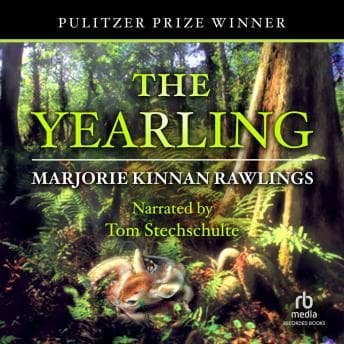

So here's the thing about classics that everyone says you should read to your kids: they're usually either too long, too boring, or too traumatizing for car listening. The Yearling? It's definitely long (14 hours!), and it absolutely wrecked me at school pickup. But boring? Not even close.
I started this one thinking it would be nice background for the morning drop-off routine. You know, wholesome old-timey Florida, a boy and his deer, probably some life lessons about nature. What I got was a gut-punch wrapped in Spanish moss and served with a side of "why am I crying in the Target parking lot?"
The Slow Burn That Snuck Up On Me
Look, I'm not gonna lie - the first few hours require patience. Marjorie Kinnan Rawlings takes her sweet time building up the Baxter family's world in the Florida scrubland. There's a lot of hunting, a lot of crop talk, a lot of weather. If you need action every five minutes, this isn't your book. (And honestly, who has time for that level of investment anyway?)
But here's what happened: somewhere around hour four, while Sophie was actually napping for once, I realized I was completely absorbed. The way Rawlings writes about this harsh, beautiful landscape - it's not just description, it's atmosphere. You can practically feel the humidity and the mosquitoes. And Jody, this lonely kid desperate for something that's just his? I got it. I really got it.
The pacing works because it mirrors Jody's life. Days blur together with chores and survival, then suddenly there's a bear attack or a flood or something that snaps everything into focus. It's not a page-turner in the traditional sense, but I found myself actually looking forward to sitting in my car after pickup just to keep listening. (Don't judge. That car time is sacred.)
Why Tom Stechschulte Works
Okay, so 14 hours is a lot to spend with one voice. Tom Stechschulte has this warm, deep quality that makes him sound like the world's most patient grandfather telling you a story on the porch. His Florida dialect work is subtle - he doesn't overdo the accents, which I appreciated. Nothing worse than a narrator who sounds like they're doing a bad impression.
What really sold me was how he handled the emotional moments. There are scenes with Jody and his father Penny that just... ugh. Stechschulte doesn't oversell the tenderness, and that restraint makes it hit harder. When Penny is teaching Jody about life and death and responsibility, it doesn't feel like a lecture. It feels like a real conversation between a father and son who don't have many words but mean every single one.
The character voices are distinct enough that I never lost track of who was talking, even when I paused for the 47th time to referee a fight about whose turn it was to pick the snack. High praise from me.
The Part Nobody Warns You About
I knew going in that something bad happens with the deer. You can't have a classic about a boy and his pet without tragedy - that's just how these things work. Black Beauty taught me that lesson years ago, and I still wasn't prepared. But knowing it's coming and actually experiencing it are two very different things.
Without spoiling the specifics: the ending of this book is devastating in a way that feels earned. It's not manipulative or cheap. It's just... life. The hard choices that don't have good answers. The moment when childhood ends not with a celebration but with a loss. That same bittersweet coming-of-age gut-punch shows up in To Kill a Mockingbird, just with a different Southern backdrop.
I finished the last hour parked in my garage, tears streaming down my face, texting my husband "DO NOT COME OUT HERE" because I needed to ugly-cry in peace. Worth it, though. Absolutely worth it.
Who Should Listen (And Who Should Skip)
Here's my honest take: this won a Pulitzer in 1939, and it deserved it. But it's not a quick, easy listen. It rewards patience. It rewards attention. It rewards coming back to it day after day and letting the story build.
If your kids are old enough (I'd say 10+), this could be a beautiful family listen. Just... have tissues ready. And maybe don't do the ending on the way to school unless you want to explain to the teacher why everyone's eyes are red. Skip this if you need fast pacing or can't handle animal-related heartbreak - no shame in that.
For fellow multitasking moms: this survived my chaotic listening schedule and still hit me right in the heart. The narration is clear enough to follow through interruptions, and the story is memorable enough that you won't lose the thread. It took me about two weeks to finish, and I thought about it constantly.
Not groundbreaking in the "reinventing literature" sense, but groundbreaking in the "this is why people still read classics" sense. Sometimes the old books got it right.