
Grading Papers with Big Brother
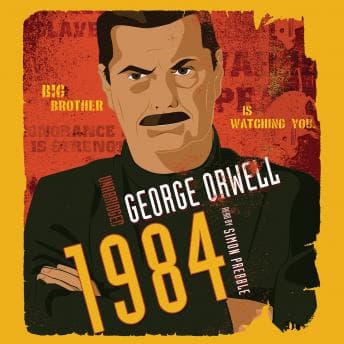
It was 11:47 PM on a Tuesday. I had seventeen essays on The Great Gatsby left to grade, my red pen was dying, and I made the executive decision to let Simon Prebble read me 1984 instead. (The essays could wait. They'd been waiting since 2003, honestly.) Within twenty minutes, I'd forgotten about Nick Carraway entirely. Winston Smith had me.
Here's the thing about teaching Orwell to teenagers for two decades: you start to think you know this book. You've dissected the Two Minutes Hate, explained doublethink until your voice gave out, watched students' eyes glaze over during the Goldstein manifesto section. But listening to it? Actually hearing it performed? That's a different animal entirely.
Why Prebble Gets It
Simon Prebble doesn't just read 1984. He inhabits it. And I don't throw that word around lightly—I've sat through enough overwrought audiobook performances to know the difference between acting and understanding.
Prebble brings this quality I can only describe as British equanimity. There's a restraint to his delivery that mirrors Orwell's lean prose perfectly. He doesn't oversell the horror. He doesn't need to. When Winston first writes "DOWN WITH BIG BROTHER" in his diary, Prebble's voice carries this quiet tremor—not melodrama, just the weight of a man committing thought-crime for the first time. The narrator understands that pause is punctuation. Every silence means something.
What really got me was his handling of the female characters. Julia, especially. He softens his voice just enough to differentiate her without slipping into caricature. It's subtle work. The kind of thing you don't notice until you realize you've been picturing a complete person, not just a narrator doing a "woman voice." (My students would hate this. I love it.)
And Winston's inner monologue? Prebble captures that peculiar mix of exhaustion and desperate hope that defines the character. There's this gravitas underneath everything, even the mundane moments. Buying a paperweight. Renting a room above Mr. Charrington's shop. These scenes feel heavy because Prebble makes them feel heavy. He knows where the story is going.
The Listening Experience
I finished this over about a week—lakefront walks with Denise, late-night grading sessions, one particularly long faculty meeting about standardized testing. (Principal Martinez, I was definitely paying attention. I was not. I was in Room 101.)
At eleven and a half hours, this is a commitment. But it never dragged for me. Orwell's prose is deceptively simple—short sentences, plain language—but there's a rhythm to it that rewards patience. I listened at 1.0x because the author chose those words, and Prebble's pacing honors that choice. The subtle tempo shifts during tense moments, the measured delivery during the philosophical passages—speeding this up would be a crime against the text.
The audio quality is clean. Professional. No weird background hums or inconsistent levels. Blackstone did right by this recording.
That said—and I need to be honest here—the middle section with Goldstein's book is still the middle section with Goldstein's book. It's dense political theory disguised as dense political theory. Prebble handles it as well as anyone could, but if you've ever taught this novel, you know students check out during those chapters. Listeners might too. Push through. The payoff is worth it.
What Orwell Is Really Saying
This reminds me of what Hemingway said about prose: the dignity of movement of an iceberg is due to only one-eighth of it being above water. Orwell's doing something similar here. The surface story—Winston's doomed rebellion, his love affair with Julia, his inevitable destruction—that's the visible eighth. Underneath is everything we're still grappling with: surveillance, historical revisionism, the malleability of truth.
Listening in 2024 hits different than reading in grad school. I kept pausing to think about things. About algorithms. About memory holes. About how "the past was alterable" doesn't sound like dystopian fiction anymore.
Prebble's narration amplifies this. There's something about hearing "War is Peace, Freedom is Slavery, Ignorance is Strength" spoken aloud that makes it land harder than reading it on a page. The prose deserves to be savored, and this performance ensures you do.
Who Should Listen (And Who Should Skip)
If you loved Brave New World or Fahrenheit 451, this is their spiritual successor—or predecessor, depending on how you're counting. Though if you want something that wrestles with truth and survival in a completely different way, Project Hail Mary uses science fiction to ask similar questions about what humans will do when everything's on the line. Essential listening for anyone interested in political fiction, dystopian literature, or just understanding half the references in modern discourse.
Best for: commutes, chores, any activity where you want to feel vaguely unsettled about the state of civilization. Pairs well with existential dread and strong coffee.
Skip if: you need something light. This is bleak. Intentionally, devastatingly bleak, but bleak nonetheless. Also if you're impatient—this is a slow burn, not a thriller.
Content warning for violence, psychological manipulation, and scenes that are genuinely disturbing. Orwell wasn't messing around.
Final Thoughts
I've assigned this book to hundreds of students. I've taught it until the pages fell out of my classroom copies. And Simon Prebble made me hear it new.
That's the power of great narration. It's not just reading—it's interpretation. Performance art. Worth pausing the faculty meeting for.
The forty-seven listeners of my podcast will be getting a bonus episode about this. Mom, try to stay awake.