
"He's the boy who cried wolf." That line hit me around hour three, and I knew exactly where this was going—or thought I did. Grafton had other plans.
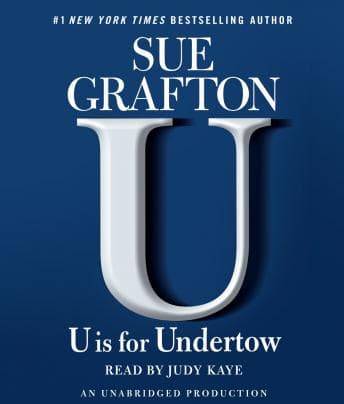
Let me cut to the chase: U Is For Undertow is solid investigative work wrapped in a cold case that's been sitting for over twenty years. A four-year-old girl vanishes in the sixties, and now some unemployed college dropout walks into Kinsey's office claiming he remembers stumbling onto her burial site as a kid. The catch? This guy Michael Sutton has a complicated relationship with the truth. And by complicated, I mean he lies like some of my former supply sergeants.
When the Investigation Actually Feels Like an Investigation
What Grafton does here—and I've got to give her credit—is show the actual grunt work of detective operations. Kinsey isn't running around with a gun drawn every chapter. She's knocking on doors, cross-referencing stories, catching people in inconsistencies. Methodical. Patient. It reminded me of after-action reports, honestly. You're piecing together what happened from people who all saw the same event differently.
The dual timeline structure threw me at first. We're bouncing between 1988 and the 1960s, getting inside the heads of characters who may or may not be connected to this kidnapping. Some folks might find that disjointed—I'll admit there were stretches during my drive to Houston where I wondered if Grafton was ever going to tie it together. She does. The payoff's there. But you've got to trust the process.
Around hour seven, things started clicking into place like a well-planned operation. That's when I stopped checking how much time was left and just let it ride.
Judy Kaye's Take on Kinsey
Here's where I need to be straight with you. Judy Kaye's voice has some gravel to it. She sounds mature, experienced—like someone who's been around the block a few times. Now, Kinsey's supposed to be thirty-eight in this book. Kaye sounds... older than that. Maybe mid-forties, maybe pushing fifty.
Did it bother me? Not really. I've worked with plenty of thirty-eight-year-olds who sounded like they'd lived three lifetimes. Combat does that. Life does that. So Kaye's interpretation worked for me. She's clear, she's crisp, and she differentiates the characters well enough that I never lost track of who was talking.
But I'll acknowledge—if you've been listening to this series with a different narrator and you've got a specific Kinsey voice locked in your head, this might take some adjustment. Kaye doesn't have those softer edges some listeners apparently expected. She's got authority in her delivery. Ranger seemed to approve, for what that's worth.
Where It Lost Me (Briefly)
Look, I'm not going to pretend this was a perfect mission. There are stretches in the middle where Grafton gets deep into character backstories and period details from the sixties. Some of it's necessary context. Some of it felt like we were setting up camp when we should've been moving to the objective.
And Michael Sutton—the guy who kicks off this whole investigation—he's frustrating by design. You're supposed to question everything he says. But there were moments I wanted to reach through my truck speakers and tell him to just spit out the truth already.
The frustration serves the story, though. Grafton's making a point about memory, about how unreliable witnesses can be, about how people construct narratives that serve their own needs. I've seen that play out in real life more times than I can count. Debriefing soldiers after contact, you'd get four different versions of the same firefight. Girl on the Train plays with that same unreliable witness angle, though it leans harder into the psychological thriller territory.
Mission Debrief
If you're a Grafton fan, you already know what you're getting. Kinsey's sharp, she's observant, and she doesn't suffer fools. The mystery here is complex without being convoluted—there's a difference, and Grafton knows it.
At fourteen hours, this is a commitment. I'd recommend 1.25x if you're used to it—Kaye's pacing is steady but not rushed, and bumping the speed keeps the momentum going during those slower investigative sections.
Who's this for? Listeners who appreciate procedural detective work over action-movie pacing. Skip it if you need constant plot momentum or can't handle a narrator who sounds older than the character she's voicing.
The ending? Satisfying. Not a twist-for-the-sake-of-twist situation. Everything connects logically, which I appreciate. Too many thrillers these days pull rabbits out of hats that were never set up. Grafton plays fair.
Mission accomplished. Ranger approved this one.