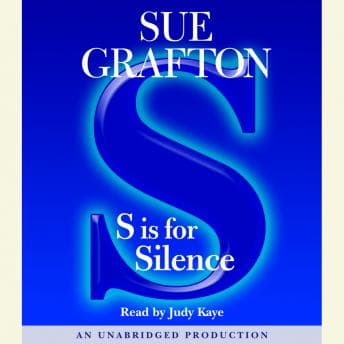

"The silence of the lost, the silence of the grave, the silence of oblivion."
That's the opening framing of this book, and honestly? It hit different at 1 AM in my apartment with every light off and Shirley curled against my feet like a furry little anchor to reality. I know, I know — this isn't horror. But Sue Grafton understands something that most mystery writers don't: the scariest thing isn't a monster in the dark. It's a woman who puts on her party dress, walks out the door, and simply stops existing.
Violet Sullivan Deserved Better Than a Cold Case File
Here's what grabbed me about S Is for Silence and didn't let go — Grafton splits the narrative between present-day Kinsey Millhone investigating and 1953 chapters told in past tense that slowly reconstruct Violet Sullivan's final days. It's a structural choice that could've felt gimmicky, but it doesn't. The 1953 sections aren't flashbacks. They're hauntings. You're watching a woman move through a small California town where everyone has an opinion about her — her affairs, her drinking, her terrible husband — and you know she's already gone. She's already a ghost. You're just watching the living version catch up.
Daisy, Violet's daughter, was not-quite-seven when her mother vanished. Now she's in her forties, hiring Kinsey because she needs the solace of closure. And that word — closure — Grafton treats it with the skepticism it deserves. Thirty-four years of silence doesn't resolve neatly. The townspeople of Serena Station have their stories calcified. Some say Violet ran off with a lover. Some say her husband killed her. Everyone's comfortable with their version. Kinsey's job isn't just detective work — it's archaeology. She's digging through layers of small-town mythology to find something that might not even be recognizable anymore.
This is book nineteen in the alphabet series, and you can feel Grafton's confidence. She's not in a hurry. The pacing is deliberate — slow-burn in the best sense — which means if you need a body every thirty pages, this isn't your book. But if you appreciate the way a good investigation unravels not through action but through conversation, through the cracks people show when they've been lying for three decades? This understands that horror isn't about gore — it's about dread. Even in a mystery.
Judy Kaye Gets Kinsey in Her Bones
The narrator commits. That's rare.
Judy Kaye gives Kinsey this brave, slightly sardonic alto that just is the character. There's an energy to her read — funny when it needs to be, quiet when the scene demands it. She doesn't perform Kinsey so much as inhabit her, and the distinction matters. You can hear the difference between Kinsey's internal monologue (dry, a little self-deprecating) and her interview mode (professional but probing, the kind of voice that makes people talk before they realize they've said too much).
The character differentiation is strong across the board. When Kaye shifts into the 1953 chapters, her vocal register changes — slightly warmer, slightly more vulnerable — and it creates this contrast between Kinsey's hard-nosed present-day investigation and Violet's increasingly claustrophobic world. The 1953 voices feel period-appropriate without tipping into caricature. That's a tightrope, and Kaye walks it.
I will say — and this is genuinely a matter of taste — there's a segment of listeners who prefer other narrators for Kinsey. Mary Peiffer's name comes up. I get it. Kaye's style is specific. Her Kinsey is more energetic than some readers might imagine from the text. But for my money, that energy is what makes twelve hours feel like seven. She's fully committed to every scene, and you either sync with her rhythm or you don't. I synced.
The Ending Problem (Let's Talk About It)
Here's where I have to be honest. The resolution feels rushed. After twelve hours of careful, meticulous excavation — peeling back decades of secrets, affairs, abuse, small-town complicity — the final act arrives and moves at a pace that doesn't match the rest of the book. It's not bad, exactly. But it's like watching someone build a cathedral and then speed-run the steeple. You feel the shift. Some of the emotional payoff that Grafton earned with those patient, layered chapters doesn't fully land because the wrap-up doesn't give you room to breathe with it.
Does it ruin the book? No. But it kept me from calling this a must-listen.
Who Gets This and Who Bounces
If you love character-driven mysteries — the kind where the investigation is really about people and their tangled, messy histories — you need this. If you're a Kinsey Millhone fan, this is one of the stronger entries, and Grafton's decision to alternate timelines gives the series a fresh charge at book nineteen. If you scare easily — well, this won't scare you. But it will unsettle you. Violet Sullivan's story is quiet devastation.
Skip if you want fast-paced thriller energy. This is a library book, not a blockbuster. (And yes, as a librarian, I mean that as the highest compliment.)
My podcast listeners are going to love this — not because it's horror, but because Grafton understands that the absence of a person can be more terrifying than any presence. Shirley Jackson walked so this kind of domestic dread could exist in genre fiction, even mystery fiction.
Shelved Under: Worth the Silence
I finished this one sitting in the dark — old habits — and sat there for a minute before turning the lights on. Not because I was scared. Because I was thinking about Daisy, forty years old, still listening for her mother's car in the driveway. That's what good mystery does. It stays.