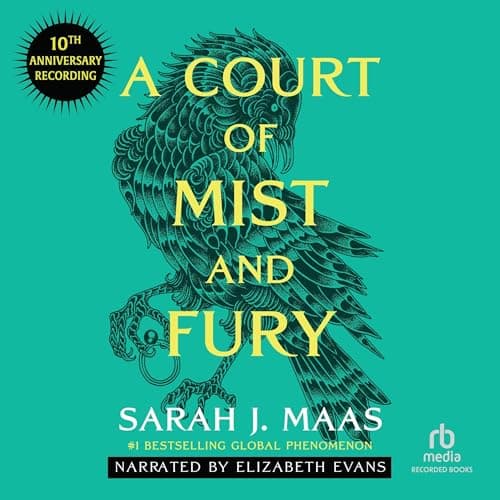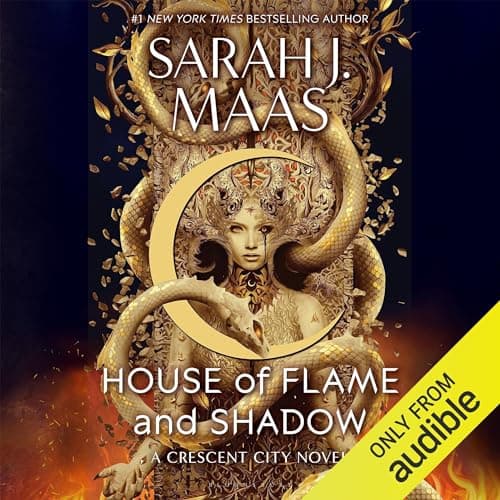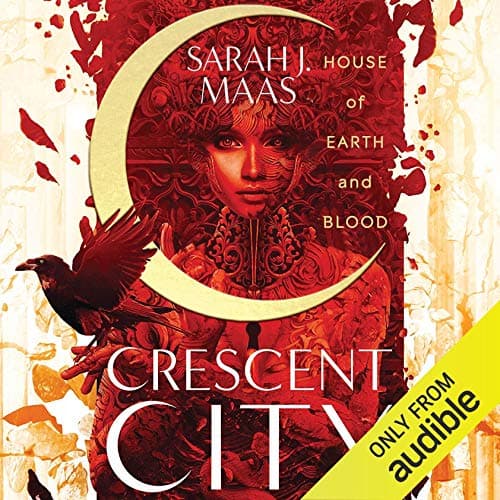

Twenty-eight hours. This book is twenty-eight hours long.
I need you to sit with that for a second. I listened to this across six nights of post-shift drives, two weekend laundry marathons, and one very long Saturday where I was meal-prepping for the week while Carlos took the kids to his mom's. I was elbow-deep in adobo when Bryce's world fell apart in the opening chapters, and I stood there with chicken juice on my hands, unable to hit pause, unable to move. That's the kind of book this is - the kind that holds you hostage in your own kitchen.
The First 10 Hours Are Hazing and I Mean That
Let me be straight with you. Sarah J. Maas drops you into Crescent City with approximately zero hand-holding. There are angels, Fae, shifters, demons, a government hierarchy that would make the VA look simple, and about forty proper nouns in the first hour. I nearly bailed around hour three. The world-building is dense in a way that feels like the first week of orientation at a new hospital - everyone's using acronyms you don't know, there's a pecking order nobody explains, and you just have to absorb it through osmosis.
But here's what kept me: Bryce Quinlan is grieving. Real, ugly, messy grief. Not the cinematic kind where someone stares out a rain-streaked window. The kind where you go back to work and people look at you with that face and you want to scream. As someone who's held the hands of families in the worst moments of their lives, I recognized what Maas was doing. Bryce's party-girl exterior cracking over the loss of her best friend Danika - that tension between performing okay and being absolutely shattered - felt authentic in a way I did not expect from a fantasy romance.
Carlos asked why I was crying in the car. I blamed allergies. In October. In the desert. He didn't buy it.
Elizabeth Evans Earned Every Penny of Her Recording Fee
Twenty-eight hours of single-narrator audiobook is a marathon, and Evans runs it well. Her Bryce has this specific quality - kind of brash and irreverent on the surface, with these micro-cracks in her voice when she's talking about Danika or pretending she's fine. The shift between Bryce's sarcastic banter with Hunt and her quiet moments alone is genuinely good voice acting, not just pitch changes.
Hunt Athalar gets this lower, more measured delivery that works for his fallen-angel-soldier thing. And she nails the secondary cast too - Ruhn's slightly aloof Fae prince energy versus Fury's clipped intensity. I could follow conversations without constantly rewinding to figure out who was talking, which in a cast this big is no small thing.
Where Evans really shines is the pacing of emotional scenes. She doesn't rush grief. She doesn't oversell the romantic tension. There's a restraint there that I appreciated, especially during the slow burn between Bryce and Hunt, which builds over - I'm not exaggerating - probably fifteen hours before it really lands.
My one gripe: there were moments where I could feel Evans navigating the sheer volume of fantasy terminology, and very occasionally the rhythm would hiccup. Nothing that broke the experience, but noticeable if you're paying attention.
"Alphahole" Is a Word I Now Have Opinions About
Okay. So. Maas uses the term "Alphahole" in this book. Multiple times. And look, I get it - it's world-building slang, it's meant to be cheeky. But by the fourth or fifth time it came up I was yelling at my dashboard again, though for different reasons than usual. ("THAT'S NOT A WORD, SARAH. STOP TRYING TO MAKE IT A WORD.")
The romance itself though? The slow burn between Bryce and Hunt works because Maas earns it. These two don't just fall together because the plot demands it. They build trust during a murder investigation, which - as someone who's worked alongside the same people through genuinely terrible nights - rings true. Bonds forged in crisis are different. They're deeper. And Maas gets that.
The mystery-thriller element surprised me. The investigation into who's actually behind the demon attacks in Crescent City has real structure. The final third picks up momentum like a trauma code - everything converging, everything urgent, and a climax that genuinely shocked me. I was pulling into my driveway during that last stretch and sat in the car for twenty minutes with the engine running. The kids were watching from the window.
Who Should Listen (And Who Should Skip)
Pick this up if you want urban fantasy with actual emotional weight and you're willing to invest ten hours before the payoff hits. If you loved A Court of Thorns and Roses but wished it were grittier, more modern, and had a murder mystery threaded through it - this is your next obsession. I reviewed the Court of Thorns and Roses dramatized adaptation a while back, and honestly the full cast production is a completely different animal from a single-narrator listen — worth knowing before you commit.
Skip it if you need a book to grab you in the first hour or if dense world-building makes you zone out. This is not a background-listening book. If your attention wanders during the setup, you'll be lost for the rest of the ride. Also skip if you're sensitive to violence or sexual content - Maas doesn't hold back on either.
Content-wise: there's drug use, heavy drinking, graphic violence, sexual content, and grief that hits like a truck. Night shift approved, but maybe not for the faint of heart.
Clocking Out
This book is a commitment. Almost 28 hours, a slow start, a world that demands your full attention. But when it clicks - and it does click, hard, around the midpoint - it becomes the kind of listen where you hope for red lights so you get a few more minutes. Maas built something big here, and Evans carries the weight of it with real skill. I'm already dreading and anticipating the sequel's runtime. My mom would love this (she still thinks I should've been a doctor), but she'd never admit to reading fantasy. I'm buying her the audiobook anyway.