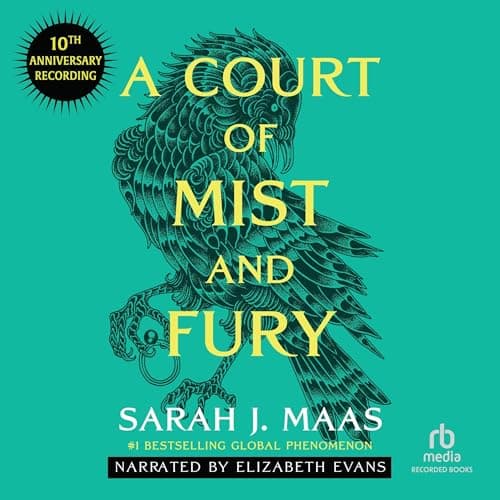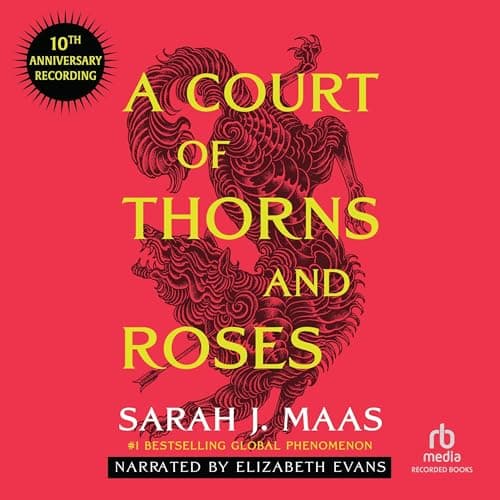

Everyone told me this was the definitive way to experience ACOTAR, and I went in skeptical. I've listened to enough anniversary re-recordings that amount to little more than a marketing exercise with a new voice slapped on familiar text. This one is different. Not because the story has changed — it hasn't — but because Elizabeth Evans narrates Feyre with a quality that makes you realize what the original recording was missing.
Here's the thing about Feyre as a character: she exists in two emotional registers for most of this book. There's the hardened, half-starved huntress who opens the story with a kill in the frozen woods, all clipped practicality and survival instinct. Then there's the version of her that slowly emerges in the Spring Court — someone grappling with beauty and abundance she doesn't trust, drawn to a world she's been raised to hate. Evans handles that transition with real specificity. Early Feyre sounds guarded, almost flat in her emotional delivery, like someone who's trained herself not to feel too much because feelings are a luxury she can't afford. Her work in Queen of Shadows showed me she could do this kind of slow emotional architecture with a different Maas protagonist, but Feyre's arc tests her range in a whole new direction. As the story shifts to Prythian, Evans lets warmth creep in gradually, and you hear Feyre's defenses cracking before Feyre herself would admit it. That's not easy to pull off across fourteen hours without it feeling like a narrator just flipping a switch.
Character differentiation is where I wanted more and got... enough. Tamlin comes through as restrained and careful — Evans pitches his dialogue with a kind of deliberate gentleness that reads as someone holding back power rather than lacking it. Lucien gets more personality in Evans's delivery: sharper, quicker, with a sardonic edge that makes his scenes a welcome change of pace from the slow-burn tension of the central romance. Where things get genuinely impressive is Amarantha in the back half. Without spoiling the specifics, Evans gives her a controlled cruelty that made me physically uncomfortable during the Under the Mountain sequences. That section — roughly the final quarter of the book — hits differently in audio because Evans doesn't let you skim past the brutality. You sit with it. The trials Feyre endures land harder when someone is making you hear every moment of fear and determination.
The romance between Feyre and Tamlin is textbook slow burn, and whether that works for you depends entirely on your tolerance for setup. The first half of this book is heavily weighted toward atmosphere, world-building, and the careful dance between captor and captive. Maas writes the power imbalance with awareness — Feyre's attraction to Tamlin is tangled up with her resentment and confusion about being taken from her family. Evans plays the ambiguity well, and the scenes where Feyre starts painting again carry a quiet emotional charge that the action sequences can't match. If you're the kind of listener who needs plot momentum in every chapter, the pacing through the Spring Court will test your patience. But if you enjoy watching a character lower her guard inch by inch, this stretch is where the audiobook earns its runtime.
A few practical notes. This is a captor-romance setup. Feyre is taken against her will, held in a beautiful prison, and falls for the person keeping her there. Maas complicates and eventually subverts some of those dynamics across the series, but in this first book, the trope is present and unvarnished. There's also violence that gets graphic, abusive dynamics that aren't always framed as abusive within the text, strong language, and sexual content that's steamy but not explicit by later ACOTAR standards. The content warnings get considerably heavier further along in the series — A Court of Silver Flames (10th Anniversary Recording) is where Evans really has to carry some emotionally brutal material, and knowing that baseline here makes that later performance even more impressive in retrospect. Know what you're walking into.
The production itself is clean — single narrator, no music or sound effects, no audio artifacts that I caught. At fourteen hours, it's a solid length for a fantasy romance opener. Evans's pacing keeps the descriptive passages moving where they might drag on page, and her delivery during the action-heavy back half is taut enough that I burned through the last three hours without pausing.
Compared to The Assassin's Blade, this is a much more focused story with a tighter emotional core. Where Assassin's Blade gives you episodic adventures, ACOTAR commits to one relationship and one escalating threat, and the audio format rewards that commitment. You're locked into Feyre's perspective for the full ride, and Evans makes that perspective feel lived-in rather than reported.
Who Should Listen (And Who Should Skip)
If you love slow-burn fantasy romance and want a narrator who makes you feel every crack in a character's armor, this is your audiobook. Skip it if you need nonstop plot momentum or if captor-romance dynamics are a hard no for you. If you've already read this in print and you're wondering whether the anniversary recording justifies a revisit — yes, particularly for the Under the Mountain section and the quieter Spring Court scenes where Evans's delivery adds layers the page doesn't capture. If you're brand new to ACOTAR, this is the version to start with. Just know you'll probably be buying the sequel within twenty-four hours.