
I was halfway through a six-hour road trip through the mountains of North Carolina when Feyre's war council scene hit, and I nearly missed my exit because I was so locked in. That's the kind of audiobook this is — the kind that makes you circle the parking lot three extra times because you refuse to pause mid-chapter.
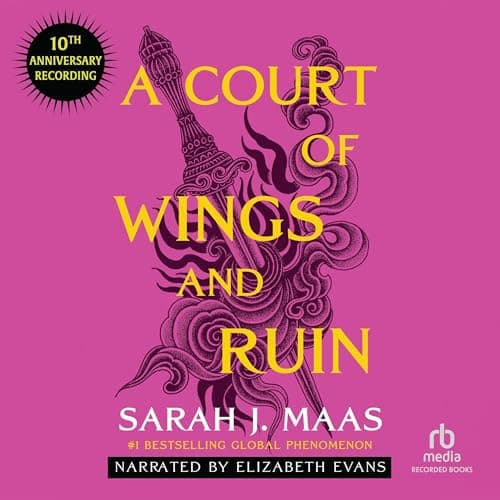
A Court of Wings and Ruin is the explosive third book in Sarah J. Maas's ACOTAR series, and this 10th anniversary recording with Elizabeth Evans brings something genuinely fresh to a story many of us have already consumed at least once. Maas handpicked Evans specifically because of their friendship and Evans's deep familiarity with these characters. That personal connection shows — not in some vague, general way, but in how Evans handles the shifting power dynamics between characters who are lying to each other's faces.
The story picks up with Feyre embedded in the Spring Court, playing spy against Tamlin while feeding intelligence back to Rhysand and the Night Court. It's a delicious setup — watching Feyre navigate political deception with stakes that could topple courts and destroy alliances. The first act is tense and claustrophobic in the best way, with Feyre walking a razor's edge between her cover story and the truth. When the facade finally cracks, the book opens up into full-scale war preparation, alliance-building across hostile High Lords, and a final battle that earns every one of its twenty hours.
The political maneuvering here has that same slow-burn momentum I noticed in A Court of Mist and Fury (10th Anniversary Recording), which sits at a 4.7 in my notes for good reason — the second book in this 10th anniversary run set a high bar that Wings and Ruin mostly clears.Evans's character work is where this recording justifies its existence as a new edition. During the Spring Court chapters, she pitches Feyre's internal monologue slightly different from her spoken dialogue — there's a layer of performance-within-performance that makes you feel the exhaustion of maintaining a cover identity. Rhysand gets a low, warm register that conveys both his power and the specific tenderness he reserves for Feyre when they're alone. Tamlin sounds heavier, more guarded — you can hear the walls he's built. Nesta's sharp edges come through without making her cartoonish, and when she and Feyre clash, Evans shifts between their cadences fast enough that you never lose the thread. The Suriel scene? Evans plays it with such quiet gravity — her voice drops almost to a whisper, and the pauses between lines feel deliberate and devastating. That scene wrecked me more through audio than it ever did on the page.
What surprised me most about returning to this book through a new narrator's lens was how much the political maneuvering landed. On my first read years ago, I was mostly invested in the romance and the action set pieces. Evans's pacing forces you to sit with the strategy sessions, the uncomfortable alliances, the moments where Feyre has to decide who to trust among High Lords who would happily watch each other burn. She reads those negotiation scenes with the tension of a thriller — voices tightening, rhythms quickening when someone says the wrong thing. The book is smarter than I remembered, or maybe Evans just knows how to make those scenes hit.
The romantic elements between Feyre and Rhysand remain central, and yes, there's heat here — fair warning for anyone listening with kids in the car or in an open office. But what lands harder is the emotional intimacy. The mate bond material could easily tip into saccharine territory, but Evans plays Feyre's internal monologue with enough steel and humor that it stays grounded. These two people love each other and also have a war to fight, and neither priority drowns out the other.
At nearly 21 hours, this is a substantial listen, and I'll be honest — the middle section where Feyre is training and building alliances occasionally drags. There are meetings about meetings, and some of the High Lord introductions feel like Maas is checking boxes on a political map rather than advancing the story. Think of it like a session where the DM is introducing six new NPCs at once — necessary worldbuilding, but your eyes glaze a bit. If you struggle with long stretches of fantasy diplomacy, those chapters will test you. But Evans keeps the energy alive through those stretches by varying her intensity — she knows when to push and when to pull back — and the payoff in the final act is worth the patience. The battle sequences are visceral and chaotic in a way that audio handles beautifully. Evans's voice shifts from commanding to desperate to triumphant within single scenes, and you're right there in the fog of war with Feyre.
The ending delivers. Without spoiling specifics, there are sacrifices and revelations that land with genuine emotional force. I found myself sitting in that parking lot with actual tears, which is not something I typically admit about fantasy audiobooks, but here we are.
Who Should Listen (And Who Should Skip)
If you've already read or listened to books one and two, you're invested in Feyre and Rhysand, and you can handle long stretches of court politics between the action and romance, this recording is the definitive way to experience the story. If you're brand new to ACOTAR, do not start here — go back to the 10th anniversary recording of A Court of Thorns and Roses first. And if you need tight, relentless pacing throughout and hate fantasy diplomacy scenes, you'll find the middle fifty percent frustrating regardless of how good Evans is.
If you've already listened to the original ACOTAR audiobook recordings, the shift to Evans might take a chapter or two to adjust to. But once you settle in, it's hard to imagine anyone else in the role. Some books are fine as text, but this one is genuinely better with Evans's voice behind it.