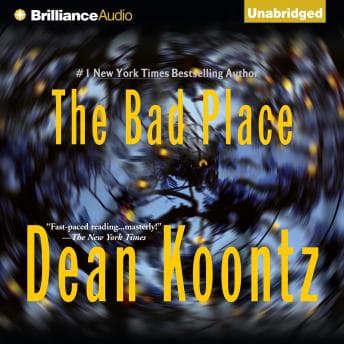

Three AM in the trauma bay, waiting for a transfer that's running late, and I'm listening to a man wake up with blood on his hands and no memory of how it got there. The irony wasn't lost on me. I've seen patients come in with that exact scenario - confused, covered in blood, terrified - and let me tell you, Koontz gets the disorientation right. That bone-deep panic of not knowing what your own body did while you were checked out.
I've been a Koontz reader since my twenties, back when I was still idealistic enough to think night shift would get easier. (It doesn't. You just get better at functioning on caffeine and spite.) This one's from his late-80s era, and it shows - in good ways and frustrating ones.
When Your Patient Is Also Your Mystery
Frank Pollard is the kind of case that would have me calling psych consult and neurology simultaneously. Waking up in alleys, finding strange objects in his pockets, blood under his fingernails. The husband-and-wife detective team, Bobby and Julie Dakota, take his case out of compassion, which - okay, that's not how private investigation works, but I'll allow it. Their dynamic is solid. Real partnership energy. They bicker like people who actually live together, not like characters written to seem married.
What got me was Thomas, Julie's brother with Down syndrome. Koontz writes him with genuine tenderness without making him a prop. Thomas understands death as "the bad place" - simple, profound, and honestly? After fifteen years of codes and comfort care, I think he's onto something. The way the book circles back to that concept, making you realize the living can create places just as bad as death - that hit different at 4 AM when the unit was too quiet.
The plot gets complicated. Like, "I had to rewind because I was also charting" complicated. There's teleportation, psychic connections, a villain with abilities that escalate into genuinely disturbing territory. Koontz doesn't hold back on the body horror. Some scenes made me wince, and I've done wound care on things that would make most people pass out.
The Tag-Team Narration Situation
Here's where I'm going to be honest: the dual narration is a mixed bag. Michael Hanson handles his sections with solid intensity - good pacing, emotional when it needs to be. The tag-team approach where each narrator takes different points of view actually helps with a plot this tangled. You always know whose head you're in.
Carol Cowan, though. Look, I've worked with doctors who have that exact vocal quality - competent, knows it, lets you know she knows it. Some listeners are going to find her delivery grating. I can see it. There's a certain... confidence that reads as arrogance if you're not in the mood for it. But honestly? After dealing with actual arrogant people all shift, her narration didn't bother me. She commits to the performance. The intensity matches the material.
The alternating voices do help with the complicated plot. When you're switching between Frank's fragmented consciousness, the Dakotas' investigation, and the villain's perspective, having distinct narrators keeps you oriented. Not a full-cast production - no sound effects, no music - just two people reading their assigned sections with conviction.
Who's Going to Love This (And Who Should Run)
This is for Koontz fans who want him at his weird, ambitious best. If you've only read his more straightforward thrillers, this might throw you - there's supernatural elements that go hard. The pacing demands attention. Not a background listen. Not for when you're doing anything that requires actual thought. Blowback has that same intensity - you miss one detail and suddenly you're lost in the conspiracy.
Skip this if you need your medical details accurate. There's some hospital stuff that made me mutter at my steering wheel. (No, that's not how sedation works. No, you can't just - you know what, never mind.) Also skip if you're sensitive to violence against vulnerable characters. Koontz goes there.
Perfect for that post-shift decompression when you need something absorbing enough to push the night's cases out of your head but dark enough to match your mood. The fifteen-hour runtime means you're committing to this one - took me almost two weeks of drives home.
Night Shift Approved, With Caveats
This is solid Koontz. Not his absolute best, but far from his worst. The core concept - what if your body did terrible things while you slept - taps into something primal. Haunted plays with similar psychological horror, that fear of what lurks in the parts of ourselves we can't control. The Dakotas are a couple you actually root for. Thomas stays with you long after the book ends.
The narration controversy is real. You might love Cowan, you might want to throw your phone out the window. There's no predicting which camp you'll fall into. But the story underneath is worth the gamble.
Carlos asked why I was sitting in the driveway for an extra ten minutes last Tuesday. I told him I needed to hear how a scene ended. He's learned not to ask follow-up questions about my audiobooks. Smart man.