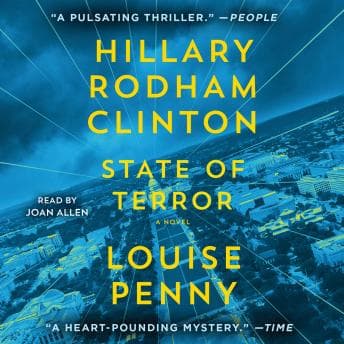

Can a political thriller written by an actual former Secretary of State deliver the goods, or does insider access just mean a fancy pedigree on the cover?
Let me cut to the chase: State of Terror is a solid piece of work. Not flawless, but it kept me engaged through a week of airport layovers and client meetings in Houston. When you've spent time in actual crisis situations, you develop a pretty good BS detector for how authors handle high-stakes scenarios. Clinton and Penny mostly pass muster here.
The Insider Advantage Actually Works
Here's what surprised me - the political machinery feels authentic. The way State Department cables move, the bureaucratic friction between agencies, the delicate dance of international diplomacy when everything's on fire. I've sat in enough joint operations briefings to recognize when someone's done their homework versus when they're just making stuff up from watching CNN. This reads like the real thing, probably because half of it came from someone who lived it.
The premise is smart: new administration inherits a mess after four years of diplomatic neglect. A new Secretary of State - Ellen Adams - has to rebuild relationships and capabilities while simultaneously dealing with an escalating terrorist threat. The chess game involving Pakistan, Afghanistan, Iran, and Russian mob connections? That's not far-fetched. I've seen similar scenarios in classified briefings (minus the mob part, usually).
The young FSO Anahita Dahir is a good entry point for readers who don't know a SITREP from a SALUTE report. She's competent without being a Mary Sue, which is refreshing.
Joan Allen's Narration - A Mixed Bag
Alright, here's where I have to be honest. Joan Allen's voice for Ellen Adams is perfect. There's this quality - a certain measured intelligence with just enough edge - that works beautifully for a powerful woman navigating impossible situations. Some listeners have noted she sounds like Hillary Clinton herself. I can see that.
But.
When you've got a cast of characters spanning three continents, multiple government agencies, and various bad actors, you need more vocal differentiation than Allen provides. I found myself rewinding more than once to figure out who was talking. During a particularly complex scene in Islamabad, I actually had to stop the car and focus because I'd lost track of which Pakistani official was speaking.
For a 15-hour audiobook with this many moving pieces, that's a problem. Not a fatal one, but it requires more attention than your average commute allows. I ended up saving some sections for when I could really focus - not ideal for a thriller that should propel you forward.
Where It Drags and Where It Flies
The pacing is generally solid. The opening hits hard, and there are genuine gut-punch moments throughout. But there's also some middle-section bloat where the authors seem more interested in showing off their knowledge of diplomatic protocol than keeping the tension tight. I ran into a similar pacing issue with Circular Staircase - strong setup, but too much meandering in the middle. I get it - when you have Clinton's Rolodex of experiences, you want to use them. But a few scenes could've been trimmed.
The climax, though? Worth the investment. The conspiracy comes together in a way that feels earned rather than convenient. And there's a twist involving a character I won't name that actually got me to say "well, damn" out loud. Ranger looked at me like I'd lost my mind.
(Speaking of which - Ranger was less interested in this one than usual. He prefers books with more action sequences and fewer diplomatic cables. Can't blame him.)
The Political Elephant in the Room
Look, I'm going to address this directly because you're probably wondering: yes, there's a political perspective here. The previous administration in the book is clearly not portrayed favorably. If that's going to ruin the experience for you, you should know going in.
But here's my take after 25 years of serving under presidents from both parties - the critique of diplomatic neglect isn't partisan, it's professional. I've seen what happens when we pull back from international engagement. The consequences described in this book aren't fantasy. They're extrapolation.
Take that for what it's worth.
SITREP
State of Terror delivers a competent, insider-informed thriller that respects your intelligence. Joan Allen's narration is excellent for the main character but struggles with the ensemble cast. At 15+ hours, it demands attention - this isn't background listening.
Who should listen: If you're into political thrillers with actual geopolitical substance, this one's for you. Who should skip: If you want pure action without the diplomatic chess, look elsewhere.
I'd recommend bumping the speed to 1.25x during the slower diplomatic passages - it helps maintain momentum without losing content.
Ranger's verdict: he fell asleep during a lengthy scene about nuclear inspection protocols. Can't say I blame him. But he perked up for the finale, so there's that.