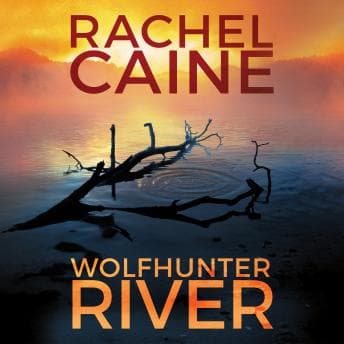
Look, I need to rant about something before we get into this. Gwen Proctor - a woman who escaped a serial killer husband, who has internet vigilantes actively hunting her family - decides to pack up her kids and drive to a town literally called Wolfhunter. WOLFHUNTER. The name alone should be a flashing neon sign that says "turn your car around." I was shelving returns at the library when this decision happened in my earbuds, and I actually stopped mid-Dewey Decimal to whisper "no" at a cart of picture books.
But here's the thing. That's exactly what makes Gwen Proctor work as a protagonist. She's not stupid - she's stubborn in the way that only someone who's survived the absolute worst can be. She's already lived through the nightmare scenario. What's one more small town full of secrets?
The Town With the Name That Should've Been a Warning
Rachel Caine understood something crucial about horror-adjacent thrillers: setting IS character. Wolfhunter River as a location does the heavy lifting that a lesser writer would've needed three chapters of exposition to accomplish. It's remote, it's insular, and the moment Gwen arrives to find Marlene Crockett already dead - with Marlene's own daughter being blamed - you feel the walls closing in. Murder at an Irish Bakery does something similar with village insularity, though the body count there comes with considerably more scones and considerably less dread. The isolation isn't just geographical. It's social. It's the way small towns can close ranks around their own darkness.
This is book three in the Stillhouse Lake series, and Caine's not interested in letting her characters breathe easy. The internet stalkers pursuing Gwen aren't some abstract threat - they're a persistent, suffocating presence that follows her into this already hostile environment. Two predatory forces converging on one family. It's claustrophobic in the best way.
Where it stumbles - and I felt this around the middle stretch - is pacing. There are sections where the tension should be ratcheting up but instead plateaus. The plot mechanics of investigating Marlene's death while simultaneously dodging online threats sometimes compete rather than complement each other. I found myself wishing Caine had trusted the Wolfhunter mystery enough to let it breathe without constantly cutting back to the stalker subplot.
Four Narrators, Four Perspectives, One Family That Can't Catch a Break
The multi-narrator format here is the real draw for the audio version. Dan John Miller handles the weight of Sam Cade's perspective with a kind of measured intensity - he's the steadying presence in a story that desperately needs one. Emily Sutton-Smith's Gwen carries the lion's share of emotional labor, and she nails the specific exhaustion of a woman who's been running for so long that fight mode is just her default state. There's a family bonding scene - I won't spoil the specifics - where Sutton-Smith's delivery genuinely caught me off guard. The tenderness felt earned, not performed.
Lauren Ezzo as Lanny and Will Ropp as Connor bring the younger perspectives to life in a way that avoids the trap of making teen characters sound like adults doing teen impressions. Ezzo in particular captures something about adolescent fear that's distinct from adult fear - it's rawer, less filtered, more immediately visceral.
The narrator commits. That's rare. All four of them, actually. Having each character voiced by their own narrator means you never lose track of whose head you're in, which matters when the story is juggling this many threat vectors simultaneously.
Shirley Jackson Walked So We Could All Be Paranoid in Small Towns
I listened to most of this during a late shift at the library, after the building was technically closed. Empty stacks, flickering fluorescents, a thriller about a woman trapped in a hostile small town playing through my headphones. My cat Shirley would've judged me. She always does.
The thing about Wolfhunter River is that it operates in that specific thriller space where horror is never quite supernatural but the dread is absolutely real. The internet stalkers represent something genuinely terrifying about modern life - the impossibility of disappearing, the weaponization of information, the way anonymous hatred can become physical danger. Caine wasn't writing horror, but she was writing something that understands horror's core principle: the monster you can't see is worse than the one you can.
Is it flawless? No. Some character decisions strain credibility (again: WOLFHUNTER), and the middle act sags. But when the trap finally snaps shut in the final hours, Caine delivers. The convergence of threats pays off in a way that had me genuinely tense.
Who Needs This in Their Ears
If you've been following the Stillhouse Lake series, this is essential - the character development across three books is the real reward. If you're new, start at book one. Jumping in here would be like walking into a room mid-argument. For thriller fans who want their suspense grounded in real-world horror rather than supernatural elements, this scratches that itch. If you scare easily, you'll be fine - this isn't that kind of fear. It's the slow, creeping kind. The "checking your locks twice" kind.
The Catalog Card
Solid mid-series entry with a killer (literally) setting and a four-narrator team that earns every minute of your attention. The pacing wobbles but the payoff lands. My podcast listeners are going to love debating whether Gwen's choices are brave or reckless - I'm still not sure myself, and I've had twelve hours to think about it.