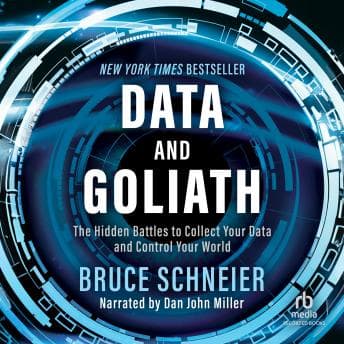

Look, I get it. Another book about how tech companies are harvesting our data like we're some kind of digital crop. I've read the blog posts, I've sat through the company security trainings, I've nodded along to coworkers ranting about Cambridge Analytica. So when I started Data and Goliath, I was fully prepared to zone out after the first hour.
I was wrong. Bruce Schneier made me paranoid in ways I didn't expect, and honestly? That's exactly what I needed.
The Security Expert Who Actually Explains Things
Schneier isn't just some journalist who read a few papers and decided to write a scary book. The guy is a Harvard fellow and genuine security researcher, and it shows. He breaks down the surveillance ecosystem - government, corporate, the weird symbiosis between them - with the kind of clarity that makes you realize how much you didn't actually understand before.
Here's what got me: I work in distributed systems. I debug production issues involving data flows all the time. And yet there were moments in this book where I went "wait, THAT'S how they're doing it?" The technical explanations are accessible without being dumbed down. Schneier respects your intelligence while acknowledging you might not have a security background. Perfect balance.
The book is from 2015, which means some specifics are dated - we're post-Snowden, pre-TikTok panic - but the frameworks he lays out? Still completely relevant. Maybe more relevant. The fundamental dynamics haven't changed, they've just gotten worse.
Dan John Miller's Voice in My Head
Okay, so Dan John Miller. Multiple Audie Awards, AudioFile Earphones Awards, the whole deal. And yeah, he's good. Clear, crisp, warm enough that you don't feel like you're being lectured at for 9+ hours. The guy makes dense policy discussions sound almost conversational.
But I'll be honest - there were stretches where I had to bump up to 1.75x because the pacing felt a bit... subdued? Like, Miller is technically excellent, but when you're deep in chapter six about metadata analysis and the delivery stays at the same measured tempo, your brain can start to wander. Especially at 6:47 AM when you're sardined into a Caltrain car and someone's breakfast burrito is waging chemical warfare on your nostrils.
This isn't a narration problem so much as a genre problem. Dense nonfiction needs a certain energy to keep you locked in, and Miller's style is more "warm professor" than "urgent TED talk." Some listeners apparently found him difficult to listen to - I didn't have that issue, but I can see how his measured approach might not work for everyone.
The Paranoia That Pays Off
What I appreciated most: Schneier doesn't just scare you. He gives you frameworks for thinking about surveillance, privacy, and data collection that actually apply to real decisions. The ROI on this audiobook is high if you're in tech, work with data, or just want to understand why you should care about privacy even if you "have nothing to hide." (Schneier demolishes that argument, by the way. Thoroughly.)
The book is dense with facts and examples. This is not a narrative-driven thriller about a whistleblower; it's a systematic breakdown of how we got here and what it means. I had a similar experience with Short History of Nearly Everything - another dense, fact-heavy audiobook that rewards your attention with actual understanding instead of just entertainment. If you're looking for a story, skip this. If you want to actually understand the surveillance landscape - government and corporate, domestic and international - this is your book.
I finished it in about four commutes, running at 1.5x most of the way. Perfect for the train because you can zone out for a minute during a dense section and still pick up the thread. Not great for the gym - too much cognitive load when you're trying to remember what rep you're on.
Who Should Listen (And Who Should Skip)
Perfect for: anyone in tech who wants to understand the bigger picture of data collection, privacy advocates who want ammunition, curious people who want to understand why surveillance matters even if they're not "doing anything wrong."
Skip if: you want a gripping narrative, you're looking for something light, or you already work in security and have read Schneier's other stuff (though even then, the audiobook format might give you new insights).
The production is clean, no weird audio issues, no awkward edits. Just Schneier's arguments delivered clearly by a competent narrator.
I came out of this more paranoid about my own company's data practices than I was before. And given that I literally work at a FAANG, that's saying something. Kevin thinks I'm being dramatic. Kevin also still uses the same password for everything, so his opinion is noted and discarded.





![Steve Jobs [unabridged audiobook] audiobook cover](/_next/image?url=https%3A%2F%2Fcovers.audiobooks.com%2Fimages%2Fcovers%2Ffull%2F9788499923406.jpg&w=1920&q=75)