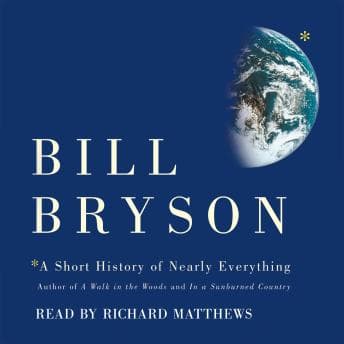

Okay, so here's the thing about 18-hour nonfiction audiobooks: they're either the best commute investment you'll ever make, or they're a slow descent into madness where you zone out somewhere around hour 4 and never recover. A Short History of Nearly Everything? Firmly in the first camp. I finished this across maybe two weeks of commutes and honestly, I'm a little sad it's over.
Bill Bryson basically decided to explain... everything. The Big Bang, plate tectonics, evolution, quantum physics, the discovery of cells, why we haven't been hit by an extinction-level asteroid lately (luck, mostly - sleep well tonight). And somehow he makes all of it not just digestible but genuinely entertaining. This is the book I wish I'd had in high school instead of those textbooks that seemed designed to make science as boring as humanly possible.
The real magic here is Bryson's approach. He's not just explaining the science - he's telling you about the absolute weirdos who discovered it. And I mean that affectionately. Scientists throughout history have been petty, obsessive, occasionally terrible people who also happened to unlock the secrets of the universe. Newton was apparently insufferable. The guy who figured out the age of the Earth got zero credit during his lifetime. There's a section about the scientists who studied lead poisoning that reads like a thriller. Bryson finds these human stories everywhere, and they're what keep you hooked through discussions of atomic weights and geological epochs.
Now, Richard Matthews. I'll be honest - when I saw it wasn't Bryson narrating his own work, I was skeptical. (I know there's an abridged version he reads himself, but 18 hours of unabridged content wins every time for me.) But Matthews absolutely nails it. That British accent is basically made for this kind of material - warm, a little wry, the kind of voice that makes you feel like you're having a really good conversation at a pub with someone way smarter than you. He handles Bryson's humor perfectly, landing the dry observations without overselling them. And when the material gets heavier - the mass extinctions, the scientists who died for their discoveries - he shifts tone just enough that you feel it.
The pacing is genuinely impressive for something this long. Some sections flew by (anything about space, the history of evolution, the truly unhinged stories about early paleontologists stealing each other's fossils). A few chapters on chemistry and particle physics required more focus - I definitely rewound a couple times during my 6AM zombie hours. But that's more about the inherent complexity of the material than any failure of the narration. Matthews keeps things moving even when Bryson is explaining why we can't actually see atoms.
Who Should Listen (And Who Should Skip): Perfect for train rides, long drives, any commute where you want to feel like you're actually learning something. The ROI on this audiobook is ridiculous - I came out of it understanding plate tectonics, the Cambrian explosion, and why we're all basically walking bags of ancient stardust. Skip if you need something for deep work sessions where you're concentrating on other tasks. This demands enough attention that you'll want to actually listen, not just have it as background noise.
A few caveats: the book came out in 2003, so some of the science is dated. We've learned more about human evolution, updated some climate projections, discovered new things about the universe. But the fundamentals hold up, and honestly, the history-of-science angle means it doesn't matter that much. The story of how we figured things out doesn't change even when the details get refined.
That same sense of awe—mixed with slightly uncomfortable wonder—is what I loved about Promised Land, though Obama's approach is obviously more personal and less cosmic.
Also, fair warning: this book will make you feel very small and very temporary. In a good way? Mostly? Bryson has this gift for conveying the absolute absurdity of existence - the fact that we're here at all, on this particular rock, at this particular moment, is statistically bonkers. I had a minor existential crisis somewhere around hour 12 (the mass extinction chapters will do that to you), but I recovered.
I finished this in maybe 12 commutes, listening at 1.5x. Matthews' pacing is natural enough that speeding up works fine - his delivery is clear and doesn't get muddy. Could probably push to 1.75x if you're familiar with the material, but I wanted to actually absorb things.
Bottom Line: Worth your commute. Absolutely. This is basically a really good podcast series about the history of science, but coherent and well-structured and narrated by someone with a genuinely lovely voice. If you have any curiosity about how the universe works and the bizarre humans who figured it out, this is 18 hours extremely well spent.





![Steve Jobs [unabridged audiobook] audiobook cover](/_next/image?url=https%3A%2F%2Fcovers.audiobooks.com%2Fimages%2Fcovers%2Ffull%2F9788499923406.jpg&w=1920&q=75)