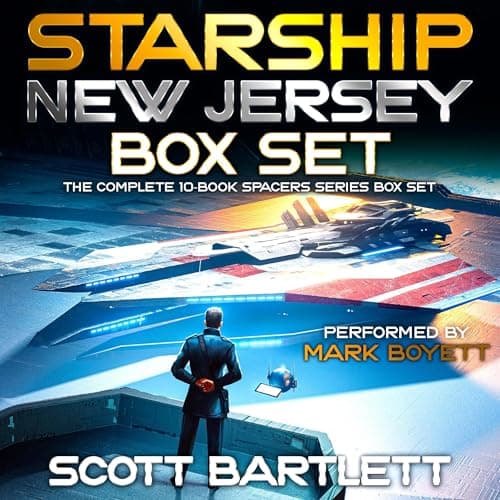

Who actually commits to 68 and a half hours of one series back to back? Me, apparently, at 2AM on a Tuesday, ring light glowing behind me while I'm batch-editing BookTok thumbnails and questioning every decision that led me here.
But listen - the Starship New Jersey box set is basically the audiobook equivalent of that one anime your friend won't stop recommending until you finally cave and then you're six seasons deep at 4AM going "okay fine, I get it now."
Tad Thatcher is Giving Main Character Energy (Finally)
So the premise is pretty straightforward - young dude Tad Thatcher grows up idolizing his starship captain grandfather, trains his whole life, gets his own command, and then boom - humanity's worst nightmare comes back after 50 years of peace. Classic setup, right? But here's what got me: Scott Bartlett doesn't just give you one arc across ten books. Thatcher starts as this eager, almost naive officer in First Command and by the time you hit Thatcher's Gambit (book 6), the way he processes tactical decisions has fundamentally shifted. You can hear the weight in how Boyett delivers his internal monologue differently - less wonder, more calculation. That character evolution across 68 hours? It actually lands.
The space battles are where Bartlett really does his thing. Like, I was at the gym doing leg press during the fleet engagement in Fleet Action and I literally forgot to count reps because the pacing of that battle sequence had my heart rate higher than the actual exercise. Bartlett writes military sci-fi combat the way it should be - you understand the stakes, you understand the geometry of who's where, and you feel when things go sideways. There's this moment where Thatcher has to make a call that sacrifices part of his fleet, and the silence Boyett leaves before the order? Chef's kiss.
Mark Boyett at 2.0x - The Verdict on 68 Hours of One Voice
Okay, real talk. Single narrator. Ten books. 68 hours. That is a LOT of Mark Boyett in your ears. And honestly? He's solid. Not the kind of narrator who's doing five distinct accents and making you forget it's one person - but he's consistent, his pacing is good, and he handles the tonal shifts between political scheming and combat sequences without dropping the ball. Bump to 2.0x immediately - at 1.0x his delivery is a little too measured for my brain, but at double speed he hits this sweet spot where the battle scenes feel genuinely urgent.
Where Boyett struggles a bit is distinguishing between secondary military characters. When you've got three or four officers in a bridge scene trading tactical dialogue, it can get muddy. I had to rewind a couple times during Wartorn Cluster because I genuinely lost track of who was speaking. Not a dealbreaker, but it's noticeable when you're deep into the series and the cast keeps expanding.
The Ten-Book Marathon Problem (And Why It Still Works)
Let me be honest - not all ten books hit the same. The middle stretch around books 4-5 (The Fall and Empire Space) has this political setup energy that slows the momentum. It's the part where Bartlett is clearly building toward something bigger, and if you're the type to DNF when things get talky, this is where you'd be tempted. I pushed through because I was already invested, and Thatcher's Gambit rewards that patience hard. The back half of this series - books 7 through 10 - is where Bartlett goes full send. Dawn War and Storm Break especially have this escalating stakes energy that had me literally sitting in my parked car refusing to go inside until the chapter ended.
The box set format is actually perfect for this series because the individual books are clearly written to be consumed in sequence. Cliffhangers between books that would've had me screaming if I had to wait for the next release? Now they're just chapter breaks. The value proposition is wild - 68 hours for one credit is basically robbery.
But here's the thing I keep coming back to: this is military space opera comfort food. It's not trying to reinvent the genre. The alien threat is familiar, the command structure drama is familiar, the "one captain against impossible odds" framework is familiar. Bartlett just executes it really well across a massive canvas. Think of it like a ten-season show where you know the formula but the characters keep you coming back.
Who Gets This Credit and Who Keeps Scrolling
If you're the kind of listener who wants 68 hours of consistent, action-driven space opera with a protagonist who actually grows across the series - this is your jam. Military sci-fi fans who loved binging long series and don't mind a slower political stretch in the middle? Run, don't walk. But if you need every book to be a standalone literary event with groundbreaking worldbuilding, you'll probably get frustrated by book 3. Same if you can't vibe with a single narrator for this long - Boyett's good, but 68 hours is a commitment.
The spice level? Zero. This is not that kind of series. (My romantasy-obsessed heart weeps but my sci-fi brain is fed.)
Speaking of feeding that romantasy heart though - Leia, Princess of Alderaan scratched a similar space epic itch for me when I needed something with a little more emotional core to it.
The 2AM Final Word
Sixty-eight hours later, my Audible stats look unhinged, my gym playlist has been replaced by space battles, and I regret nothing. Bartlett wrote a marathon, not a sprint, and if you're willing to commit? The payoff in that final trilogy of books is genuinely satisfying. Not every book earns its runtime, but the series as a whole? Worth the ride.









