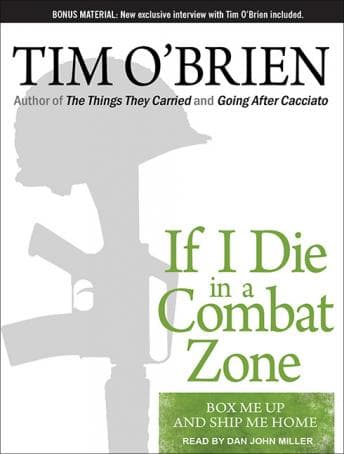

Tim O'Brien wrote this before he was Tim O'Brien. Before The Things They Carried made him required reading for every college lit class. This is the raw version - a 22-year-old kid from Minnesota who didn't want to go to Vietnam, went anyway, and came back with something he had to get out of his system before it killed him.
I listened to most of this on a Sunday morning while my parents were visiting. My dad was in the kitchen making doenjang jjigae, telling the same story he always tells about the dry cleaning business's worst year. And I had one earbud in, listening to O'Brien describe walking minefields in Quang Ngai Province, wondering if the next step would be his last. The contrast was not lost on me. Two different kinds of survival. Both completely real.
What a 22-Year-Old Foot Soldier Understood That MBAs Don't
Here's what this book is actually about: the gap between what institutions tell you and what reality delivers. O'Brien was told this war was necessary. He was told courage meant going. He was told that doubt was weakness. None of it held up in the field. The chapter on 'Bouncing Betty' mines - where he describes the particular horror of a mine that jumps to groin height before detonating - isn't just war writing. It's a case study in how systems send people into situations where the information they were given is worse than useless.
This is what my parents did instinctively. Now it has a TED talk. They never trusted the official story about what it took to run a small business in America. They learned from the ground. O'Brien learned the same way, at much higher cost.
The book is also genuinely short for what it contains. Five hours and forty-seven minutes. No padding. No chapter that exists to justify the advance. O'Brien says what he needs to say and stops. I've read business books three times this length that delivered a third of the insight. The only other book I've reviewed recently that earns its runtime this completely is Boys in the Boat, which also has no business being as gripping as it is given how well you already know the ending. The section where he explores what 'truth' even means in combat - whether the true war story can ever be told straight - is the kind of thinking that makes you pause the audio and just sit with it for a minute. And I don't pause audio.
The Dan John Miller Question
Okay, the narrator. Divisive, apparently. I get it.
Miller has a quality that some listeners described as 'Eeyore voice' - a kind of measured, slightly mournful delivery that doesn't vary much in register. Here's my take: for this specific book, that's actually correct. O'Brien isn't a triumphant narrator. He's not processing his Vietnam year from a place of resolution. He's still in it, emotionally, even decades later. A voice that sounds like it's carrying weight is the right voice for material that IS weight.
That said - if you need vocal fireworks to stay engaged, this will test you. Miller's character differentiation is real (I also had to double-check it was one narrator after he shifted into a Vietnamese officer's voice), but his baseline register is low and deliberate. At my standard 2.0x it actually worked fine - tightened the pacing without losing the gravity. I'd actually recommend 1.5x here rather than my usual speed. This is one of the rare books where you want to slow down just enough to feel the weight of individual sentences.
The brief O'Brien interview at the end? Skip it. Adds nothing the book didn't already say better.
The ROI on This One
Bottom line: this is not a business book. It's not self-help. It's not going to give you a framework or a matrix or three actionable takeaways. What it will do is recalibrate your sense of what actually matters - which, if you're a consultant or a founder or anyone who spends time optimizing systems, is occasionally necessary maintenance.
I've seen leaders make catastrophic decisions because they trusted the institutional narrative over what the ground was telling them. O'Brien at 22, in a rice paddy, figured out something about institutional failure that some executives never learn. That's worth five hours and forty-seven minutes of your time.
Jenny would say I'm being harsh on the narrator. Jenny is right. He's not for everyone. But the book is.