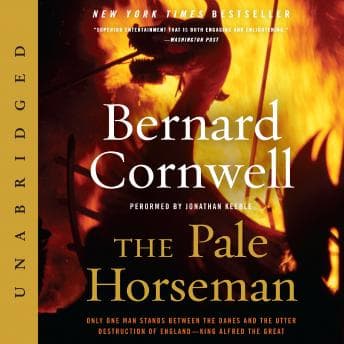
What makes a man choose his enemies over his blood? It's the question at the heart of The Pale Horseman, and honestly, it's the question that kept me walking an extra mile around the lakefront when I should've been home grading essays.
Bernard Cornwell has this gift—and I don't use that word lightly—for making you feel the mud between your toes and the weight of a shield on your arm. But here's what struck me about this second installment: it's not really about the Vikings versus the Saxons. It's about identity. Uhtred is caught between two worlds, raised by Danes but bound by birth to Wessex, and Cornwell refuses to give us easy answers. My students would probably say he's "problematic" for not picking a side. I'd argue that's exactly why this works.
Jonathan Keeble Understands the Assignment
Look, I've listened to a lot of historical fiction narrators who think "dramatic" means shouting during battle scenes. Keeble doesn't fall into that trap. His Uhtred has this burly, weathered quality—sounds like a man who's seen too much and drunk too much mead to process it all. The character differentiation? Genuinely impressive. Alfred sounds appropriately pious and calculating. The Danish warriors sound like men who'd rather die laughing than live bowing.
What really got me was the pacing. Cornwell writes action sequences that could easily become exhausting over fourteen hours. Keeble knows when to push and when to let a sentence breathe. There's a moment—I won't spoil it—where the narrative shifts from chaos to something almost elegiac, and Keeble nails that transition. The pause is punctuation. The author chose those words, and Keeble chose to honor them.
(I may have missed my turn twice during that sequence. Denise was not amused.)
The Slow Burn That Earns Its Fire
This is where I need to be honest with you. If you're looking for constant action, The Pale Horseman will test your patience in the middle sections. Cornwell spends time—real time—on Alfred's character, on the political maneuvering, on the slow degradation of Wessex before the Vikings strike. Some listeners will find this tedious.
I found it essential.
Because when the overwhelming horde attacks out of that wintry darkness, you understand what's at stake. You've lived in that world. The battle scenes hit harder because you've earned them. This is something I try to explain to my students about Dickens—the setup matters. The context matters. Cornwell gets this instinctively.
The violence is graphic, I should mention. Not gratuitous, but unflinching. If you're sensitive to battle descriptions, maybe sample first. But Cornwell never feels exploitative about it. This is what war was. This is what men did to each other with axes and spears.
Where This Fits in the Canon
I've been thinking about how The Pale Horseman compares to other historical fiction I've taught and loved. It's sharper than most Follett, funnier than Mantel, more accessible than Eco. It has that same meticulous attention to historical detail I found in Radium Girls: The Dark Story of America's Shining Women, though Moore's focusing on twentieth-century injustice rather than medieval warfare. Cornwell writes with the pacing of a thriller novelist but the research depth of an academic. The man knows his Anglo-Saxon history, and more importantly, he knows how to make you care about it.
If you loved The Last Kingdom (the first book), this is its spiritual successor in the best way—same DNA, higher stakes, deeper character work. If you're coming from Game of Thrones and want something "like that, but real," as The Observer put it, this delivers. The political scheming is there. The moral ambiguity is there. The difference is these people actually existed.
Who's This For (And Who Should Skip It)
If you have patience for political buildup and want your battle scenes earned rather than constant, you'll love this. Skip it if you need nonstop action or can't stomach graphic medieval violence—Cornwell doesn't flinch, and neither does Keeble.
Already Planning the Reread
Here's my confession: I'm already planning to restart the series from the beginning over summer break. Fourteen hours per book, thirteen books in the series—that's a commitment. But Keeble's narration makes it feel like time well spent rather than time passed.
My students would hate this. Too slow. Too historical. Too many characters with names like Æthelwold and Guthrum. I love it. This is why we still read the classics—or in this case, what I suspect will become a classic of the genre.
Worth pausing the faculty meeting for. (Sorry, Principal Martinez. I definitely wasn't listening to Vikings sack a monastery during your budget presentation. Definitely not.)
One note of sadness: apparently Keeble doesn't narrate all the books in the series. I'm already mourning that transition. When you find a narrator who truly understands the material, losing them feels like losing a friend.