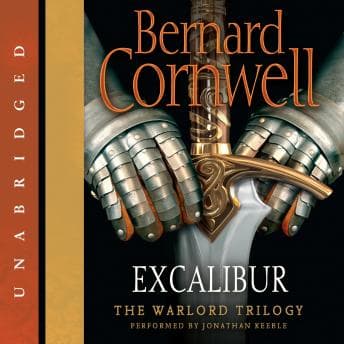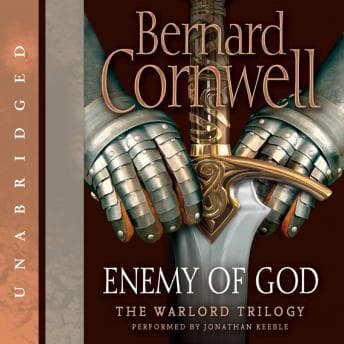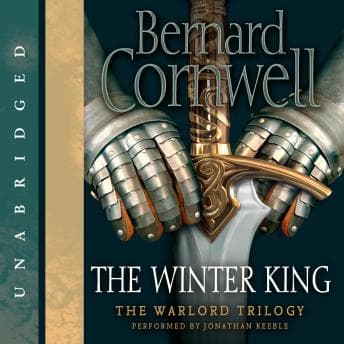

"I am Derfel Cadarn, and this is my tale."
That's how it starts — or close enough. An old monk, scratching his memories onto parchment in a cold monastery, telling the story of Arthur not as legend but as a man he actually knew. And something about the way Jonathan Keeble delivers that opening frame, quiet and weary and full of a lifetime's worth of remembering, made me set down my red pen mid-sentence. I was grading sophomore essays on The Great Gatsby at 11 PM. Fitzgerald would have to wait. Derfel had me.
The Arthur Your Literature Professor Never Taught You
I've taught the Arthurian legends in various forms for twenty years. Malory. Tennyson. T.H. White. The sanitized, chivalric, round-table-and-holy-grail version that makes for nice unit plans and predictable essay prompts. Cornwell throws all of that into a ditch somewhere in fifth-century Britain and sets it on fire.
This is Arthur as a warlord in a world that smells like mud and blood and wood smoke. There's no Camelot — there's a series of hill forts and Roman ruins slowly crumbling into the landscape. Guinevere isn't a passive damsel; she's sharp-tongued, politically ambitious, and genuinely dangerous in ways that made me think of Lady Macbeth more than any traditional Arthurian queen. Merlin is terrifying. Not the kindly wizard. Terrifying. He collects skulls and speaks in riddles that feel less whimsical and more like the pronouncements of someone who might actually be insane.
This reminds me of what Hemingway said about writing — that the dignity of movement of an iceberg is due to only one-eighth of it being above water. Cornwell gives you the visible eighth in visceral detail, but the weight underneath is this careful, almost scholarly reconstruction of post-Roman Britain. The politics between the British kingdoms, the tension between Christianity and the old Druidic religion, the desperate attempt to hold together a civilization that's already half-collapsed. My students would hate this. I love it.
Keeble Understands That Silence Is Punctuation
Twenty hours is a commitment. I won't pretend otherwise. And yes, the first few hours are dense — you're meeting Derfel, learning the political landscape of Dumnonia, sorting through a cast of characters with names like Gundleus and Owain and Nimue that all blur together if you're not paying attention. I almost lost the thread during a lakefront walk with Denise when she started talking about her sister's kitchen renovation right as Cornwell was laying out the succession crisis. (Sorry, Denise. Sorry, kitchen.)
But here's where Keeble earns his keep. His narration doesn't just carry you through the slow stretches — it makes them feel intentional. He reads Derfel's retrospective voice with this quality of — I don't know how else to describe it — earned sadness. Like a man who knows exactly how the story ends and is taking his time because the telling is all he has left. The prose deserves to be savored, and Keeble clearly agrees.
His battle scenes are something else entirely. The energy shifts completely. There's a ferocity to how he handles the combat sequences that genuinely startled me during a faculty meeting. (Principal Martinez, I promise I flinched because of a budget line item and not because of a Saxon shield wall. Mostly.)
I do wish I could point to more specific vocal choices for individual characters — Keeble's differentiation is more about energy and intent than distinct accents or vocal tricks. Arthur sounds steady and warm. Merlin sounds like someone you'd cross the street to avoid. But some of the secondary characters blend together vocally in a way that compounds the early confusion with all those unfamiliar names.
Who This Is Really For
If you loved Mary Renault's Greek novels or Hilary Mantel's Wolf Hall — books that take a familiar historical figure and strip away the myth to find the human — this is their spiritual successor for the Arthurian tradition. The Count of Monte Cristo does something similar with Dumas's revenge tale, peeling back the theatrical flourishes to find the raw human cost underneath. If you want magic swords and jousting tournaments, you'll be disappointed. If you want to understand why a man might fight to hold together a crumbling world even when he knows it's hopeless — well. That's the book.
The pacing is genuinely slow in places. This is a 20-hour listen that could probably be 15 without losing much. Edge has a similar density issue — brilliant when it hits, but you earn those moments through stretches that demand real commitment. Some of the political maneuvering in the middle third tested my patience, and I'm a guy who voluntarily listens to Middlemarch. But when Cornwell hits — and he hits hard in the final quarter — you understand why he took his time. The payoff needs the buildup.
Fair warning: this is violent, occasionally sexual, and unflinching about the brutality of the period. Not gratuitous, but not shy about it either.
Worth Pausing the Faculty Meeting For
I finished this one on a Sunday morning walk, Lake Michigan flat and gray, and I just stood there for a minute after the last line. Not because of some dramatic twist. Because Cornwell had done what the best historical fiction does — he made me feel the weight of time passing, of stories being told and retold until the truth gets buried under legend. And then he dug it back up.
This is why we still read the classics. Even when someone rewrites them from the mud up.