
What makes a legend endure for fifteen centuries?
I was grading senior essays on Beowulf at 11:47 PM—the usual parade of students discovering that, yes, monsters can be metaphors—when Keeble's voice dropped into that final battle at Camlann. I stopped mid-red-pen. Just sat there in the kitchen light, coffee going cold, listening to Arthur's world collapse.
This is why we still read the classics. Or in this case, listen to them.
The Narrator Understands That Pause Is Punctuation
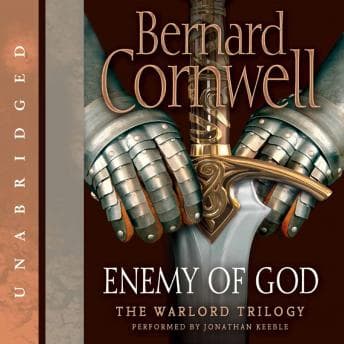
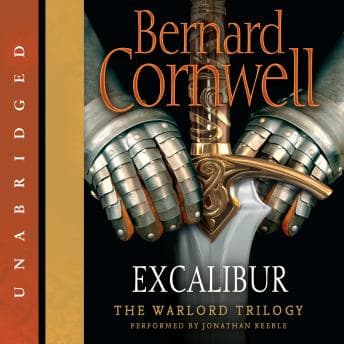
Jonathan Keeble doesn't read Bernard Cornwell's prose. He performs it like a man who's studied the weight of every sentence. His Derfel—our aging warrior narrator looking back on glory days—carries this bone-deep weariness that's earned, not affected. When Derfel describes watching Arthur ride into battle, Keeble's voice lifts with something like religious awe. When he recounts betrayal, there's a crack in the delivery that feels genuinely wounded.
But here's where Keeble really earns his four AudioFile Earphones Awards: the differentiation. His Arthur has this quiet authority, almost reluctant—the voice of a man who never wanted to be a legend but can't escape it. Mordred, the crippled king who owes Arthur everything and repays him with treachery, gets this sniveling, entitled edge that made me want to throw my phone across the room. And Nimue—Merlin's former protégé turned bitter enemy—sounds genuinely unhinged in a way that's unsettling rather than theatrical.
The battle scenes? Lord. Nearly nineteen hours of audiobook, and when Mount Badon finally arrives, Keeble narrates the chaos with such vivid energy that I could smell the mud and blood. My students would hate this. I love it.
What Cornwell Is Really Saying
This reminds me of what Hemingway said about writing—that the dignity of movement of an iceberg is due to only one-eighth of it being above water. Cornwell's Arthur trilogy works the same way. On the surface: swords, shields, Saxon hordes. Underneath: a meditation on what we owe to the people who build our worlds, and how easily we destroy them.
Arthur wins. That's not a spoiler—history tells us he won at Badon, the one great defeat of the English invaders. But Cornwell is more interested in what victory costs. Arthur reunites with Guinevere (finally), achieves the impossible peace he's been fighting for across three books... and then watches it crumble because the people he trusted couldn't match his vision.
Derfel's perspective makes this work. He's not the hero—he's the witness. The friend who survived to tell the story. And Keeble's narration captures that particular grief of outliving everyone you loved. When he delivers the final line—"and so my lord was gone. And no one has seen him since"—I had to pause and just... sit with it.
(Denise found me staring at the wall at midnight. "The Arthur book?" she asked. She knows me too well.)
The Ending Problem
Look, I have to be honest. Some listeners found the ending abrupt, and I understand why. After nearly sixty hours across three books, the conclusion arrives fast. One moment you're in the thick of Camlann, the next you're done. It's not unsatisfying exactly—it's just sudden. Like Cornwell trusted you to sit with the weight of it rather than spelling out every emotional beat.
I actually think this works. The prose deserves to be savored, and an ending that lingers too long would undercut the tragedy. But if you're someone who needs closure wrapped in a bow, you might feel cheated. A few listeners called this the weakest of the trilogy, and while I'd argue Enemy of God hit harder emotionally, Excalibur does exactly what a finale should: it makes you feel the loss.
Who Should Take This Journey (And Who Should Ride Past)
If you loved Mary Renault's Alexander trilogy or Hilary Mantel's Cromwell books—fiction that treats history as lived experience rather than costume drama—this is their spiritual successor for Arthurian legend. Inferno attempts something similar with its historical setting, though it leans more toward puzzle-solving than the raw brutality Cornwell delivers here. You want the mud under the fingernails, the uncertainty of battle, the way power corrupts even the best intentions.
Skip this if you want the shiny Camelot of Malory. No round tables here. No courtly love poetry. This Arthur is a warlord in a brutal age, and Cornwell never lets you forget it. Also: commit to the full trilogy. Starting with Excalibur would be like reading Return of the King first. You'd understand what happened, but you'd miss why it matters.
Class Dismissed
Eighteen hours and fifty minutes is a significant commitment. I listened across three weeks of lakefront walks, faculty meetings (sorry, Principal Martinez), and late-night grading sessions. Not once did I reach for the speed controls. At 1.0x, Keeble's pacing feels deliberate—the author chose those words, and Keeble chose exactly how to honor them.
This is how Arthurian legend should be told. Not as fairy tale, but as elegy. Not as triumph, but as the long, painful process of watching everything good slip away.
My students think I'm ancient for caring this much about a story everyone already knows the ending to. But that's the thing about great literature—the ending was never the point. The journey was.