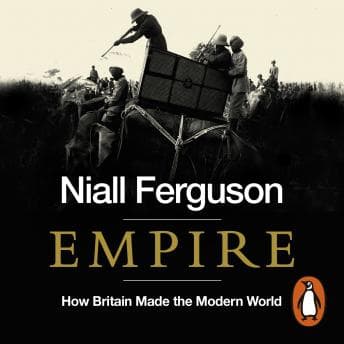

What do you actually owe the British Empire? Seriously. That question rattled around my head for about sixteen hours straight while Ranger and I wore out a stretch of I-35 between Austin and Dallas - three round trips for client site assessments last week, and every mile had Jonathan Keeble in my ear laying out the case.
Niall Ferguson's Empire is one of those books that's been on my list for years, and I finally pulled the trigger because I needed something with enough heft to survive a week of windshield time. Sixteen hours and fourteen minutes. That's basically a deployment brief that never ends. But here's the thing - it earned almost every minute.
The Argument That Won't Let You Off the Hook
Let me cut to the chase: Ferguson's thesis is provocative and he knows it. He's arguing that the British Empire, for all its documented horrors - slavery, famines, brutal suppression of rebellions - ultimately dragged the modern world into existence through institutions, free trade, rule of law, and parliamentary government. He's not whitewashing. He spends real time on the Bengal famine, on the Amritsar massacre, on the systematic exploitation of African labor. But he frames the empire as a net positive for globalization, and he does it with the confidence of a man who's already been yelled at by every reviewer in London and doesn't care anymore.
What surprised me - and I genuinely didn't expect this - was how much of the early empire story reads like organized crime. Ferguson traces the whole thing back to pirates and privateers. Literal buccaneers like Henry Morgan, operating under letters of marque, basically running a protection racket in the Caribbean. The transition from piracy to plantation economy to global trading empire isn't presented as some grand national destiny. It's opportunism layered on opportunism, and Ferguson has the intellectual honesty to say so even while making his larger argument.
The structure follows a chronological arc but each section is organized around a theme - why Britons went abroad, why they stayed, how they governed. The chapters on missionaries and their role in both enabling and eventually undermining imperial authority were territory I hadn't really considered. Ferguson draws a direct line from evangelical Christianity's anti-slavery movement to the moral contradictions that eventually made empire untenable. That's smart historical thinking, whatever you make of his conclusions.
Where the Flanks Are Exposed
This is where it lost me in places. Ferguson's argument sometimes feels like he's selecting evidence for the defense while acknowledging the prosecution exists. The sections on India are particularly tricky - he'll detail the catastrophic failures of British administration and then pivot to railways and the civil service as if they balance the ledger. I've seen this kind of briefing before. When someone gives you all the good news first and buries the bad, you learn to listen harder for what's being glossed over.
The book was originally published in 2003 and was tied to a Channel 4 TV series, and you can feel that in the pacing. Some sections move briskly through decades of complex history - the Scramble for Africa gets compressed in ways that left me wanting more - while others linger on anecdotes that feel chosen for television appeal. The fall of Singapore gets dramatic treatment (deserved), but the Boer War concentration camps get less space than I expected given how central they are to any honest accounting.
Still, Ferguson writes with a sharpness that keeps you engaged even when you're arguing with him in your head. And I was arguing with him a lot. That's not a criticism - a history book that doesn't make you push back isn't doing its job.
Keeble Behind the Mic
Jonathan Keeble handles this well. Really well, actually. Sixteen hours of dense historical narrative is a marathon for any narrator, and he maintains a clear, measured delivery that lets Ferguson's prose do the work without getting in the way. His pacing is steady - I listened at my usual 1.25x and it hit perfectly, gave the material urgency without sacrificing comprehension. He doesn't try to do character voices for historical figures (thank God - nothing worse than a narrator attempting a bad Churchill impression in a serious history book). The tone stays authoritative without becoming lecturing, which is harder than it sounds when you're reading someone else's argument for sixteen hours.
No production issues that I noticed. Clean audio throughout. For a book this long, that matters.
Who Needs This Intel
If you're interested in imperial history and you can handle a historian with a clear point of view - one you might strongly disagree with - this is worth your time. Military history buffs will find plenty here, from the East India Company's private armies to the strategic disasters of the 20th century. If you need your history to come with a trigger warning and predetermined conclusions, look elsewhere. Ferguson respects his audience enough to present the ugly alongside his argument and let you fight with him. I ran into the same dynamic with Short History of the United States - a historian with a clear point of view who trusts you to push back rather than holding your hand to predetermined conclusions.
Skip it if you want a balanced, multi-perspective treatment. This is one historian's case, argued with considerable skill but unmistakable bias.
Mission Debrief
Worth your time? Here's the debrief: Ferguson gave me sixteen hours of genuine intellectual engagement, a few moments where I wanted to throw my phone out the truck window, and a framework for thinking about empire that I'm still chewing on a week later. The author clearly did their homework - the research depth is serious even when the conclusions are debatable. Ranger slept through most of it, but he perked up during the battle descriptions. Smart dog.
Mission accomplished - with caveats.




![Steve Jobs [unabridged audiobook] audiobook cover](/_next/image?url=https%3A%2F%2Fcovers.audiobooks.com%2Fimages%2Fcovers%2Ffull%2F9788499923406.jpg&w=1920&q=75)