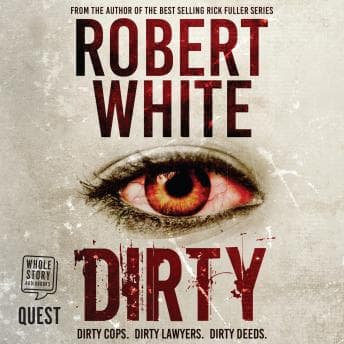

What happens when the people sworn to protect and serve become the very threat they're supposed to guard against?
I was running surveillance footage for a client—mind-numbing work, watching parking lot camera feeds at 2x speed—when I threw this on. By hour three, I'd forgotten about the footage entirely. Ranger was giving me that look he reserves for when I've missed his dinner time by forty minutes. Worth it.
When Cops Go Wrong (And the Author Gets It Right)
Let me cut to the chase: Robert White knows his procedural details. Dave Stewart's moral compromise in the opening—changing one line in a statement to nail a murderer—is exactly the kind of ethical quicksand I've watched good people sink into. You tell yourself it's for the greater good. You tell yourself the ends justify the means. Then you're in so deep that someone like DCS McCauley owns you.
The corruption here isn't cartoonish. McCauley collects dirt on people the way some guys collect baseball cards. Patient. Methodical. He's the kind of snake I've encountered in uniform—the ones who know that power isn't about rank, it's about leverage. When Stewart sleeps with DS Anne Wallace and suddenly finds himself in McCauley's crosshairs, you can feel the noose tightening. Three bodies later, Stewart's the prime suspect, and the paedophile ring operating under McCauley's nose becomes the thread that could either save him or bury him.
Keeble's Voice Work Earns Its Stripes
Jonathan Keeble. This guy gets it. His character differentiation is solid without being theatrical—no squeaky falsetto for the women, which I appreciate more than I can express. (Nothing yanks me out of a story faster than a narrator doing a cartoon voice for female characters.) The accents feel authentic, the pacing matches the tension, and he's got this ability to make you forget you're listening to one person performing multiple roles.
One listener recommended dropping to 0.8x speed. I get it—there's a lot happening, and White's plot is a tightly woven spider web that slowly unravels. But I kept it at my usual 1.25x and followed fine. Your mileage may vary depending on how much multitasking you're doing.
Where It Hits Different
I've seen this scenario play out in real life—not the murder investigation specifically, but the institutional rot. The way organizations protect their own until protecting becomes impossible. The way good people make one bad call and spend years paying for it. Stewart's not a hero in the traditional sense. He's compromised from page one. T Is for Trespass works the same territory—protagonists who aren't squeaky clean but are trying to do right in a world that punishes honesty. But watching him try to claw his way out while uncovering something genuinely monstrous? That's where the book earns its stripes.
The paedophile ring revelation isn't gratuitous—it's the kind of horror that exists in the real world, protected by exactly the kind of power structures White depicts. He handles it without being exploitative, which takes skill.
Who Should Deploy (And Who Should Stand Down)
If you want your thrillers clean and your protagonists spotless, look elsewhere. This is for readers who can handle moral ambiguity, who understand that sometimes the line between criminal and cop is thinner than anyone wants to admit. Fans of British procedurals will feel right at home. If you're tired of American settings, the UK flavor here is refreshing.
Stand down if: you need likeable protagonists, you're uncomfortable with institutional corruption themes, or you want something light for background listening. This demands attention.
Mission Debrief
Dirty is a solid, dark procedural that doesn't insult your intelligence. The author clearly did his homework on police corruption, the narrator delivers without grandstanding, and at just under eleven hours, it doesn't overstay its welcome. I finished at 0200 hours, which tells you something about the grip this one had on me.
Ranger approved this one. Though he's still annoyed about dinner.