
What happens when the person sitting across from you in therapy matters more than the technique they're using?
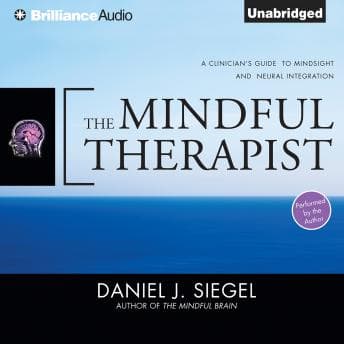
That's the question Daniel Siegel is really asking in The Mindful Therapist, and it's a question that kept rattling around my head while I was making chana masala at midnight — the kind of elaborate cooking I do when my brain won't shut off. And my brain would not shut off. Not because this audiobook is a page-turner in any traditional sense, but because Siegel is essentially arguing that the therapist's own internal world is the primary instrument of healing. As someone who studies how narratives shape identity, I found myself asking: why does the field keep chasing manualized protocols when the research points to the relationship as the active ingredient?
Siegel knows this. He knows it deeply. And he's trying to give clinicians a framework — "mindsight," he calls it — for understanding how energy and information flow within and between minds. The concept of neural integration as the mechanism underlying both personal well-being and therapeutic connection is genuinely interesting. The research actually shows that integration across different brain regions correlates with flexibility, coherence, and resilience, and Siegel builds his clinical model around this idea with real conviction.
When Your Textbook Starts Talking Directly to You
Here's where the audiobook format gets complicated. Siegel narrates this himself, and the book is written in what he describes as a "relational" style — he's speaking directly to you as a fellow clinician. In text, this probably works. In audio, narrated by the author in his characteristically earnest, professorial tone, it creates this odd intimacy that I alternately appreciated and found exhausting. He's warm. He's clearly passionate. But twelve hours of someone explaining the neuroscience of interpersonal resonance while simultaneously trying to model interpersonal resonance through their narration is... a lot.
The dense neuroscience sections — and there are many — hit differently in audio than they would on a printed page. You can't flip back to reread a paragraph about prefrontal cortical function and its relationship to the nine domains of integration. You just have to hope your working memory catches it on the fly. (Mine didn't, multiple times. And I have a PhD in a field adjacent to this.) Some listeners have noted that the mindfulness exercises woven throughout aren't particularly engrossing in the audio format, and I'd agree — they feel more described than experienced. You're being told about mindfulness practice rather than guided through it in a way that lands somatically.
The Sequel Problem: Expectations vs. Reality
This is a fascinating case study in how a sequel — even a non-fiction one — carries the weight of its predecessor. Siegel's earlier The Mindful Brain apparently delivered more concrete therapeutic applications, and you can feel listeners' frustration when this book goes deeper into theory at the expense of practical tools. One reviewer put it bluntly: it's a disappointing follow-up that "lacks the excellent therapeutic applications that such a title promises." And psychologically, this tracks. We don't evaluate books in isolation. We evaluate them against our expectations, against the author's previous work, against what the title implicitly promised us.
The thing is — if you approach this not as a how-to manual but as a conceptual deep dive, the substance is genuinely solid. Marc Brackett is doing something adjacent in Permission to Feel, though he lands closer to the practical end of the spectrum — which, depending on what you're looking for, is either a relief or a disappointment. Siegel's synthesis of psychotherapy and neuroscience is the kind of cross-disciplinary work I wish more people attempted. The problem isn't that the ideas are bad. The problem is that the audiobook format amplifies every weakness: the density becomes impenetrable without visual anchors, the relational writing style becomes a monologue you can't interrupt, and the exercises that should be experiential become just... more words.
Who Gets the Most Out of This (And Who Should Run)
If you're a clinician already familiar with Siegel's framework and you want to sit with the theoretical underpinnings during focused study time — maybe with a notebook nearby and the ability to pause frequently — this has real value. If you're looking for an accessible introduction to mindfulness in therapy, or something you can absorb while jogging through Cambridge (trust me, I tried, it does not work), this is not your book. And if you haven't read The Mindful Brain first, start there. Seriously.
My therapist would have thoughts about this book, actually. She'd probably appreciate the core argument — that her presence matters more than her CBT worksheets — while also noting that a twelve-hour audiobook about being present is, ironically, very hard to stay present for.
My Case Notes
Daniel Siegel understands human nature at the intersection of neuroscience and clinical practice better than most people writing today. But understanding something and translating it into a compelling audio experience are different skills. I respect this book. I learned from it. I also paused it seventeen times to go do something else because my attention kept fracturing under the weight of the content. Worth owning in print. Worth borrowing in audio — but only if you're willing to treat it like a graduate seminar, not a listen.