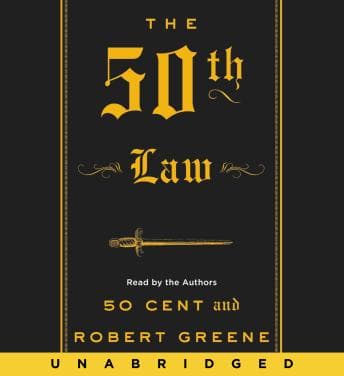

Let's get this out of the way immediately: seeing "50 Cent" and "Robert Greene" on the same cover looks like a fever dream I'd have after a 14-hour slide-deck marathon. The guy who wrote The 48 Laws of Power (the bible for every sociopath I worked with in consulting) teaming up with the guy who survived nine bullets? It sounds like a gimmick.
But here I am, listening to it on my commute, expecting a train wreck. And honestly? It's weirdly coherent.
The Voice in My Head (And the Error That Broke Me)
Here's the thing about the audio: if you're buying this expecting 8 hours of Curtis Jackson dropping wisdom in that signature gravelly mumble, you're gonna be disappointed. 50 shows up, sure. But Robert Greene does the heavy lifting here.
And Greene... well. He has this surprisingly relaxed, almost "late-night jazz DJ" vibe. It's cool. It's unhurried. It's definitely not what I expected from a guy who writes about crushing your enemies totally.
But—and this is a massive "but" that nearly made me throw my phone out the window on the 405—he mispronounces the word "banal." Repeatedly. He says it like "bay-nal." Every. Single. Time.
(Jenny says I need to let things go. Jenny hasn't heard a guy mispronounce a key vocabulary word 15 times in an audiobook about perfection and power. It's distracting. It breaks the fourth wall. It's just... ugh.)
Hustle Porn or Actual Strategy?
The core premise is "fearlessness." In the startup world, we call this "risk tolerance," but 50 Cent calls it "not dying."
I've sat through thousands of hours of "business wisdom." Most of it is fluff wrapped in jargon. This book is different because it validates the hustle in a way that feels visceral. It's the same raw economic reality I found in Capital—just without the 19th-century beard and footnotes. When 50 talks about the street corner, he's talking about market saturation and inventory management. My parents did this in Koreatown in the 90s without reading a single page of Greene. They lived the 50th Law instinctively.
The book connects 50's street moves to historical figures—Napoleon, Malcolm X, some samurai guys. Is it a bit of a stretch sometimes? Yeah. Does it work? Surprisingly well. It's basically a Harvard Case Study for people who actually have to work for a living.
The Bottom Line
Is it repetitive? Yes. Could it have been an email? Maybe a long one.
But the mindset shift is valuable. Greene's academic approach grounds 50's raw anecdotes, and 50's reality checks keep Greene from floating away into pure theory.
Who should listen: Entrepreneurs feeling paralyzed by the current market (who isn't?). This is a good kick in the teeth. Who should skip: Anyone expecting 50 Cent to narrate the whole thing, or people allergic to historical analogies.
Just crank the speed up to 1.5x or 2.0x. Greene reads slowly—too slowly for anyone with a P&L to manage—and the faster speed helps gloss over the pronunciation errors. Skip the intro if you want, dive into the chapters on self-reliance. That's where the ROI is.