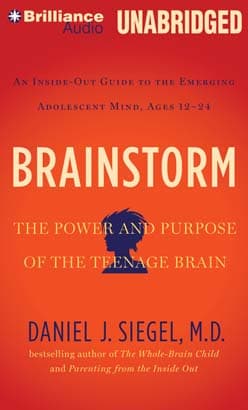

"The adolescent brain isn't broken—it's under construction."
That line hit me somewhere around hour two, crammed into a window seat on the 6:47 AM Caltrain, and I actually paused my playback. Which I never do. Look, I don't have kids. Kevin and I aren't even close to that conversation. But I have a 14-year-old niece who's been giving my sister absolute hell, and my sister keeps texting me these desperate "what is WRONG with her" messages at midnight. So when this popped up in my recommendations, I figured I'd do some reconnaissance.
Turns out this book isn't just for parents. It's basically a user manual for understanding why the teenage years feel like running a distributed system with half the nodes offline and the other half sending conflicting signals.
The Neuroscience Actually Holds Up
Okay, so here's what I wasn't expecting: Dr. Siegel doesn't dumb things down, but he also doesn't bury you in jargon. He explains how the prefrontal cortex—the part that handles impulse control and long-term planning—is literally still being wired during adolescence. The brain is pruning connections and strengthening others. It's not chaos; it's optimization.
As someone who spends her days thinking about system architecture, this framing clicked immediately. Teenagers aren't malfunctioning. They're in beta. Their reward systems are hypersensitive, their risk assessment is calibrated differently, and their emotional processing is running on different parameters than adults. None of this is a bug—it's a feature that's supposed to push them toward independence and novelty-seeking.
Siegel introduces this framework called ESSENCE (Emotional Spark, Social Engagement, Novelty-seeking, and Creative Exploration) and honestly, it's a pretty useful mental model. He argues these traits aren't problems to be managed but strengths to be channeled. The ROI on understanding this framework is basically: fewer screaming matches, more productive conversations.
When the Author Is the Narrator
Here's the thing about author-narrated nonfiction: it can go either way. Some authors have no business behind a microphone. Dr. Siegel? He's fine. Better than fine, actually—there's a warmth to his delivery that feels like a really good lecture from a professor who genuinely cares whether you're following along.
But I'll be honest: it's not Ray Porter. (I mean, what is?) The pacing is steady, professional, maybe a little too even. Around hour five, during one of the more technical sections about dopamine and the limbic system, I found myself drifting. Not because the content was bad—it wasn't—but because the delivery needed a gear shift that never quite came.
That said, there's something authentic about hearing the author explain his own research. You can tell when he's genuinely excited about a concept versus when he's covering necessary groundwork. And his compassion for both teenagers AND their exhausted parents comes through clearly. This isn't a guy who's going to shame you for losing your patience with your kid.
Perfect For: Train. Skip For: Deep Work
I finished this in about 4 commutes, listening at 1.25x. (I bumped it down from my usual 1.5x because some of the neuroscience sections benefit from slower processing.) It's ideal for commute listening—you can zone out for a minute and not lose the thread completely, but it's engaging enough to keep you from falling asleep standing up.
Would not recommend for deep work background listening. Too much actual content. Your brain will try to engage and then you'll realize you've been staring at the same function for ten minutes.
The exercises and "Mindsight" practices scattered throughout are... fine? They're clearly designed for the print version where you can pause and journal. In audio format, I mostly just noted them mentally and moved on. If you're the type who actually does the exercises in self-help books (I am not that person), you might want the physical copy instead.
Who Should Listen (And Who Should Skip)
My sister. Definitely my sister. I'm sending her this review right now.
But also: anyone who works with teenagers, anyone who WAS a teenager and wants to understand what the hell was happening in their brain during those years, and honestly? Anyone who manages junior engineers. (I'm only half joking. The sections on how to communicate with someone whose prefrontal cortex is still developing? Surprisingly applicable to code reviews with new grads.)
Skip this if you want quick fixes or "how to make your teenager stop being annoying." Siegel is playing a longer game—helping you understand the WHY so you can figure out your own HOW. It's the opposite of 48 Laws of Power—less about manipulation tactics, more about actually understanding what's happening under the hood.
I texted my niece after finishing. Just a "thinking of you, hope school's going okay" message. She responded with a single emoji. Progress? Maybe. At least now I understand why.