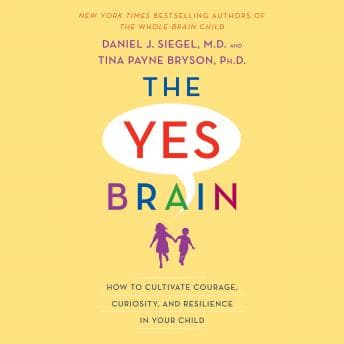

Okay, I have a bone to pick with Siegel and Bryson. Not about the science — the science is solid, and I'll get to that. My complaint is that they've essentially written a book that made me psychoanalyze my own childhood while I was supposed to be chopping onions for chana masala. The onions were already making me cry. I didn't need the emotional double whammy of realizing that my parents' well-intentioned "because I said so" approach was basically a textbook No Brain response. Thanks for that, guys.
But here's the thing. Once I got past my own minor existential crisis (my therapist would have thoughts about this, and I'm sure I'll hear them Thursday), I found myself genuinely impressed by the framework they've built here.
The Four Pillars Are Actually Four Lenses
Siegel and Bryson organize everything around balance, resilience, insight, and empathy — and what I appreciate as a researcher is that these aren't arbitrary categories pulled from a parenting blog. They map onto real neuroscience about integration in the developing brain. The "Yes Brain" isn't about saying yes to your kid's every whim (which, honestly, is what the title sounds like if you're scrolling past it). It's about cultivating a neurological state of receptivity versus reactivity. The distinction matters.
What makes this framework compelling is how they handle the push-versus-cushion tension. When does your child need you to gently nudge them past their comfort zone, and when do they need you to be the safety net? The research actually shows that getting this wrong in either direction creates problems — too much pushing breeds anxiety, too much cushioning breeds fragility. Siegel and Bryson don't pretend there's a simple algorithm. They give you a way to read your specific child's signals, which is harder to teach but infinitely more useful.
I found myself asking: why does so much parenting literature treat children like they're one uniform species? This book at least acknowledges that a strategy that works for your seven-year-old might backfire spectacularly with your four-year-old. The scripts they provide — actual language you can use in the moment when your kid is melting down over screen time limits — feel grounded rather than aspirational.
Hearing the Authors Think Out Loud
Both Siegel and Bryson narrate, and this is where the audiobook format gets interesting. Author-narrated nonfiction is a gamble. Sometimes you get a brilliant mind who sounds like they're reading a tax document. Here, though, you get something closer to sitting in on a really good lecture. Siegel has that clinical professor cadence — measured, deliberate, occasionally pausing in ways that feel like he's actually thinking about what he's saying rather than just reading it. Bryson brings a warmer, more practitioner energy. She sounds like someone who has actually been in a room with a screaming toddler in the last year.
The trade-off? Neither of them is a professional narrator. There's no dramatic range here, no vocal fireworks. At under six hours, though, it doesn't overstay its welcome. I listened at 1.25x during my morning jog and it tracked perfectly — the content is dense enough to keep your brain engaged but structured clearly enough that you don't lose the thread when you're dodging puddles on the path along the Charles.
Where the Psychology Nerd in Me Got Skeptical
Here's my honest assessment: if you've already read The Whole-Brain Child and No-Drama Discipline, portions of this will feel like a remix. The core neuroscience — Dan Siegel's interpersonal neurobiology framework — is the same engine. The Yes Brain adds the balance-resilience-insight-empathy structure, which is genuinely useful as an organizing principle, but some of the foundational concepts are repeated almost verbatim. This is a fascinating case study in how popular science authors walk the line between accessibility and redundancy. Isabel Wilkerson does something structurally similar in Caste — she builds a framework that feels genuinely new even when the underlying history is familiar, and I kept thinking about how both books use a single organizing metaphor to reframe information most readers already think they understand.
Psychologically, though, it tracks. The emphasis on integration — connecting different parts of the brain, connecting logic with emotion, connecting self with others — is consistent with what developmental psychology actually supports. Carol Dweck's endorsement isn't just a blurb; the growth mindset connection is real and well-articulated here.
What I wish they'd done more of: acknowledging cultural variation. As someone raised by Indian immigrant parents who had a fundamentally different model of childhood autonomy, I kept thinking about how "encouraging curiosity" and "gentle pushing" look very different across cultural contexts. The book assumes a pretty specific Western, middle-class parenting paradigm. It's not wrong within that frame. But it's a frame.
Who This Is Actually For (and Who Should Skip It)
If you're a parent who wants an evidence-based framework that's actually actionable — not just "be more mindful" platitudes — this delivers. If you've never read Siegel and Bryson before, start here or with The Whole-Brain Child; either works as an entry point. If you've read both their previous books, this one adds value but with diminishing returns. You'll recognize the machinery.
Skip it if you want deep dives into specific challenges (ADHD, anxiety disorders, neurodivergence). This stays at the framework level.
My Prescription
Solid science, practical tools, authentic delivery, slight redundancy for returning readers. The kind of parenting book that respects your intelligence. I'm going to text it to three friends who just had kids and pretend I'm being generous when really I just want someone to discuss the resilience chapter with.