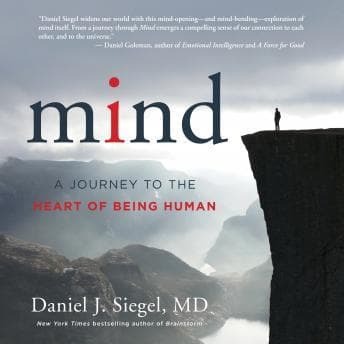

Fifteen hours. FIFTEEN HOURS for what is essentially a meditation wheel with four spokes and some neuroscience. I started this at 6AM on a Monday, finished it Thursday afternoon, and somewhere around hour 8 I found myself genuinely irritated that Dr. Siegel kept explaining the same concept seventeen different ways. "Where attention goes, neural firing flows, and neural connection grows." Got it the first time, doc. And the fifth. And the twelfth.
But here's the thing—I kept listening. Through the packed morning trains, through the sleepy evening commutes, through that one delay at Millbrae where we sat for 40 minutes. Because underneath the repetition, there's something genuinely useful here.
The Wheel Is Simpler Than He Makes It Sound
Bottom Line: The Wheel of Awareness is basically a structured attention exercise. You imagine a hub (your awareness), spokes (your attention), and a rim divided into four segments—external senses, internal body sensations, mental activities, and connection to others. You move your attention around the rim, then rest in the hub.
That's it. That's the practice.
If you've used Headspace or done any body scan meditation, you'll recognize about 80% of this immediately. Siegel's contribution is the framework—the metaphor of the wheel—and the neuroscience explaining WHY this works. Some listeners were disappointed it wasn't more groundbreaking. I get that. But sometimes repackaging existing wisdom in a memorable framework IS the innovation. I've done body scans before and forgotten about them. The wheel metaphor actually sticks.
When The Neuroscience Clicks
The second half is where Siegel earns his runtime. He's a UCLA psychiatry professor, and it shows. The sections on integration—how different brain regions need to be both differentiated AND linked for optimal function—genuinely changed how I think about mental health. It's basically systems architecture for your brain. (Yes, I'm comparing neurons to microservices. Kevin would be so proud.)
Siegel narrates this himself, which is a double-edged sword. On one hand, you're getting the material straight from the source. His voice is calm, clear, professorial—exactly what you'd expect from a meditation-focused psychiatrist. On the other hand, there's a certain... earnestness that can feel repetitive. He really wants you to understand. He REALLY wants you to understand. He's going to make sure you understand by saying it again slightly differently.
At 1.5x speed, this becomes manageable. At 1.75x (my usual for business books), he starts sounding like an auctioneer who's very concerned about your prefrontal cortex.
The ROI Calculation
Here's my honest assessment: this is probably a 6-hour book stretched to 15. The core practice takes maybe 2 hours to learn. The neuroscience is fascinating but could be tighter. The philosophical sections on consciousness and interconnection are interesting but feel like bonus content.
BUT—and this is a big but—if you're someone who needs the "why" before you'll commit to the "what," this depth is actually valuable. I'm a skeptic about meditation woo-woo stuff. Siegel's approach of grounding everything in neuroscience made me actually want to try the practice. Motivation Myth takes a similar evidence-based approach to debunking self-help myths, which is exactly the kind of no-nonsense framework I need. "Neural integration" sounds way more appealing to my engineer brain than "becoming one with the universe."
Who This Is (and Isn't) For
Skip if: You want a quick practical guide. There are shorter meditation audiobooks that'll get you practicing faster. Also skip if repetition drives you crazy—Siegel's teaching style involves a LOT of circling back.
Perfect for: Anyone who's bounced off meditation before because it felt too mystical. Engineers, scientists, skeptics who need data before they'll try something. People with long commutes who want to understand their brain better while stuck in transit.
Worth the Commute Hours?
I finished this in about 10 commutes, which is longer than I'd like for a self-help book. But I'm still thinking about the wheel metaphor a week later. I've actually done the practice a few times—usually the abbreviated version, because who has 30 minutes—and it's... useful? Calming? I notice when I'm stuck on the rim versus resting in the hub now.
Is it groundbreaking? Probably not. Is it a solid, science-backed framework for meditation that'll stick in your head? Yeah, actually. The ROI is there if you're willing to invest the time. Just bump up that playback speed.