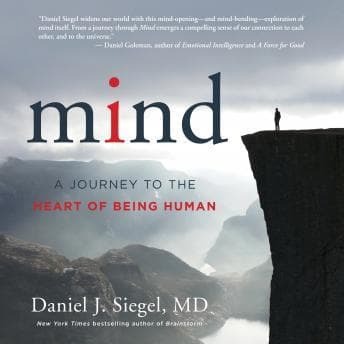

Knife hovering over an onion, mid-chop, I literally stopped. Siegel had just asked "What is the mind?" somewhere in the first hour, and I realized I'd never actually tried to define it. Not really. I've spent years studying how minds break, heal, manipulate, and transform. But define the thing itself? We've been dancing around this question for centuries.
This is a fascinating case study in academic ambition. Siegel attempts what most researchers wouldn't dare: synthesizing neurobiology, quantum physics, anthropology, and contemplative practice into a unified theory of mind. Nearly nineteen hours of it. I listened across three weeks of morning jogs through Cambridge, and I won't pretend every mile was riveting.
When a Scientist Gets Personal
What makes this audiobook compelling is Siegel's willingness to be vulnerable. He's not hiding behind jargon—though there's plenty of that too. He shares his own meditation experiences, his uncertainty, his moments of genuine wonder. He's both observer and observed, and he knows it. His voice carries this quality of someone thinking out loud rather than lecturing. It's intimate in a way academic texts rarely are.
But here's where I found myself asking: why does he really need nineteen hours? The core thesis—that mind emerges from both embodied brain processes AND our relationships with others—is genuinely important. Revolutionary, even. But Siegel circles it repeatedly, approaching from quantum mechanics, then from interpersonal neurobiology, then from meditation traditions. Each approach adds texture. Each also adds... time.
The Author-Narrated Gamble
Siegel narrating his own work is both gift and limitation. Gift: you hear the pauses where he's genuinely moved by his own ideas. There's a moment—maybe hour seven or eight?—where he's describing the interconnected nature of consciousness, and his voice softens. You can tell this isn't performance. This is a man who has sat with these ideas for decades.
Limitation: he's not a trained narrator. The pacing is uneven. Some chapters feel rushed, others meander. When he gets excited about a concept, his speech patterns become almost stream-of-consciousness. Appropriate, given the subject matter. But at 1.0x speed during a long run? My attention wandered toward the Charles River more than once.
Authors reading their own work often can't see the forest for the trees. They emphasize what fascinated them in the writing, not necessarily what listeners need emphasized for comprehension.
Who Should Press Play (And Who Should Keep Scrolling)
If you're a casual self-help reader looking for quick insights, this isn't it. Full stop. This is graduate-seminar material disguised as popular science. You need to want this.
But if you're someone who lies awake wondering about consciousness—if you've ever felt that strange vertigo of realizing you're a mind contemplating itself—Siegel offers something rare. He takes the question seriously. He doesn't reduce mind to brain (the materialist trap) or float off into pure mysticism (the spiritual bypass). He holds the tension. That same refusal to oversimplify shows up in Inside of a Dog, where Horowitz resists the urge to anthropomorphize while still honoring the complexity of canine consciousness.
Siegel's clinical background shows in how he discusses integration—the way healthy minds connect differentiated parts into a coherent whole. It's not just theory. You sense the patients he's sat with, the suffering he's witnessed, the healing he's facilitated.
My Therapist Would Have Thoughts
She'd probably note that Siegel's emphasis on "MWe"—his term for the integration of individual and collective identity—aligns with attachment theory in ways he doesn't always make explicit. She'd also probably say I shouldn't have tried to absorb quantum physics explanations at 6 AM while dodging cyclists.
Fair point.
The production is clean but minimal. No music, no effects—just Siegel's voice and your brain. For material this dense, that's probably wise. Anything else would be distraction.
Nineteen Hours: Worth the Investment?
Here's my honest assessment: this is a 4-hour insight stretched across a marathon. But those 4 hours? Genuinely valuable. Siegel's definition of mind as "an emergent, self-organizing process that regulates energy and information flow" gave me language I'd been missing. His framework for understanding how relationships literally shape neural architecture? That's going into my next paper (which approximately nobody will read, but still).
Skip this if you want actionable takeaways or crisp storytelling. Commit to it if you're genuinely curious about consciousness and willing to sit with complexity. Maybe a long flight. Maybe a road trip where you can pause and think. The ideas deserve attention, even when the delivery tests your patience.