
What happens when you take a fantasy reader's favorite trope — the orphan with a mysterious destiny — and drop it into 1840s Los Angeles instead of a secondary world?
I was up way too late reorganizing my board game shelf (look, sometimes you need to re-alphabetize by designer, don't judge me) and had this running because I figured a Louis L'Amour Western would be straightforward background listening. I was wrong. About three hours in I'd stopped touching the board games entirely and was just sitting on the floor between Gloomhaven and Terraforming Mars, completely locked in.
Johannes Verne Is Basically a D&D Character Sheet Made Flesh
Here's the thing nobody tells you about The Lonesome Gods: this isn't a standard Western. Johannes Verne starts as a child left to die in the Mojave Desert by his own grandfather, gets rescued by outlaws, raised partly by Native Americans, educated by a mysterious woman, and grows into this frontier polymath who can quote Montaigne and track a man through scrubland. He's like if someone rolled a character with high INT and high WIS and then somehow also dumped points into STR. The progression is satisfying — you watch this kid level up across decades, picking up skills and knowledge from every community he passes through.
L'Amour does something here that I genuinely didn't expect: he builds early Los Angeles the way a fantasy author builds a city. The ranchos, the mix of Mexican and American cultures, the land politics, the sense that this place is becoming something new and dangerous — it reads like world-building. This is Sanderson-level world-building, but for a real historical setting, and that's a wild sentence to write about a Louis L'Amour novel. I found a similar sense of place in To Tame a Land, where L'Amour's landscape work feels just as deliberate, though the pacing is tighter and more traditional. The desert itself functions almost like a magical realm, with the "lonesome gods" — ancient stone figures in the mountains — serving as this ambient mythic layer over everything. It's not quite magical realism, but it's not not magical realism either.
And the grandfather, Don Doroteo Doña, is a villain driven by family honor so absolute it's become madness. His hatred of Johannes isn't some mustache-twirling evil — it's the obsessive, generational kind. The scene where young Johannes sees his grandfather's eyes for the first time, and that image just lives in him for decades? That's the kind of character detail that sticks. My D&D group would love this — it's basically a backstory that writes itself.
Four Narrators Walk Into a Western (And It Gets Complicated)
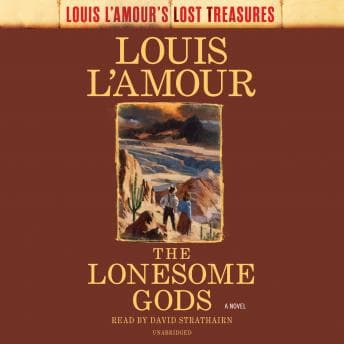
Okay, so. The elephant in the room. This edition has four narrators: Dan John Miller, David Strathairn, Jason Culp, and Oliver Wyman. Four narrators for what is essentially a first-person story with one main POV character. That's... a choice.
I can see what they were going for — Strathairn's got that gravel-and-gravitas quality, and the idea of splitting up the Lost Treasures supplementary material from the main narrative makes structural sense. But the execution is uneven. There are moments where the transitions between narrators pull you out of Johannes's headspace right when you're deep in it. Some listeners have described the whole thing as feeling like "aliens were speaking," and while I wouldn't go that far, I get where that frustration comes from. The tonal shifts between readers can feel jarring, especially when you've spent hours settling into one voice's version of Johannes and then suddenly you're hearing someone else's interpretation.
Steven Pacey walked so other narrators could run, and this production needed someone with that kind of singular vision. Dan John Miller, who narrates one of the sections here, shows that same versatility in American Tragedy, where he carries a much darker, more interior story without breaking character once. A single narrator who could handle the boy, the man, the desert mystic, and the educated gentleman — that would've elevated this from good to great. What we got instead is competent but fractured.
Who Should Saddle Up (And Who Should Ride On)
If you only know L'Amour from the short, punchy shoot-em-up Westerns, this will surprise you. It's 16 hours. Yes, it's worth it. The pacing is slow-burn — this is a life story, not an action set piece — and there are stretches where Johannes is just... thinking about landscape and philosophy and memory. If you don't like info-dumps, this isn't for you (but you're wrong). If you love progression fantasy and want to see that structure applied to historical fiction, this scratches an itch you didn't know you had. Fledgling scratches a similar itch for me — it's a genre-bending story that builds its world and character progression slowly, rewarding patience with depth.
Skip this version if narrator consistency matters to you more than story. The multi-narrator approach is the weakest element, and I'd honestly recommend grabbing a physical copy alongside the audio.
I read this instead of writing my thesis. Dr. Patel would not approve. But Johannes Verne spent years in the desert becoming the person he needed to be, and maybe my thesis is just my desert. (It's not. My desert is procrastination. But it sounded good for a second.)
Roll for Wisdom, Keep the Book
The source material here is genuinely special — L'Amour at his most ambitious, writing something that feels more like literary fiction wearing Western boots. The Lost Treasures bonus material from Beau L'Amour adds context that any world-building nerd will appreciate: plot notes, alternate drafts, the archaeology of a story. The audio production just doesn't quite match the ambition of the text. Worth experiencing, but know what you're getting into.