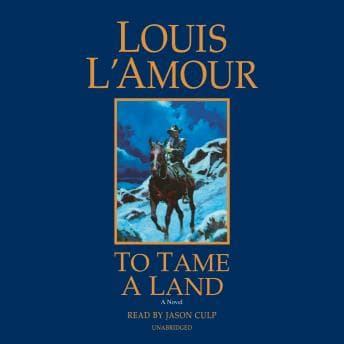

"A man who won't defend himself is asking for trouble, and in this country trouble comes hunting."
That line hit me around the two-hour mark, and I had to pause the audio. Not because it was profound in some literary sense—Hemingway would've cut it in half—but because it captures everything L'Amour understood about the mythology of the American West. I was grading sophomore essays on *The Great Gatsby* at the time, red pen in hand, and I realized I'd been staring at the same paragraph for ten minutes. The papers could wait. Rye Tyler couldn't.
The Education of a Gunfighter (And Why It Still Works)
Here's what L'Amour does that most Western writers forget: he makes you care about the learning before the shooting. Rye Tyler is twelve when we meet him, orphaned by violence, taken in by a stranger named Logan Pollard who teaches him to read Plutarch and handle a Colt with equal proficiency. This reminds me of what Hemingway said about writing—you need to know ten times more than you put on the page. L'Amour clearly knew his frontier history, his firearms, his terrain.
At five and a half hours, this is lean storytelling. No fat. The book covers years of Rye's life—cattle drives, horse breaking, the slow accumulation of a reputation he never wanted—but it never drags. L'Amour understood that a coming-of-age story in the West is really about subtraction. What gets stripped away. What hardens. By the time Rye becomes marshal of Alta, you've watched a boy become something dangerous and decent simultaneously.
My students would hate this. I love it.
Jason Culp's Soft Drawl and the Art of Restraint
Culp won an Earphones Award for a reason, and you hear it in his approach to Rye. He doesn't oversell the violence or melodramatize the romance with Liza Hetrick. His voice has this textured quality—rough but not theatrical—that fits characters who are, as one listener perfectly put it, "decent but rough, born with the bark on." That's exactly right.
The narrator understands that pause is punctuation. When Rye confronts difficult moments—and there are several, including a killing that forces him to leave his new home—Culp lets the silence do work. He's not racing to the next scene. He trusts L'Amour's economy. I listen at 1.0x because the author chose those words, and Culp clearly agrees. His character differentiation isn't showy—no wild accent shifts or voice gymnastics—but you always know who's speaking. The mysterious Logan Pollard has a different weight to his words than the young Rye, a gravity that makes the final confrontation at Robbers' Roost land properly.
The Triangle That Breaks the Formula
Let's talk about what L'Amour is really doing here. The love triangle—Rye, Liza, and Logan Pollard—isn't really about the woman. (Sorry, Liza. L'Amour wasn't great with female characters. This is 1955.) It's about what happens when a student surpasses his teacher. When the man who taught you about books and guns and friendship becomes the obstacle.
The tracking sequence to Robbers' Roost is pure Western mythology, but the confrontation itself is something else. Two men who love each other in that particular frontier way—through shared survival, through education, through the unspoken code of the territory—forced to opposite sides. This is why we still read the classics. The bones of the story are ancient. Mentor versus student. Civilization versus wilderness. The cost of becoming what you needed to become.
If you loved *Shane*, this is its spiritual successor. Same DNA, different execution. Lost World: A Novel works with similar mythic structures, though it trades the frontier for something older.
Worth Pausing the Faculty Meeting For
Is this L'Amour's best? Some listeners think so—I've seen it called "nearly a perfect example of the western genre." I'm not sure I'd go that far. The middle section with the cattle drives feels slightly episodic, and Liza remains more symbol than person. But at five hours and change, these are minor complaints. The production is clean, Culp's performance is controlled and effective, and L'Amour's prose moves like a man who knows exactly where he's going.
Who should listen: Anyone who appreciates genre fiction done with craft. Anyone who thinks Westerns are just shootouts and hasn't encountered the good ones. Anyone who wants to hear what American mythmaking sounds like when it's not trying to be literary but accidentally becomes so anyway.
Who should skip: If you need complex female characters, look elsewhere. If you want moral ambiguity and antiheroes, this isn't your book. Rye Tyler is good. Unambiguously. L'Amour believed in good men, and he wrote them without apology.
I finished this at 11:47 PM, papers still ungraded, Denise already asleep. Sometimes the old stories are the ones that keep you up. Not because they surprise you, but because they remind you why the formula exists in the first place.
Someone understood something true, once. And if you're lucky, a good narrator helps you hear it again.