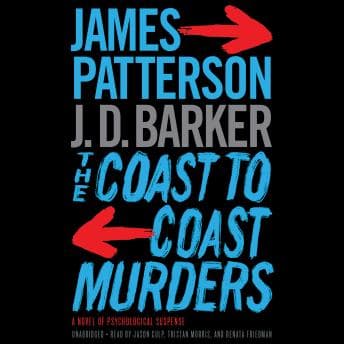

What happens when you take two authors who specialize in making readers deeply uncomfortable and give them a cross-country murder spree to play with? You get Coast-to-Coast Murders, and honestly, I listened to most of this while pretending to debug my thesis code. (Dr. Patel, if you're reading this, I was definitely working.)
So here's the setup: Michael and Megan Fitzgerald are adopted siblings with the kind of childhood that makes you grateful for your boring suburban upbringing. Their parents are these high-profile psychologist types who basically used their kids as experimental subjects. And now there's a murder trail stretching from California to New York, and the investigators can't figure out which Fitzgerald might be involved. It's Patterson and J.D. Barker doing what they do best—short chapters, constant twists, and that propulsive pacing that makes you forget you've been listening for three hours.
The Three-Voice Gambit
Look, multi-narrator audiobooks are hit or miss. Sometimes they elevate the material, sometimes they feel like a committee project. This one mostly works. Jason Culp, Renata Friedman, and Tristan Morris each handle different perspectives, and the handoffs are clean. Culp in particular has that Earphones Award pedigree, and you can hear why—his detective work is solid, grounded, the kind of voice that makes you trust the investigation even when the plot goes off the rails.
Friedman brings the right energy to the psychological thriller elements. There's something about how she handles the Fitzgerald family dynamics that feels appropriately unsettling. And Morris? He's good at the procedural stuff, keeping the FBI side of things moving.
Now, I gotta be honest about something. Some listeners have complained about one character's voice being annoying, and I can see it. There's a quality to one of the performances that—how do I put this—grates a little. Like that one player in your D&D group who insists on doing a weird accent for their character. You get used to it, and apparently that voice shows up less as the story progresses, but it's there.
When the Plot Goes Full Thriller Mode
Patterson's whole thing is those tiny chapters that end on mini-cliffhangers, and if you're not into that, this isn't going to convert you. Some folks find it choppy. Personally? It's perfect for listening while coding. I can hit a natural break point, actually focus on my work for five minutes, then get pulled right back in.
The psychological thriller elements are where this really shines. The Fitzgerald family backstory—the experimental upbringing, the secrets, the way trauma shapes people—it's the kind of worldbuilding I appreciate. House of a Thousand Candles has that same focus on family secrets shaping everything, though it plays out in a very different setting. Not Sanderson-level magic systems, obviously, but there's a logic to how these characters became who they are. The nature versus nurture question runs through the whole thing, and Patterson and Barker don't give you easy answers.
That said, the ending gets... chaotic. I've seen reviews calling it confusing, and yeah, there's a lot happening in the final act. Multiple reveals stacking on top of each other, plot threads resolving at breakneck speed. It's not incoherent, but it definitely asks you to keep up. If you zone out for even a minute—say, because your advisor just Slacked you about your missing progress report—you might miss something important.
The Pacing Sweet Spot
At 14 hours, this is a solid medium-length thriller. Crown sits in a similar sweet spot for length—enough to get invested without requiring a week off work. Not the epic commitment of a Stormlight book (obviously), but substantial enough to sink into. The pacing works for the most part. There's maybe a section in the middle where the investigation feels like it's spinning its wheels, but the narrators keep it engaging enough that you don't notice until later.
The production quality is clean. No weird audio glitches, no volume inconsistencies between narrators. That matters more than people realize—nothing kills immersion like suddenly having to adjust your headphones because one narrator is quieter than another.
Who's Rolling Initiative on This One
If you're into psychological thrillers and you want something that'll keep you engaged during a commute or a long coding session, this delivers. Patterson fans already know what they're getting. The multi-narrator format adds texture without being gimmicky.
Skip it if you need your thrillers to stay grounded and realistic. There are moments where the plot stretches credibility, and if that bothers you, you'll be frustrated. Also skip if you really can't handle short chapters—some folks find the constant breaks annoying rather than propulsive.
Thesis Defense: The Audiobook
I burned through this in about a week, mostly during thesis-avoidance hours. It's not going to change your life, but it's a solid, engaging thriller with narration that keeps you hooked. Sometimes that's exactly what you need.
(Now if you'll excuse me, I have a progress report to fabricate. I mean write.)