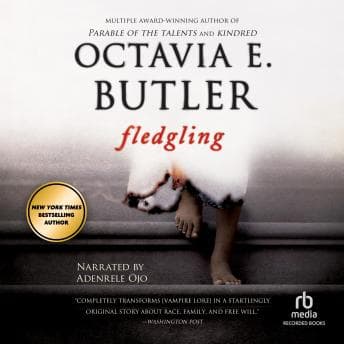

Look, I need to complain about something first. Octavia Butler wrote a vampire novel where the protagonist is a 53-year-old vampire who looks like a 10-year-old Black girl and has consensual sexual relationships with adult humans. And nobody warned me about the brain-breaking I was about to experience at 6:47 AM on a Tuesday, sandwiched between a guy eating a breakfast burrito and someone's overly aggressive cologne.
Quick Verdict: Worth your commute. But maybe not the 6 AM commute. Maybe the evening one when your brain has warmed up.
Butler Does What Butler Does Best
This is basically Kindred but for vampire mythology—taking a genre you think you know and making you deeply uncomfortable about power dynamics you never questioned. Shori wakes up with amnesia, covered in wounds, in a cave. She's hungry. What follows is Butler systematically dismantling everything you thought you knew about vampire fiction while also making you examine consent, race, and what it means to be human.
The Ina (Butler's vampires) form symbiotic relationships with humans who become essentially addicted to their venom. It's... a lot. The book forces you to sit with discomfort in a way that only Butler can manage. Is it consent if there's a biological imperative? If both parties benefit? If one party literally can't survive without the other?
I've read a lot of sci-fi that thinks it's smart. Butler's work actually is smart. Still Life has that same confidence—it trusts you to keep up without holding your hand. The difference is she doesn't stop to explain why she's smart—she just drops you into Shori's perspective and lets you flail.
Adenrele Ojo: The Voice That Splits Listeners
Okay, here's where I have to be honest. Ojo's narration is polarizing, and I get why. She voices Shori with this particular quality—young but ancient, vulnerable but predatory—that some listeners have described as "whiny." I didn't hear it that way. What I heard was someone capturing the genuine strangeness of a character who has a child's voice but a creature's hunger.
Her character differentiation is solid. The human symbionts each get distinct voices, and you can track the various Ina family members without getting lost. The emotional delivery during the council scenes (basically a vampire trial) had me missing my stop. Twice.
But—and this is a real but—if you're sensitive to vocal quality, maybe sample the first chapter before committing. The narration works for the material, but "works for the material" and "pleasant to listen to" aren't always the same thing.
The Pacing Problem (Sort Of)
At 12 hours and 24 minutes, this isn't a quick listen. Butler takes her time building the Ina society, the rules of symbiosis, the politics between vampire families. The middle section where Shori is essentially learning how to be Ina again—it drags a little. I won't lie. I bumped up to 1.75x for about two hours.
But then the final act hits and suddenly you understand why Butler spent all that time on worldbuilding. The "apocalyptic battle" the description promises is less physical combat and more ideological warfare, which is very Butler. The real conflict is about whether a genetically modified vampire (Black, able to walk in daylight) has the right to exist. The parallels aren't subtle. If It Bleeds operates with similar directness when it comes to its themes—no subtlety, just impact. They're not meant to be.
This Demands Your Full Attention
I'm gonna be real with you—this is not a background book. This is not a "half-asleep at 6 AM" book. The themes require you to actually think, and there are enough characters and Ina family politics that you'll get lost if you zone out.
Skip for: Gym, housework, anything where you might miss five minutes and suddenly not know who's talking.
Perfect for: That evening commute when you're actually awake. Long flights. Dedicated listening time when you can actually engage.
Who Gets This and Who Should Run
If you loved Kindred or Wild Seed, you already know Butler's going to challenge you. Get this. If you want your vampires sexy and uncomplicated, this ain't it. If you're uncomfortable with the premise I described at the top (and honestly, that's valid), skip it.
The ROI on this audiobook is high if you want something that'll make you think. Low if you want pure entertainment. Butler never wrote pure entertainment in her life, and she wasn't about to start with vampires.
End of Stack Trace
I finished this in about 5 commutes plus one late-night insomnia session after a production incident (don't ask). It's the kind of book that makes you stare out the train window and think about what it means to be dependent on someone. What it means to be modified. What it means to belong to a species that might not want you.
Butler won a MacArthur Genius Grant. After this book, I get why. She took vampires—vampires!—and made them a meditation on race, consent, and belonging. That's some serious engineering.
Content warning: violence and sexual content. The sexual content is particularly challenging given Shori's appearance. Butler doesn't flinch from making you uncomfortable. That's the point.