
"The way love arrives and changes everything."
I don't remember the exact timestamp, but somewhere around hour six, Sarah Winman said something like that - about love arriving - and I had to pause my work because my eyes were too blurry to see the design I was supposed to be finishing. Frida looked at me from across my desk like I was being dramatic. I was. I absolutely was.
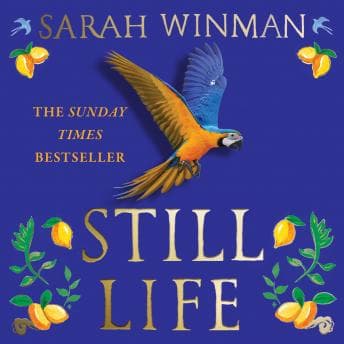
So look, here's the thing about Still Life: it's not a book that happens TO you. It's a book that happens WITH you. Over almost fifteen hours, you're not just listening to a story about a British soldier named Ulysses and an art historian named Evelyn meeting in a bombed-out Tuscan wine cellar in 1944. You're living with these people. You're watching decades unfold. You're becoming part of their weird, beautiful, chosen family that includes - I kid you not - a talking parrot named Claude who quotes E.M. Forster.
(Abuela would have lost her mind over that parrot. She would have rewound every single Claude scene.)
When an Author Reads Their Own Soul
Sarah Winman narrating her own book is everything. EVERYTHING. There's this quality to author-narrated audiobooks that can go either way - sometimes writers just... can't perform, you know? But Winman trained as an actress, and you can feel it. She doesn't just read the words. She inhabits them.
That kind of vocal commitment reminds me of the narrator in Theft of Swords, who gave each character such distinct life that I could tell who was speaking before they were even named.
The Italian accents. The cockney warmth of the East End characters. The quiet, measured wisdom of Evelyn. Each person in this sprawling cast gets their own voice, their own energy. And Claude the parrot? She does this slightly theatrical, knowing delivery for him that made me laugh out loud on multiple occasions while walking to get coffee. People stared. Worth it.
What really got me was the pacing. This isn't a rush-through-it audiobook. The prose is lyrical - almost poetic in places - and Winman takes her time with it. She knows where the quiet moments need to breathe. She knows when to let a sentence just... sit there. I listened at my usual 1.0x because anything faster would have felt like a crime. You need to savor this one.
The Slow Unfurling of Decades
Okay, fair warning: if you need constant plot momentum, this might test you. Still Life spans from 1944 to the early 1980s, and it meanders. Beautifully. But it meanders. Characters drift in and out. There are long stretches in Florence where you're just... existing in a piazza, watching life happen. Listening to conversations about art and love and what it means to build a life with people who aren't your blood but are absolutely your family.
I was designing a logo for a vintage clothing boutique while listening to the Florence sections, and honestly? The vibes were immaculate. The warmth of that Italian sun, the detailed descriptions of paintings and buildings, the slow rhythm of days passing - it all seeped into my work. My client got a logo with way more warmth than they probably expected. (They loved it. Thank you, Sarah Winman.)
But I'll be honest - there were moments in the middle where I had to really focus. This isn't a multitasking audiobook. The narrative structure jumps around, and if you zone out for ten minutes, you might miss a significant shift. I had to rewind a few times when Diego decided to knock something off my shelf and I lost the thread.
My Heart. MY HEART.
The thing about this book is that it sneaks up on you emotionally. The first few hours are charming, interesting, setting the stage. But by hour ten? Twelve? I was a mess. The way Winman writes about chosen family, about the people who show up for you and stay - it wrecked me.
Year of Yes hit me in a similar way with its honesty about the people who matter most, though Shonda's approach was more about choosing yourself alongside your people.
I cried three separate times. Once during a scene about loss that I won't spoil. Once during a moment of unexpected joy. And once at the very end, which felt less like an ending and more like being gently released from a world I didn't want to leave.
This book felt like a warm afternoon in a place you've never been but somehow already love. Like someone handed you a glass of wine and said, "Sit. Stay. Let me tell you about these people." And then fifteen hours later, you're crying because you have to say goodbye to them.
The vibes are: rainy Sunday. Sunday turning into Monday. Monday where you call in sick because you need to finish this book and process your feelings.
Who Should Listen (And Who Should Skip)
If you love character-driven historical fiction, if you care more about people than plot, if you want to feel held by a story rather than propelled through it - this is your book. If you appreciate art, Italy, found family, queer love stories woven naturally into life, and yes, a philosophical parrot - run, don't walk.
Skip if you need action, if you get antsy during quiet moments, or if you listen while doing something that requires real concentration. This one asks for your attention.
But honestly? Give it your attention. It's worth it.
Abuela would have loved this one. She would have cried harder than me.