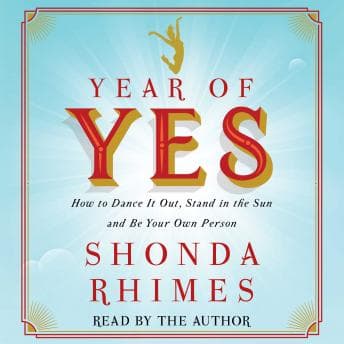

I was standing over a pot of simmering chana masala—the complicated version my mother insists is the "only" way to make it—when Shonda Rhimes started yelling at me. Well, not at me. But she was definitely yelling.
I'd put this audiobook on expecting a polished, media-trained executive giving me sterile advice on how to be a "boss." (My therapist says I project my own need for control onto media figures. She's probably right.) Instead, what I got was the creator of Grey's Anatomy admitting she used to hide in pantries to avoid people.
And honestly? I've never felt more seen.
The Psychology of the "Titan"
Here's the thing about Shonda. We think we know her because we know Meredith Grey or Olivia Pope. We assume the woman writing these hyper-verbal, confident characters is exactly like them.
She isn't.
Psychologically, this book is a fascinating case study in cognitive dissonance. You have a woman who runs Hollywood, basically, but is paralyzed by the idea of a live interview. The disconnect between her public avatar and her private anxiety is massive.
When her sister tells her, "You never say yes to anything," it acts as the inciting incident. In narrative psychology, we call this the disruption of the status quo. For Shonda, it triggered a year of radical exposure therapy. She didn't just dip a toe in; she cannonballed into her phobias.
(And yes, hearing her describe her panic attacks while I was safely chopping cilantro in my kitchen was weirdly comforting. It's nice to know that even billionaires hyperventilate.)
Not Just Reading, But Performing
Usually, I have a strict rule: Authors should not narrate their own audiobooks unless they are Neil Gaiman or David Sedaris. Just... don't do it. Hire a professional.
But Shonda breaks my rule.
Because this is a memoir about finding her voice, hearing her actual voice is non-negotiable. Is she a trained voice actor? No. There are moments where she's a little flat, or the pacing gets a bit... jaunty? Like a stream-of-consciousness monologue that runs away from her.
But then she drops in the actual audio recordings of the speeches she gave during this year—the Dartmouth commencement, the Sherry Lansing acceptance speech.
This is the killer feature.
You hear the tremble in her voice. You hear the room react. It stops being a book and starts being a documentary. If you read the print version, you're missing half the emotional data. It's raw. It's imperfect. And it tracks perfectly with the book's thesis.
Where It Wanders
Look, I'll be real. The middle gets a little squishy.
There are parts where she goes off on tangents about weight loss or specific celebrity encounters that feel less like a structured argument and more like a late-night phone call. If you're looking for a rigid "Step 1, Step 2" self-help manual, this isn't it. The behavioral scientist in me wanted a bit more data, a bit more structure.
But the storyteller in me? I didn't mind. The narrative arc is messy because change is messy.
She talks about shedding the "fat suit" of her personality—not just physical weight, but the emotional layers she wore to stay invisible. It's a powerful metaphor. (Though, as someone who cooks with this much ghee, I have complicated feelings about the diet talk. But that's for another day.)
Final Analysis
By the time the book ended, my chana masala was cold because I'd stopped cooking to just listen.
Shonda Rhimes isn't trying to be your guru. She's trying to be that friend who grabs you by the shoulders and shakes you until you admit you're worthy of taking up space. That same unapologetic energy—though in a completely different context—is what makes Science of Getting Rich so polarizing; it demands you claim what you want without apology.
It's messy, it's loud, and it's unapologetically her.
Who should listen: If you've ever cancelled plans because the idea of putting on pants and being "perceived" by others was too much, you need this. Who should skip: If you want a structured, data-driven self-improvement framework, the meandering personal narrative will frustrate you.
My therapist would probably say I should apply these lessons immediately. I'll start by saying "Yes" to ordering takeout next time instead of cooking this elaborate meal.









