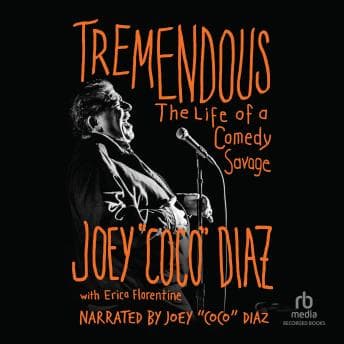

"It's not a story for the faint of heart, or for prudes who've never spent a week sleeping on a piece of playground equipment."
That line—dropped somewhere early in the first hour—stopped me dead in my tracks. I was grading AP Lit essays on The Great Gatsby at the time. I usually tell my students that Fitzgerald captures the decay of the American Dream. Joey Diaz? He lived the decay. And the rot. And the resurrection.
Look, if you listen to my podcast, you know I'm usually dissecting the sentence structure of Virginia Woolf or complaining about how modern narrators don't understand the semi-colon. This audiobook is... not that. It's the literary equivalent of a gravel truck dumping its load in your living room. And I loved every second of it.
When the Author is the Only Option
Usually, I preach about diction. I tell my third-period English class that enunciation is next to godliness. Joey Diaz breaks every single rule I've taught for twenty years. He wheezes. He shouts. He whispers. He eats words and spits them out sideways.
And it is absolutely perfect.
(Seriously, if a classically trained narrator like Simon Vance tried to read this, it would be a farce. It would be offensive.)
This isn't really "narration" in the traditional sense. It's performance art. You've been cornered in a dive bar by the most interesting, terrifying guy in the room, and he's not letting you leave until you hear how he survived 1980s North Bergen. You can hear the years in his voice. The cigarettes and the regret and the laughter. It's texture.
The "Gatsby" of the Gutter
(Okay, that's a stretch, but stay with me.)
We talk a lot about "unreliable narrators" in literature. Joey is the opposite. He is painfully, brutally reliable. He tells you exactly how he screwed up. The kidnapping (yes, really), the prison time, the addiction. It's raw.
My wife Denise asked what I was listening to because I kept making these horrified gasping noises while doing the dishes. I told her it was a biography about an immigrant finding his way in America. Which is technically true. I just left out the parts about the cocaine and the felonies.
What surprised me wasn't the crime—it was the heart. I didn't expect to get choked up listening to a comedian talk about his mother. But the way he frames his childhood, the loss, and the sheer desperation to belong... it hits hard. It's a redemption arc, but not a straight line. It's a jagged mess. Just like real life. That same messy, hard-won resilience shows up in I'm Still Standing, though the setting couldn't be more different.
Why I Can't Assign This to My Students (But Want To)
Underneath the profanity—and let's be clear, there is a lot of profanity; my mother would wash this man's mouth out with a fire hose—there's a staggering amount of wisdom here.
It's about being a misfit. It's about resilience. It's about the fact that your past doesn't have to be a life sentence, even if you literally had a life sentence.
Who's this for? Anyone who appreciates raw memoir over polished prose. Fans of Diaz's comedy. People who've ever felt like outsiders clawing their way toward something better. Skip it if you need your audiobooks G-rated, or if you prefer your life lessons delivered without f-bombs.
I listen to audiobooks to understand the human condition. Usually, that means Tolstoy. This week, it meant Joey "Coco" Diaz. And honestly? I think he understands the human condition better than some of the guys on my syllabus.
Just don't tell Principal Martinez I said that.