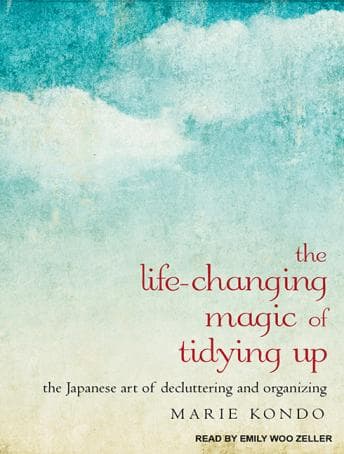

I am standing in the middle of my living room, staring at a stack of New Yorker magazines from 2018 that I swear I'm going to read "someday," listening to Emily Woo Zeller tell me to thank my socks.
(Yes, thank them. Out loud. For their service.)
My therapist suggested I try this book because apparently, my physical environment reflects my mental state—which, if true, means my mental state is a cluttered pre-war apartment in Cambridge with too many throw pillows. I went into this expecting to hate it. I expected a drill sergeant. I expected to be told I'm lazy.
Instead, I found myself weirdly... soothed?
The Psychology of "Sparking Joy"
Here's the thing about Marie Kondo's method that actually tracks psychologically: it's not about cleaning. It's about decision-making. As a behavioral psychologist, I see people paralyzed by choice every day. That same paralysis—rooted in childhood patterns—is what Adult Children of Emotionally Immature Parents unpacks so brilliantly. We hold onto things because of sunk cost fallacy ("I paid $50 for this ugly sweater!") or fear of the future ("What if I need this specific cable for a device I haven't owned in six years?").
Kondo cuts through that neurosis with a machete made of gratitude.
By asking if an object "sparks joy" (tokimeki), she forces you to engage your emotional brain rather than your rationalizing, hoarding brain. It's cognitive reframing. And frankly? It works. I found myself holding a chipped mug and realizing, I hate this thing. Why is it in my house?
(My mother, who saves used gift wrap "just in case," would be horrified. Sorry, Maa. The blender you gave me is gone. It sparked anxiety, not joy.)
Emily Woo Zeller: The Voice of Zen
If I had to listen to someone tell me to throw away my books (sacrilege!) in a harsh or judgmental voice, I would've thrown my phone across the room. But Zeller? She is a sedative.
Her voice has this incredible, unwavering warmth. She captures Kondo's persona perfectly—delicate but firm. There's a specific cadence she uses, a sort of smiling precision, that makes even the weirdest advice sound reasonable. When she narrates the anecdotes about Kondo's clients—the woman who couldn't throw away old love letters, the guy with the cord collection—she does these subtle character voices that are funny without being mocking.
She also manages to convey the spiritual aspect of the book. Because let's be real, Kondo is an animist. She believes objects have energy. Zeller sells it. When she talks about waking up your books by tapping them (I actually did this, don't judge me), she sounds totally sincere.
Weirdly Emotional (I Cried While Folding T-Shirts)
I didn't expect tears while folding laundry, but here we are.
The section on sentimental items is brutal. Psychologically, we attach our identity to the past. Kondo argues—and Zeller delivers this with gentle grace—that by letting go of the past, we make space for the person we are becoming.
It's less of a cleaning manual and more of a therapy session for your house. Speaking of which, Why We Sleep made me realize my physical environment wasn't the only thing affecting my mental state—turns out sleep deprivation was doing most of the heavy lifting.
Is it perfect? No. The idea of emptying your purse every single day is psychotic. Who has time for that? I'm lucky if I remember to take my keys out of the door lock. And sometimes the repetitive nature of the advice ("visualize your destination") feels a bit like a broken record. But because the audiobook is under five hours, it doesn't overstay its welcome. Short, punchy, and surprisingly effective.
The Verdict
I listened to this over two days while aggressively purging my closet.
Did I thank my socks? No. That's a bridge too far. But I did fill four trash bags with clothes I haven't worn since grad school. Emily Woo Zeller made the process feel less like a chore and more like a ritual.
Who should listen: If you're feeling overwhelmed—mentally or physically—and need a gentle push toward letting go, put this in your ears. Who should skip: If you're already a minimalist or can't stomach the idea of thanking your belongings, this will drive you up a wall.
Just maybe don't listen while driving, or you might get the urge to pull over and organize your glove compartment.
(Now, if you'll excuse me, I have to explain to my mother why her old sari is now "donated to spark joy elsewhere.")