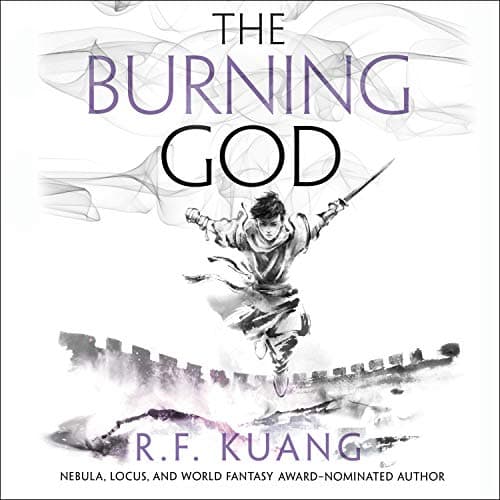

What happens when a girl raised to be a weapon finally turns on everyone holding the leash?
I was reshelving returns at the library — late shift, nobody left in the building but me and the hum of the fluorescent lights — when Emily Woo Zeller delivered the moment where Rin stops pretending she's fighting for anyone's liberation but her own. I actually set the cart down. Just stood there in the 900s section, staring at nothing, processing.
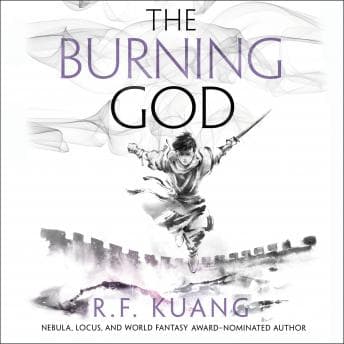
Here's the thing about The Burning God: it's the rare fantasy conclusion that understands horror isn't about gore — it's about dread. And the dread here isn't from monsters or gods. It's from watching a protagonist you've spent two books rooting for become the thing you should've been afraid of all along. R.F. Kuang doesn't flinch. She lets Rin spiral, lets her rationalize atrocity, lets her become a demagogue who genuinely believes she's a savior. The Mao Zedong parallels are barely even subtext at this point — they're just text — and Kuang's background in Chinese studies means she's not playing dress-up with this history. She's dissecting it.
The Phoenix Burns Everything, Including Your Sympathies
Rin's arc across this trilogy is essentially a 60-hour argument about whether cycles of violence are inevitable or chosen, and this final book lands hard on "both." What wrecked me wasn't the battle sequences — though those are brutal and relentless across nearly 24 hours of audio — it was the quiet political maneuvering. The Southern Coalition scenes, where Rin's supposed allies manipulate her popularity while she manipulates them right back. Nobody in this book has clean hands. Nobody. The moment Rin recognizes that her followers worship her as a goddess and decides to use that instead of correcting it? That's the horror. Not the fire. Not the Phoenix screaming in her skull. The calculated choice to become a myth.
Kuang pulls off something I've talked about on the podcast for years: she makes you complicit. That slow moral erosion — where you catch yourself rationalizing things you'd never excuse in real life — is something I only found once before at that same gut level, in Punishing Miss Primrose, Part I, where the reader's complicity is basically the whole mechanism of the story. You want Rin to win, even when winning means burning civilians. Even when winning means addiction and psychological collapse. The way the book slowly, methodically strips away every justification Rin has — and every justification you've been making for her — is genuinely disturbing in a way most capital-H Horror novels wish they could achieve.
Emily Woo Zeller Understands the Assignment
The narrator commits. That's rare. And across three books and god knows how many hours, Zeller has built something specific with Rin's voice — you can hear the brittleness underneath the bravado, the way Rin's confidence curdles into megalomania. It's not a sudden shift. It's incremental. By the final act, Rin sounds different from Book 1 Rin in ways that sneak up on you. Zeller plays the overconfidence with just enough edge that you can feel the sanity slipping before Rin herself can.
The war scenes are ferocious — Zeller doesn't pull back during the violence, and at 1x speed, the extended battle sequences have this grinding, exhausting quality that feels intentional. You're meant to be worn down by it. You're meant to feel what the soldiers feel. I will say: at 24 hours, there are stretches in the middle coalition-building chapters where the pacing loosens and the political scheming blurs together, especially on audio. Not a dealbreaker, but I caught my attention drifting during a couple of strategy meetings before Rin inevitably sets something on fire.
Who This Burns and Who It Spares
If you've listened to the first two Poppy War books, you already know whether you're in or out. But if you're coming to this expecting a triumphant hero's ending — the chosen one rises, the empire falls, cue the victory theme — Kuang has other plans. Devastating, historically grounded, morally annihilating plans. Skip this if you need catharsis or clean resolutions; listen if you want a fantasy ending that trusts you enough to leave you gutted.
I listened to the final two hours in the dark. Mistake? Maybe. Worth it? Absolutely. Shirley (my cat) was unimpressed. I was wrecked. The ending didn't destroy me because it was sad — it destroyed me because it was inevitable. Everything Rin became, every terrible choice, every burned bridge — literal and otherwise — led exactly here. And Kuang made you watch the whole descent with your eyes open.
My podcast listeners are going to love this one, and they're going to argue about it for weeks. That's the mark of a trilogy ending that actually earns its weight.
Shelve It in the Restricted Section
This is 24 hours of war, addiction, radicalization, and the seductive horror of absolute power. It earns every minute of that runtime, even when it occasionally sags under the weight of its own political machinery. Shirley Jackson walked so R.F. Kuang could — well, not walk. Burn. Burn everything down and make you understand why.