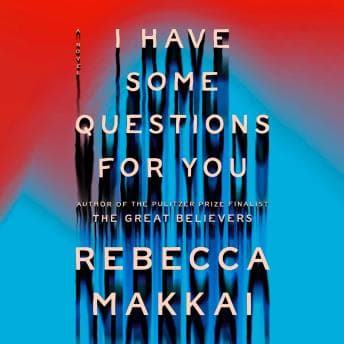

Look, I need to complain about something before we get into this. Why does every literary thriller with a true-crime angle make me question every cold case I've ever heard about? I was perfectly content not relitigating the past, and then Rebecca Makkai comes along with I Have Some Questions for You and suddenly I'm lying awake at 1 AM wondering if I missed something obvious about a case that doesn't even exist. Shirley (my cat) was unimpressed by my existential crisis. I was spiraling.
This book got under my skin in ways I wasn't expecting. And honestly? That's exactly what good horror-adjacent fiction should do. Yeah, I'm claiming this one for the genre. Fight me.
The Dread That Builds Like a Slow Leak
Here's the thing about I Have Some Questions for You - it's not a whodunit in the traditional sense. It's more like... a why-did-we-all-look-away-unit. Bodie Kane returns to her fancy New Hampshire boarding school to teach a film course, and she can't stop picking at the scab of her roommate's murder from 1995. The athletic trainer was convicted. Case closed. Except - and this is where Makkai really shines - nothing about it feels closed.
The horror here isn't supernatural. It's the horror of collective memory, of institutional failure, of realizing you might have known something important and buried it so deep you convinced yourself it never existed. Shirley Jackson walked so this author could run. That same understanding of psychological dread shows up in From Dead to Worse, though it takes a more supernatural route. Makkai understands that dread isn't about jump scares. It's about the slow, creeping realization that the foundation you've built your life on might be rotten.
I listened to most of this during late-night library shifts (yes, the irony of a librarian listening to audiobooks at work is not lost on me). The building was empty. The stacks were dark. And Julia Whelan's voice in my ears made me feel like I was right there with Bodie, sifting through memories that didn't want to be found.
Julia Whelan Understands the Assignment
Whelan commits. That's rare. And she absolutely commits.
Her delivery is conversational in a way that feels like Bodie is sitting across from you at a coffee shop, spilling everything she's been holding back for decades. The anger, the confusion, the creeping dread - Whelan captures all of it without ever tipping into melodrama. She navigates multiple characters with the kind of ease that makes you forget you're listening to one person. That takes serious skill.
JD Jackson's cameo adds something essential too. I won't spoil the specifics, but his presence brings a different texture to certain sections that the story desperately needs. Smart production choice.
The pacing is interesting. This is not a fast-paced thriller. If you're looking for constant twists and breathless reveals every chapter, you're going to be frustrated. This is a slow burn. A 14-hour slow burn. But here's the thing - the burn paid off for me. I was hooked not because I needed to know who did it, but because I needed to understand how everyone - including Bodie - had failed to see what was right in front of them.
Where It Gets Complicated
I'm not going to pretend this book is for everyone. Some listeners found the ending unfulfilling, and I get it. Makkai isn't interested in tidy resolutions. She's interested in the mess. The questions that don't have clean answers. The way we construct narratives about the past that serve our present comfort.
Who should skip: If you need your mysteries wrapped up with a bow, this isn't it. Same goes if you're impatient with books that spend time on character interiority and social commentary about race, class, and institutional power.
Who should listen: If you want a story that respects your intelligence, that asks you to sit with discomfort, that understands horror isn't about gore - it's about dread? My podcast listeners are going to love this.
I'll be honest - I started a character cheat sheet about four hours in. Not because the book is confusing, but because Makkai populates Granby with so many people who matter to the story that I wanted to keep track. That's not a criticism. That's a feature of literary fiction that takes its world seriously.
The Verdict from the Stacks
Maybe not an immediate relisten. This one sits heavy. But I'm already planning to recommend it on the next episode of The Witching Hour, because it does something that so few books manage: it makes you complicit. You're not just watching Bodie investigate. You're investigating with her. And you're asking yourself uncomfortable questions about what you would have seen, what you would have ignored, what convenient stories you've told yourself about your own past.
Horror that respects the genre - even when it's not technically horror. The Earphones Award was well-deserved. Whelan and Jackson deliver something special here.
Just maybe don't listen alone in an empty building at midnight. Mistake? Maybe. Worth it? Absolutely.