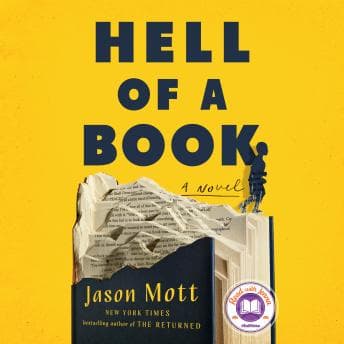

What happens when a writer can't remember his own name but can't forget the face of a dead Black boy on every television screen in America?
I finished this one at 2 AM, grading papers abandoned on the kitchen table, Denise long asleep. The kind of book that makes you sit in the dark afterward, wondering if you've been paying attention to the right things your whole life. My students would probably call that dramatic. They'd be wrong.
The Author Who Forgot Himself
Jason Mott has done something I haven't seen pulled off this well since Toni Morrison was playing with time and memory in Beloved. We follow an unnamed Black author—successful, boozy, falling apart on a book tour—who keeps seeing a child no one else can see. Meanwhile, we're getting the story of Soot, a young boy in the rural South whose parents teach him to be "unseen" as a survival mechanism.
The genius is in how these stories don't just parallel each other—they haunt each other. You're listening, thinking you understand the structure, and then Mott pulls the floor out. The final twists genuinely earn the title. I won't spoil it, but I will say I had to pause and just... sit there. This reminds me of what Hemingway said about writing true sentences, except Mott's true sentences cut in directions Hemingway never had to navigate.
Two Voices for Two Truths
The dual narration here isn't gimmick—it's architecture. JD Jackson takes the unnamed author, and there's this quality to his voice, this sandy sadness (someone else's phrase, but it's perfect) that captures a man coming undone while performing competence. When the author's self-awareness starts cracking, Jackson shifts so subtly you barely notice until you realize the character has changed.
Ronald Peet handles Soot's sections with this magisterial, melodic authority that shouldn't work for a ten-year-old boy's perspective—but it does. Because Soot isn't just a child. He's carrying the weight of generations of survival tactics, of parents who love him so much they teach him to disappear. Peet understands that these sections aren't childhood memories. They're testimony.
The production keeps them distinct without jarring you. No sound effects, no music. Just two men telling two sides of something that turns out to be the same story.
The Classroom I Can't Teach
I've taught Invisible Man. I've taught Native Son. I've walked my students through the literary tradition of Black American fiction with all the confidence of a white man who's done his homework. This book made me feel like I've been teaching from the footnotes. I had a similar humbling experience with Ninth, though that one didn't quite reach the same heights.
Mott is funny—genuinely, electrically funny in places—about the absurdity of being a successful Black author in a country that's simultaneously celebrating you and killing people who look like you. The book tour scenes have this dark comedy energy that reminded me of early Vonnegut, if Vonnegut had been writing about police shootings playing on loop in every hotel lobby.
But the humor makes the gut-punches land harder. The prose deserves to be savored. I listened at 1.0x because Mott chose those words, chose that rhythm, and Jackson and Peet understood the assignment.
Who Needs This in Their Ears (And Who Should Skip)
If you loved The Water Dancer or Sing, Unburied, Sing, this is their spiritual successor—but with a metafictional edge that's entirely its own. If you're looking for something to discuss in book club, this will generate three hours of conversation minimum.
But here's the honest part: if you're not ready to sit with discomfort, if you want your audiobooks to be escape rather than encounter, this isn't for you. The content warnings are real—police brutality, racial trauma, the death of children. Mott doesn't exploit these things, but he doesn't let you look away either.
My students would hate this. Not because it's difficult—they can handle difficult. Because it asks them to feel things they've been trained to scroll past. I love it. Worth pausing the faculty meeting for. Worth the 2 AM dark kitchen and the abandoned grading.
Class Dismissed
Nine hours and forty minutes. That's what this asks of you. What it gives back is a book that genuinely becomes its title—a hell of a book, in every meaning of that phrase. The National Book Award wasn't charity. This is why we still read. This is why we still listen.