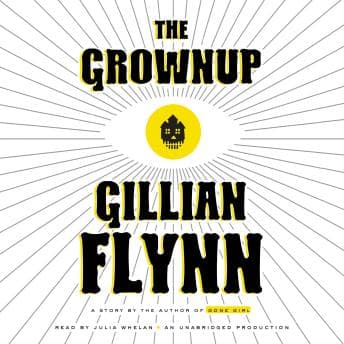

I was shelving returns at the library last Tuesday — late shift, nobody around, rain absolutely hammering the windows — when I decided to knock this out. Seventy-eight minutes. That's basically a long lunch break. I figured I'd listen while closing up, and then maybe start something longer on the drive home.
I did not start something longer on the drive home. I sat in the parking lot with the engine running, staring at my steering wheel, trying to untangle what Gillian Flynn had just done to me.
The Con Artist Who Cons Herself
Here's what Flynn does better than almost anyone working in dark fiction right now: she writes narrators you shouldn't trust but absolutely want to follow. The unnamed protagonist of The Grownup is a fraud — literally, she gives fake psychic readings and, before that, performed a different kind of service in the back rooms of the same establishment. Flynn opens with this character's voice already fully formed, this matter-of-fact swagger about her own dishonesty that's weirdly charming. She's not apologetic. She's not performing edginess. She's just... practical about being terrible.
And then Susan Burke walks in. Rich, beautiful, desperate Susan, who believes her Victorian house is haunted. Who believes her creepy teenage stepson Miles might be the source. Who wants someone — anyone — to tell her she's not crazy.
What makes this work as horror rather than just a con-artist story is the pivot. Our narrator goes into the house expecting to run a scam and slowly — agonizingly — starts wondering if the scam might be running her. Flynn doesn't lean on atmosphere alone. She builds this layered uncertainty where you're questioning whether the ghosts are real, whether Susan is manipulating everyone, whether Miles is genuinely disturbing or just a weird kid. Every time you think you've figured out which genre you're in — ghost story, psychological thriller, domestic noir — it shifts. That same layered dread — where the crime and the psychology keep trading places — is something I ran into again in Bones Never Lie, though it earns its unease through a very different kind of darkness.
Shirley Jackson walked so Gillian Flynn could run. And I mean that specifically here, not just as a general compliment. The bones of this story — woman enters a house that may or may not be alive with malice, questions her own perception — that's Hill House DNA. But Flynn's version is meaner, funnier, and way more cynical about the people involved.
Julia Whelan Understands the Assignment
The narrator commits. That's rare.
Whelan starts with this energetic, almost amused delivery for our con artist protagonist — you can hear the smirk in her voice when the character is sizing up her marks. But as the story darkens, as the house starts feeling wrong and Miles starts saying things that no teenager should say with that much calm, Whelan's performance shifts underneath you. The swagger erodes. By the last twenty minutes, there's real fear in her voice, and you feel it in your chest because she earned it.
Her Susan Burke is this particular flavor of desperate — not screaming, not hysterical, but wound so tight that every sentence sounds like it might crack. And Miles. God, Miles. Whelan gives him this flat, too-measured quality that made Shirley (the cat, not Jackson) look up from her spot on my lap. Animals know when something's wrong.
No music. No sound effects. Just Whelan's voice and Flynn's words. And it's enough. More than enough.
The Seventy-Eight-Minute Problem
Here's where I have to be honest with you. This is essentially a long short story — originally published as "What Do You Do?" in George R.R. Martin's Rogues anthology — and it has an ending that will either thrill you or infuriate you. I landed somewhere in between. Flynn builds this incredible machine of paranoia and misdirection and then... stops. Not wraps up. Stops. You're left holding three or four possible interpretations of what actually happened, and while I think that's intentional — this is a story about people who lie, told by someone who lies, so why would the ending be honest with you? — I also wanted about twenty more minutes.
Compare it to something like Sharp Objects, where Flynn gave herself the runway to really twist the knife. Here she's working in miniature, and the craft is extraordinary, but you feel the compression. Especially in audio, where you don't get to flip back and reread a paragraph that felt important.
That said — for a single-credit audiobook? For an hour and change of genuinely unsettling fiction performed by one of the best narrators working today? I've spent more money on worse coffee.
Who Needs This in Their Ears
If you're a Flynn completist, obviously. If you love unreliable narrators who are unreliable about the unreliability — yes. If you want horror that isn't about gore but about dread, about the slow realization that you might be the mark in someone else's story — absolutely. If you need tidy endings, skip. If you scare easily, you'll still be fine, but you'll feel uneasy for the rest of your evening.
I listened in the dark. Mistake? Maybe. Worth it? Absolutely.
My podcast listeners are going to love this — it's the perfect "what should I listen to on a short flight" recommendation. Just don't expect to stop thinking about it when the plane lands.