Two narrators share the highest displayed score in our data: 4.6 out of 5. One of those 4.6s is the average of 36 published reviews. The other is the average of 10. Same number on screen, very different amounts of data behind it — and the distance between what a score shows and what it actually measures is what this piece is about.
Where these numbers come from
The source first. Every rating below is a narrator score attached to a review published on this site: 6,554 published reviews in the database when the data was last refreshed. Narrator ratings are produced by our AI-assisted review pipeline and stored on each review. They are records in our corpus — not telemetry from listening apps, and not proof that a person heard every recording.
Ranking a narrator requires at least 10 rated reviews, which leaves most of the collection unranked: the 80 narrators who clear that bar account for 1,691 ratings, roughly a quarter of all published reviews. The tables describe the narrators our reviews cover best — nothing stronger.
The top of the table: read the count next to the score
| 1 | Julia Whelan | 4.6 | 36 |
| 2 | Bahni Turpin | 4.6 | 10 |
| 3 | Davina Porter | 4.5 | 11 |
| 4 | Frank Muller | 4.5 | 15 |
| 5 | Kate Reading | 4.5 | 24 |
| 6 | Ray Porter | 4.5 | 21 |
| 7 | Marc Thompson | 4.5 | 22 |
| 8 | Robin Miles | 4.5 | 13 |
| 9 | Andi Arndt | 4.4 | 12 |
| 10 | Simon Vance | 4.4 | 18 |
Every narrator in the top ten averages between 4.4 and 4.6, and inside that band the ordering is thin ice. These are averages rounded to one decimal: a displayed 4.6 can stand for anything from 4.55 up to just under 4.65 — which is how Julia Whelan and Bahni Turpin can share a displayed score while resting on 36 reviews versus 10. The honest reading of the top of this table is not a precise ranking; it is that this group's averages are high.
When a row represents many readers
| 71 | Kirby Heyborne | 3.7 | 15 |
| 72 | Karen White | 3.6 | 11 |
| 73 | Sandra Burr | 3.6 | 11 |
| 74 | Jesse Bernstein | 3.5 | 12 |
| 75 | Laural Merlington | 3.4 | 10 |
| 76 | Phil Chenevert | 3.4 | 24 |
| 77 | Michael Scott | 3.4 | 37 |
| 78 | Alexander Cendese | 3.3 | 10 |
| 79 | Various Readers | 3.2 | 83 |
| 80 | LibriVox Volunteers | 2.7 | 233 |
The last two rows are not people. Various Readers (3.2 across 83 reviews) and LibriVox Volunteers (2.7 across 233) are collective labels that stand in for many different recordings by many different readers — one credit, no single voice. Their low averages describe how the mixed editions filed under those labels scored in our collection; they cannot tell you whether any specific recording under the label is good or bad, because the label designates no single performance to judge.
The bottom row also carries far more reviews than anyone in the top ten — 233 versus 36. A count like that measures how much our pipeline has written about these editions, not how many people listened. That the most-reviewed label sits at the bottom is worth noticing; what it means beyond the mixing of editions is an open question.
The gap, visualized
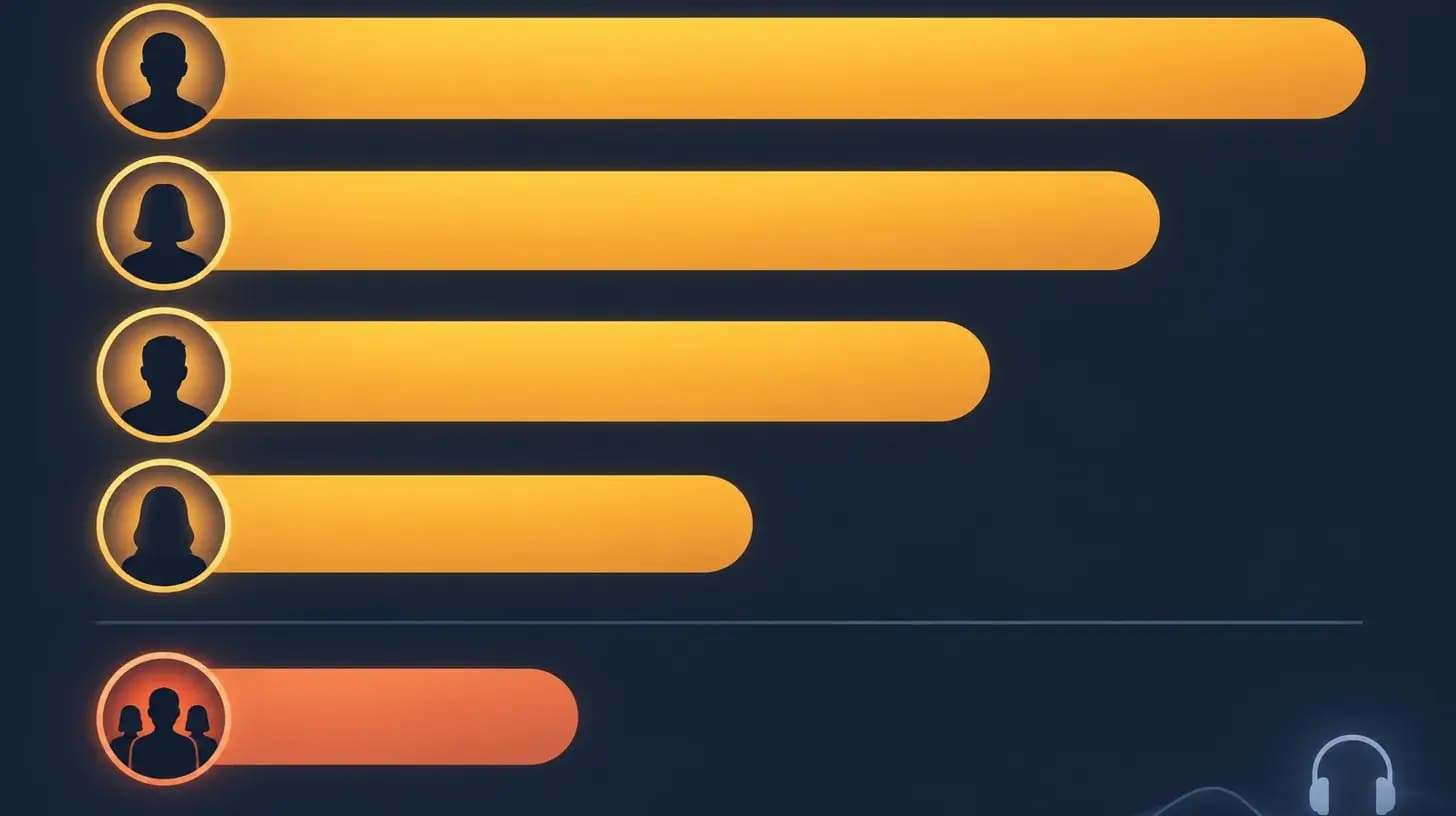
- Julia Whelan4.6★ · 36 reviews
- Bahni Turpin4.6★ · 10 reviews
- Davina Porter4.5★ · 11 reviews
- Frank Muller4.5★ · 15 reviews
- Michael Scott3.4★ · 37 reviews
- Alexander Cendese3.3★ · 10 reviews
- Various Readers3.2★ · 83 reviews
- LibriVox Volunteers2.7★ · 233 reviews
From top to bottom, the ranked set spans 1.9 stars, from 4.6 down to 2.7. Read it as a property of the corpus rather than a head-to-head result: each narrator's average pools different books and editions, so this comparison does not isolate the narrator from the material behind each score. A narrator whose 4.5 comes from one set of titles has not been measured against the books behind another narrator's 4.5.
What to do with this
- Read the score and the count together. A 4.6 backed by 36 reviews and a 4.6 backed by 10 are not the same claim — same display, different weight. When two averages are close, treat them as a tie.
- Open the narrator's profile before you spend a credit. Every name in the tables links to that narrator's profile on this site, and from there to the reviewed editions. The review of the exact edition you're considering is worth more to you than any average.
- Sample the exact recording. The same book often exists in more than one recording, and our averages describe the editions in our collection — not the copy in your cart. Audition the sample of the exact recording you're about to get; it is the one test of the take you will actually hear.
- Treat collective-credit rows as what they are. If a listing credits Various Readers or a volunteer ensemble, the label's average tells you little about the specific recording. Go straight to the sample.
None of this makes the scores useless. It makes them what they are: the narration scores of one review collection — a strong starting point for choosing what to audition, not the last word on any narrator.