
Fifty hours and thirty-eight minutes. That's not an audiobook - that's a deployment.
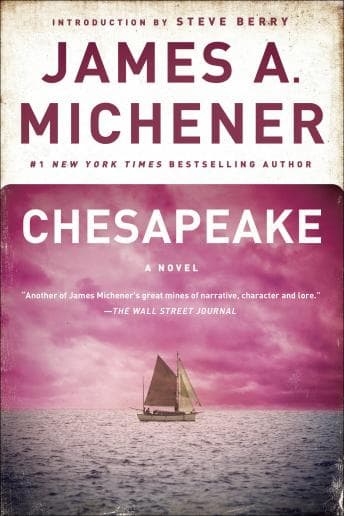
I knew what I was signing up for. Michener doesn't write books, he writes civilizations. And Chesapeake is exactly that: the entire history of Maryland's Eastern Shore from pre-colonial days through the twentieth century, told through generations of families who settle, fight over, exploit, and eventually love this particular patch of earth. I started this one during a string of long drives between client sites across Texas, and by the time I finished, I'd put almost two thousand miles on the truck. Ranger rode shotgun for most of it.
When Ten Miles of Marsh Becomes the Whole Damn World
Let me cut to the chase on the book itself: Michener does what Michener does. He picks a place - in this case, a tiny section of Chesapeake Bay country - and he excavates it layer by geological layer, century by century, family by family. You get the Steed family (English Catholics seeking refuge), the Turlock family (rough-hewn watermen who've been poaching since before poaching was a word), the Paxmore Quakers with their quiet moral stubbornness, and the Cater family whose story runs through the devastating lens of slavery and its aftermath.
What separates Chesapeake from some of Michener's other epics is how intimate it feels despite the massive scope. The Eastern Shore is so small geographically that the same creeks, the same marshes, the same oyster beds keep showing up across four hundred years. There's something almost haunting about that - a family fighting over the same piece of waterfront in 1660 and 1960. Michener was meticulous about the ecological history too. You'll learn more about blue crabs, geese, and oyster cultivation than you ever thought you wanted to know. And somehow it works. The passage about the great goose Doag Doag - a nearly mythical creature that successive generations of Turlocks obsess over hunting - is pure Michener genius. It's absurd and beautiful and says everything about how humans relate to land.
The historical accuracy is solid. I've read enough about colonial Maryland and the Chesapeake region to spot lazy shortcuts, and Michener clearly did his homework. His treatment of the War of 1812 along the Bay, including the British bombardment that inspired the Star-Spangled Banner, is grounded and specific. The slavery chapters are unflinching without being exploitative. I've seen some Michener fans rank this below The Source or Hawaii, but I'd push back on that - Chesapeake has a sense of place that the others can't quite match because the geography is so concentrated. Still Life gave me that same feeling - a world so rooted in its particular corner of the earth that the setting stops being backdrop and starts being character.
Where it drags? Hours fifteen through twenty-five or so. The middle section covering the late colonial and early American period felt like Michener was contractually obligated to include every local political dispute and land deed transfer. I found myself checking the progress bar more than I should've been. But then the Civil War hits and the pace picks right back up.
McKeever and the Accent Problem
Now - Larry McKeever. This is where I have to be honest with you. The man has a voice built for long-haul narration. Rich, steady, the kind of baritone that doesn't wear you out over fifty hours. And that matters enormously when you're committed to a book this size. He's doing heavy lifting and he doesn't quit.
But there's an accent issue that I can't sugarcoat. At times - particularly with certain character voices and during passages with period dialogue - McKeever's accent muddles the words. At 1.25x speed, which is my standard, I had to rewind maybe a dozen times because I genuinely couldn't parse what he said. Dropped it to 1.0x for a few stretches. That's a problem. For a book where you're already asking listeners to commit two full days of their lives, clarity isn't optional.
It's not a dealbreaker. I adjusted. But if you're listening in a noisy environment - truck cab on I-35 with the windows cracked, for instance - you'll miss things.
Who Gets This Mission
If you love Michener, you probably already own this. If you've never tried Michener, I'd actually recommend Chesapeake as a starting point - the geographic focus keeps it more cohesive than his globe-spanning stuff. History buffs who care about the Chesapeake region, colonial America, or the waterman culture will eat this alive.
Skip it if you need plot-driven pacing. This isn't a thriller wearing historical clothing. It's a slow, deliberate archaeological dig through time. You need patience. You need windshield time.
Mission Debrief
Worth your time? Here's the debrief. Fifty hours is a serious commitment, and there are stretches where you'll wonder if Michener's being paid by the oyster. But when it hits - the family sagas, the ecological passages, the way the same shoreline echoes across centuries - it's the kind of storytelling that justifies the format. McKeever mostly gets the job done, accent hiccups aside. I wouldn't call it a slam-dunk performance, but it's a solid one for a marathon effort.
Ranger approved this one. Mostly because it meant fifty extra hours of truck rides.