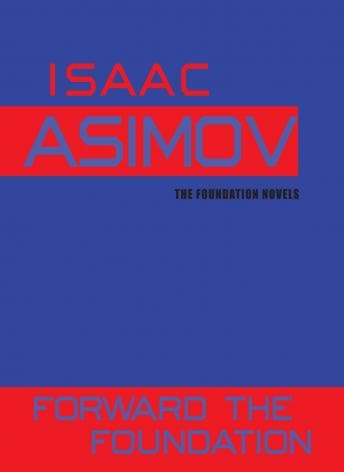

Look, I need to be honest about something upfront: I almost DNF'd this audiobook. Not because of Asimov — the man basically invented the genre I spend 2+ hours a day mainlining into my skull — but because of the narration situation. And I say this as someone who once powered through a 40-hour fantasy series narrated by a guy who pronounced "cavalry" as "calvary" for the entire run. I have tolerance. Larry McKeever tested it.
But here's the thing nobody tells you: I finished it. All 16 hours. And I'm glad I did.
Hari Seldon Deserved a Better Voice Actor (But Not a Different Story)
TL;DR: Worth your commute — barely — but bump the speed up and bring patience.
So Forward the Foundation is Asimov's final novel, published posthumously, and it covers the last decades of Hari Seldon's life as he fights to protect psychohistory from every power-hungry faction on Trantor. The book is structured as four novellas, each set roughly a decade apart, and that episodic structure actually works really well in audio — natural stopping points, built-in pacing resets. I finished each section in roughly one round-trip commute.
The problem is Larry McKeever. I'd come off Scott Brick's narration of Prelude to Foundation, which is solid — he's got that authoritative sci-fi voice, good character separation, keeps things moving. McKeever is... not that. His delivery sits in this uncanny valley between "careful reading" and "someone's dad reading the newspaper aloud at Thanksgiving." There's a flatness that strips the political tension right out of scenes that should crackle. When Hari is maneuvering against the demagogue Laskin Joranum or navigating Emperor Cleon's paranoia, you want urgency. You get... measured recitation.
One listener compared him to a computer-generated voice, and at 1.0x speed? Yeah, I can see it. Here's my fix: 1.5x minimum. I bumped to 1.75x for the middle sections and suddenly McKeever's careful pacing turned into something almost deliberate-sounding. Like a professor who's thought carefully about every word. It's not a miracle cure, but it transformed a plodding listen into a tolerable one.
The Part Where Asimov Makes You Care About Math (Again)
Here's what kept me going through the narration rough patches: this book is basically a retirement arc for the most important mathematician in fictional history, and Asimov makes it genuinely moving. Each novella strips away another layer of Seldon's support system — his wife Dors, his adopted son Raych, his political protectors — until he's this aging man sitting alone on a bench, recording holographic messages for a Foundation that doesn't exist yet.
I was on the 7:12 AM train, Wednesday morning, half-dead from a late-night deployment review, and the final section hit me harder than I expected. There's something about listening to a man systematically prepare for his own irrelevance — making sure his work will outlive him — that lands differently when you're surrounded by a hundred other exhausted people commuting to jobs where they're also just cogs in massive systems. Psychohistory is basically predictive analytics at civilizational scale. Seldon is the principal engineer who knows he won't be around for the system's production deployment. That's... weirdly relatable.
The political machinations across the four sections — Joranum's populist uprising, the military junta, the various assassination attempts — they're classic Asimov. More talking than action, more chess than combat. If you've read Foundation, you know the vibe. The slow-burn political intrigue actually reminded me of something I'd never have expected to reach for on a Tuesday morning — Women of Chateau Lafayette has that same quality of watching people maneuver through systems larger than themselves, decade by decade, with the outcome already shadowing every scene. The science actually holds up in the sense that psychohistory's limitations are honestly explored: Seldon can predict the macro but keeps getting blindsided by the micro. His personal life is the chaos his equations can't model.
Who Gets the Credit (And Who Doesn't)
Perfect for: Foundation completionists who need every piece of the timeline. People who can handle narrator friction for the sake of great source material. Anyone who liked Prelude and wants to see Seldon's story through.
Skip for: Anyone who hasn't read the original Foundation trilogy (this is a prequel that assumes you know where things end up — half the emotional weight comes from dramatic irony). Also skip if narrator quality is a dealbreaker for you. I mean it. Some people literally said McKeever "almost ruined it" for them, and I can't argue.
The ROI on this audiobook is complicated. You're getting 16 hours of peak Asimov ideas wrapped in below-average narration. It's like getting a Michelin-star meal served on a paper plate — the food's still great, but you notice the plate the whole time.
If Audible ever re-records this with someone like — I don't know — Scott Brick for consistency, or (dream scenario) Ray Porter? Ray Porter narrates this. Need I say more? That version would be a must-listen, no question.
This version? It's worth your time if you speed it up, commit to the four-novella structure, and let Asimov's ideas carry the weight. Which they can. Because he's Asimov.
The Commit Message
A flawed delivery of an essential book. Bump the speed, lower your narrator expectations, and let Seldon's final act do its work. Three and a half commutes, one production-worthy story, one narrator who needed more range. I'd do it again. Probably at 1.75x.